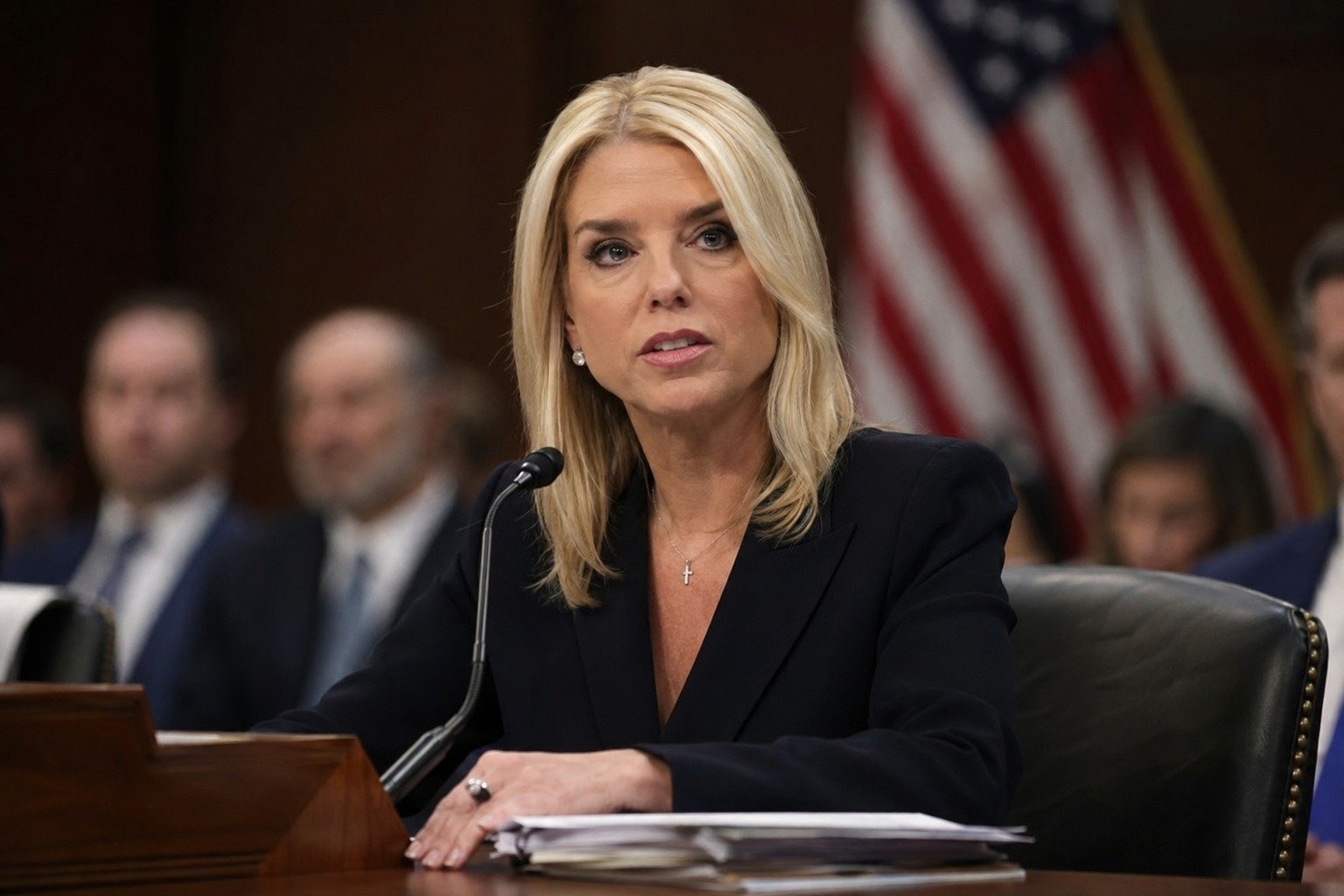
The House Oversight Committee has released the full 111-page transcript of former Attorney General Pam Bondi’s interview about how the Justice Department handled the Epstein files, and the document is now drawing intense scrutiny over what the DOJ knew, when it knew it, and how it communicated with the public.
The transcript was posted by oversight.house.gov in early June 2026 and covers a roughly four-hour transcribed interview Bondi sat for on May 29. It was reported by NBC News, The Hill, and CBS News, and was released alongside a separate transcript from former Epstein prison guard Tova Noel, who was interviewed on May 18.
A Subpoena, Then a Transcribed Interview
Bondi had been subpoenaed to be deposed about the Justice Department’s handling of records connected to Jeffrey Epstein. Rather than a formal deposition, she sat for a transcribed interview under an arrangement worked out with Oversight Chair James Comer, a Republican from Kentucky. The session was not video-recorded. That distinction matters: a transcribed interview produces a written record but does not carry the same format as a sworn, on-camera deposition, and it is not live public testimony.
Bondi is the former, outgoing Attorney General in this reporting. By the time the transcript was released, the day-to-day handling of the matter had moved on, and throughout the interview she repeatedly deferred to acting Attorney General Todd Blanche on key questions.
The 3.2 Million Pages
The single most striking detail in the transcript concerns the sheer volume of material the department was working with. According to the transcript, the DOJ was unaware of roughly 3.2 million pages of Epstein-related material at the time it issued its July 2025 memo on the case.
That is a staggering figure. A memo is supposed to reflect what an agency has reviewed and concluded. If millions of pages of relevant records were not accounted for when that memo went out, it raises a basic question about whether the public was given a complete picture of what the government actually had in its possession.
The transcript does not resolve every question it raises. It documents what Bondi said, the points on which she deferred to Blanche, and the acknowledgment about the unreviewed material. The committee’s decision to release it in full means the underlying record is now available for anyone to read rather than filtered through summaries.
Two Transcripts, One Story
The committee paired Bondi’s transcript with one from Tova Noel, a former guard at the facility where Epstein was held. Releasing the two together signals that Oversight is building a documentary record around the broader question of how Epstein-related matters were managed across multiple parts of the system, not just inside the upper ranks of the Justice Department.
Reactions and the Partisan Divide
Reaction has split along familiar lines. Critics argue the answers raise more questions than they resolve and point to the deferrals and the unreviewed material as evidence that the public was not told the full story. Supporters counter that sitting for a transcribed interview shows cooperation with the committee and that deferring to the acting attorney general on current matters is appropriate. Characterizations of Bondi “dodging” or being less than forthcoming are contested and fall along partisan lines; the transcript itself is the record, and readers are drawing their own conclusions from it.
What This Means for Americans
At its core, this is a transparency story. When the Justice Department tells the public it has reviewed a case and reached conclusions, people are entitled to trust that the review was complete. The revelation that millions of pages were unaccounted for at the time of an official memo goes directly to whether that trust was earned. Accountability for how these records were handled is not an abstract concern; it is about whether the institutions responsible for the law held themselves to the same standard they apply to everyone else.
Stay informed on the stories that matter most. Follow Your Daily Updates on Facebook and bookmark yourdailyupdates.news for breaking news and analysis.