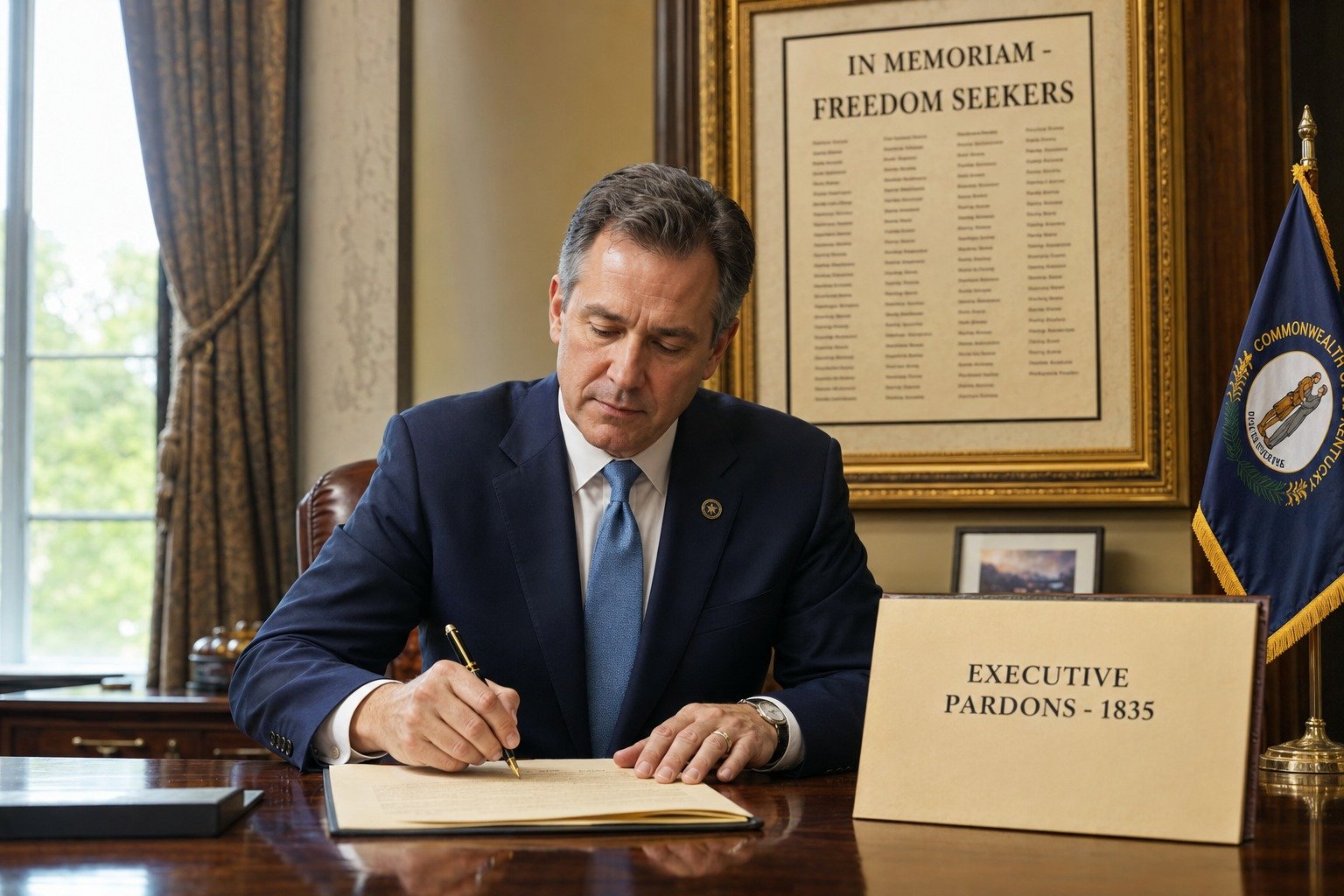
Nearly two centuries after they were branded criminals, 43 Kentuckians have finally been recognized for what they truly were: people of conscience who risked their freedom so that others might find theirs. Ahead of Juneteenth, Gov. Andy Beshear issued posthumous pardons for those who were convicted under an 1835 state law for the “crime” of helping enslaved people escape to freedom.
The law, passed in the decades before the Civil War, made it a felony to assist, entice, or guide an enslaved person away from the person who claimed to own them. Penalties ran as high as two decades behind bars. Kentucky, a slaveholding state that bordered the free soil across the Ohio River, sat at one of the most heavily traveled gateways of the Underground Railroad — and the state used laws like this one to punish the men and women, both Black and white, who helped others cross to safety.
Honoring those who refused to look away
“These were not criminals. These were courageous men and women,” Beshear said in announcing the action, which he deliberately timed to the days leading up to Juneteenth. The governor also signed a proclamation declaring June 19, 2026, as a day to commemorate freedom in the Commonwealth, tying the pardons directly to the holiday that marks the end of slavery in the United States.
Those pardoned were a mix of free Black residents, formerly enslaved people, and white allies — ordinary Kentuckians who concluded that the law itself was the crime. They sheltered escapees, ferried them across rivers under cover of darkness, and pointed them toward the next safe house on the long road north. For that, the state took years of their lives.
The story of Elijah Anderson
Among the 43 was Elijah Anderson, a free Black man remembered as one of the most active Underground Railroad conductors in Kentucky. By various historical accounts, Anderson helped as many as a thousand people reach freedom over the course of his work. He was ultimately imprisoned for it — and he died behind bars, never living to see the cause he served prevail. Now, generations later, the official record carries a pardon where once it carried a conviction.
Anderson’s case captures what these pardons are meant to do. They cannot return the years that were stolen, or the lives lost in cold cells. But they correct the record. They say plainly that the people the state punished were right, and the law that punished them was wrong.
Why it still matters today
Posthumous pardons are largely symbolic; the people who receive them are long gone, and no prison doors swing open. But symbolism is not the same as emptiness. For descendants and for the communities these figures came from, a pardon is a public acknowledgment that an injustice happened, that it had names and faces, and that the state owes those names the truth.
The action also fits a broader effort across the country to reckon honestly with the history of slavery and the legal machinery that sustained it. By tying the pardons to Juneteenth, Beshear framed them not as a quiet bureaucratic footnote but as part of an ongoing national conversation about how we remember the people who resisted.
Kentucky has now said the words out loud: these 43 were never criminals. They were Americans who put everything on the line so that others could be free — and at long last, their country’s record reflects it.