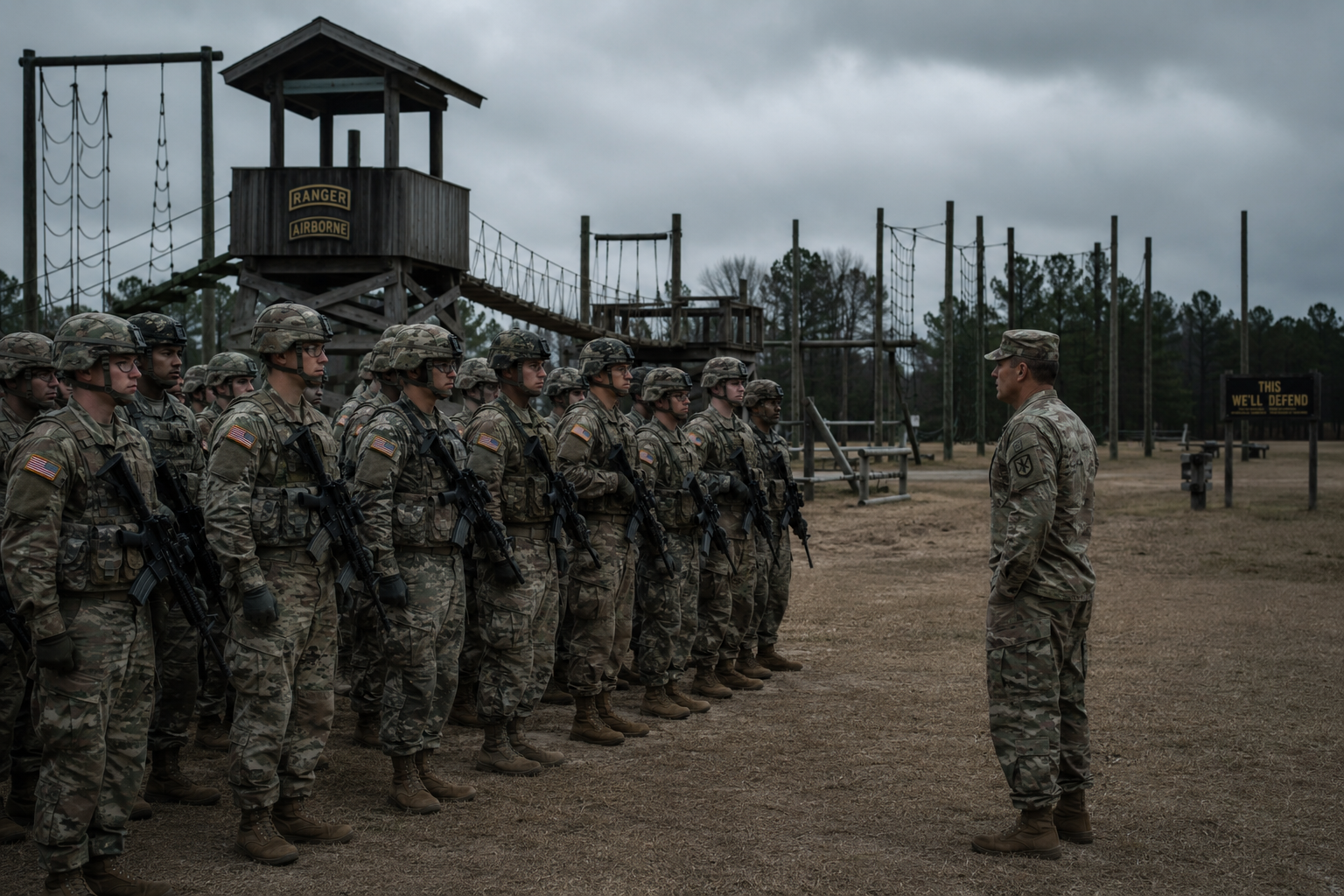
The U.S. Army has quietly canceled some of its most demanding training programs — not because of strategy, but because it’s out of money. With months still left in the fiscal year, the military is staring down a budget shortfall estimated between $4 and $6 billion, and the cuts are already hitting hard.
Among the casualties: the Sapper Course, one of the Army’s most grueling combat engineering schools, has been suspended. Artillery training at Fort Campbell has been paused. The Army has even trimmed the minimum flight hours required for pilots — a move that raises serious questions about operational readiness as global tensions continue to rise.
The Sapper Course is not a routine training program. It is one of the most physically and mentally demanding schools in the U.S. Army, producing combat engineers capable of executing high-stakes missions — breaching fortifications, clearing obstacles under fire, conducting reconnaissance in hostile environments. Soldiers who complete it wear a coveted tab that signals they belong to an elite tier of the force. Suspending the course doesn’t just delay training. It delays the production of a specific kind of warfighter that takes years to develop.
The situation at Fort Campbell is similarly alarming. Artillery training is a foundational element of combined arms warfare — the coordination of ground forces with fire support that modern battlefield doctrine depends on. Pausing it mid-year means units currently in their training cycle will arrive at their next assignment with gaps in their readiness. Those gaps are hard to close on a compressed timeline.
The shortfall isn’t a mystery. Three major spending pressures are draining the budget simultaneously: a deployment of National Guard troops to the southern border, ongoing support for overseas operations, and a years-long effort to upgrade aging military infrastructure. Together, they’re burning through roughly $1.1 billion per year beyond what was planned. Add it up over several years, and the gap becomes impossible to ignore.
Documents reviewed by ABC News revealed that the Army had already cut approximately half of its available training budget before the year reached its midpoint. That figure was not the result of a single policy decision. It accumulated gradually — each quarter, each unplanned expenditure, each extension of a border mission that was supposed to be temporary — until the math stopped working.
Defense officials are careful about how they describe the situation publicly. Words like “pause” and “adjustment” appear frequently in official communications, replacing starker language about capability loss. But inside the Army, the concern is less about messaging and more about the downstream consequences. A soldier who doesn’t complete the Sapper Course this year won’t have another opportunity until the next fiscal cycle opens. In some specialties, that’s a full year of lost development time — time that adversaries are not wasting.
The pilot flight-hour reduction may be the most quietly consequential of the cuts. Aviation is among the most perishable of military skills. Pilots who fly fewer hours are slower to react, less comfortable in complex scenarios, and statistically at higher risk during high-pressure operations. The Army’s decision to lower the minimum threshold was not made lightly — but it was made because the alternative was grounding aircraft entirely due to fuel and maintenance costs that exceeded available funding.
Congress has been briefed on the situation. Lawmakers on the Armed Services Committees are aware of the shortfall’s scope and the training cancellations it has forced. But no emergency supplemental funding has been approved, and the legislative calendar makes a quick fix unlikely. The appropriations process that could address the gap won’t produce results until the next fiscal year begins — and by then, the window for this year’s training cycle will have closed.
The Army is doing what it can with what it has. Prioritization decisions are being made at every level of command — which schools to keep open, which exercises to scale back, which deployments to sustain. But those decisions have consequences that are not always visible from the outside. What looks like a budget line item in Washington is, at the unit level, a question of whether the soldiers headed downrange are as prepared as they need to be.
The broader issue extends beyond any single service. The military’s ability to maintain readiness while managing competing budget pressures has been a persistent challenge for more than a decade. What’s different now is the combination of factors hitting simultaneously — high operational tempo, deferred infrastructure investment, and a domestic mission that was never fully resourced. The Army didn’t create this gap overnight, and it won’t close it overnight either.
For the soldiers who were set to attend the Sapper Course this year, or the artillery units at Fort Campbell whose training has been put on hold, the budget debate isn’t abstract. It’s a canceled school, a missed promotion opportunity, a unit that heads into its next assignment less prepared than it was supposed to be. That’s the ground-level reality of a $6 billion shortfall — measured not in dollars, but in training windows that don’t come back.