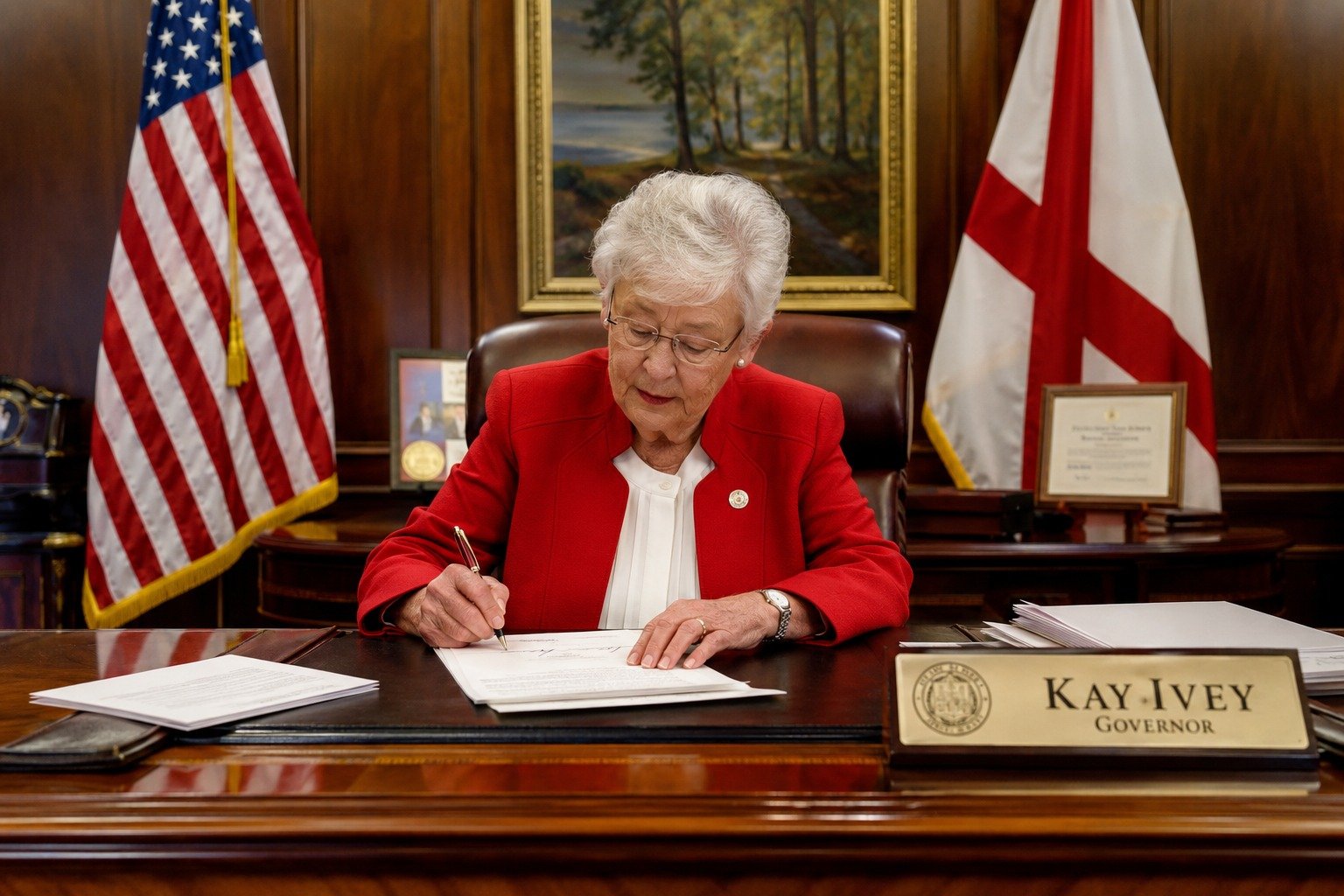
Alabama just drew one of the sharpest lines in American law. On February 12, 2026, Governor Kay Ivey signed the Child Predator Death Penalty Act — making Alabama one of a small number of states where convicted child predators can now face execution. The law takes effect October 1, 2026.
What the Law Does
The Child Predator Death Penalty Act classifies three specific crimes as capital offenses when committed against children under 12: first-degree rape, first-degree sodomy, and first-degree sexual assault. Capital offenses in Alabama are eligible for the death penalty. A person convicted of sexually assaulting a child under 12 can now face execution in the state.
Prior to this law, Alabama’s death penalty applied primarily to murder. The new legislation extends that punishment to the worst cases of child sexual abuse — a category advocates have long argued deserved harsher consequences than prison sentences alone.
A Near-Unanimous Vote
The bill faced almost no opposition. The Alabama House passed it 73-6 and the Senate followed 33-1. Those margins reflect broad bipartisan support — both Republican and Democratic lawmakers voted in favor, signaling that protecting children from predators is one of the few issues that still commands genuine consensus in American politics.
Governor Ivey had signaled her support before the bill reached her desk. The signing ceremony made Alabama’s position clear: the state intends to impose the maximum legal consequence on those who sexually abuse its youngest residents.
The Constitutional Question
Legal experts almost immediately flagged the law as a direct challenge to a 2008 Supreme Court ruling. In Kennedy v. Louisiana, the Court held 5-4 that the Eighth Amendment bars execution for crimes — including child rape — that do not result in the victim’s death. That ruling has blocked similar laws in other states for nearly two decades.
Alabama’s new law puts that precedent squarely in the crosshairs. Legal challenges are widely expected once the law takes effect and the first prosecution moves forward. Some analysts believe the current Court — with its changed composition since 2008 — could be more receptive to reconsidering Kennedy. Others argue the constitutional barrier remains in place regardless of who sits on the bench.
What This Means for Americans
For Alabama families, the law represents the state’s strongest possible statement about protecting children. Whether it results in executions depends on what happens in the courts — but the message from Ivey and the legislature is unambiguous: sexually assault a child under 12 in Alabama, and you may face death.
For the rest of the country, Alabama’s move could trigger a renewed national debate about child protection laws and the limits of the Eighth Amendment. If the law survives a legal challenge — or if the Supreme Court revisits Kennedy v. Louisiana — other states may follow Alabama’s lead. October 1st is when that battle begins.
Stay informed on the stories that matter most. Follow Your Daily Updates on Facebook and bookmark yourdailyupdates.news for breaking news and analysis.