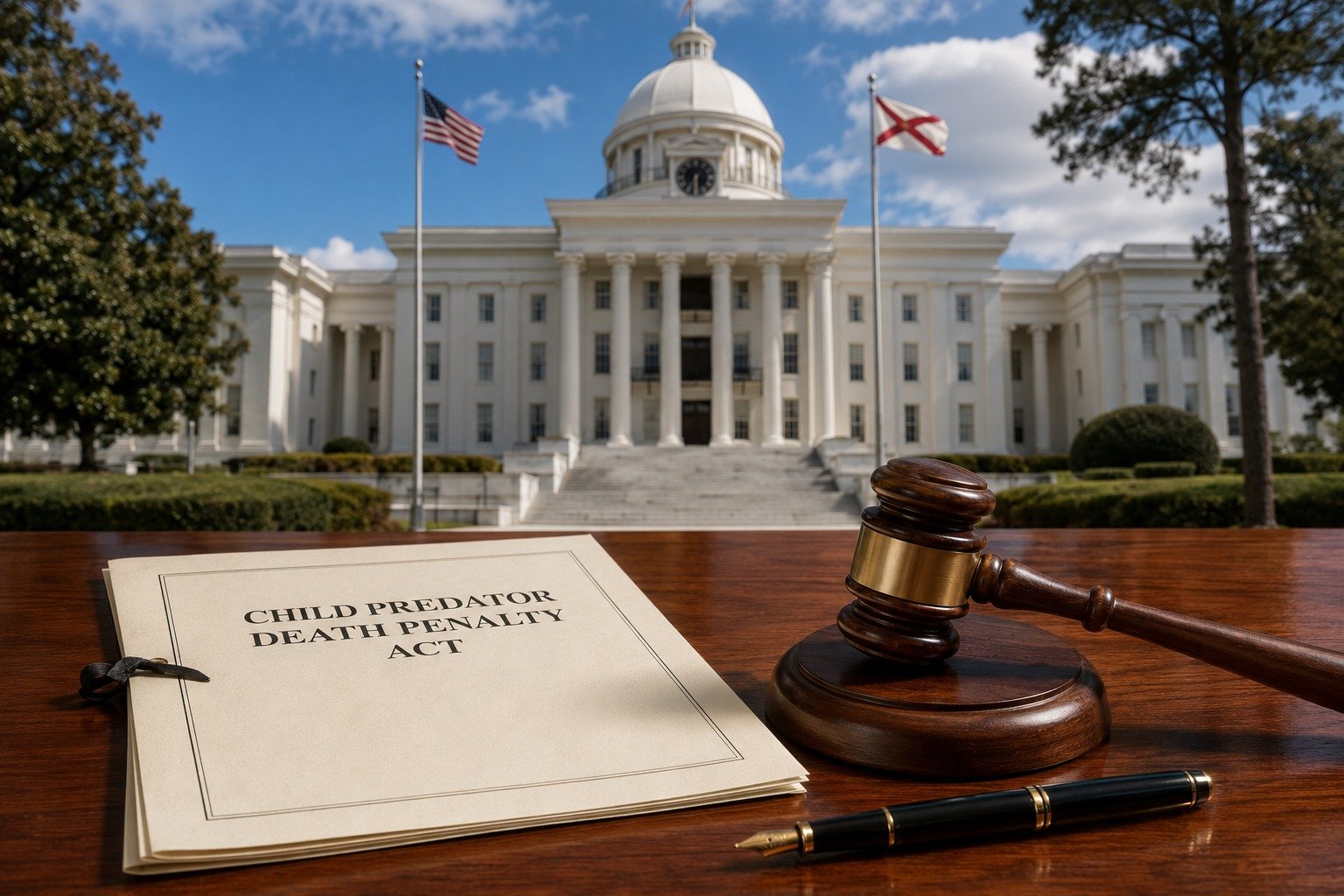
Alabama has enacted one of the most severe child-crimes statutes in the United States — and it is on a direct collision course with the U.S. Supreme Court.
Gov. Kay Ivey signed the “Child Predator Death Penalty Act” into law in February 2026. The measure makes first-degree r*pe, sodomy, and s*xual torture of a victim under the age of 12 automatically punishable by death. It sailed through the Alabama Legislature with lopsided support, clearing the House 73-6 and the Senate 33-1.
A Law Signed, But Not Yet In Force
One crucial detail has been lost in much of the reaction to the law: it is not yet in effect. The statute does not take force until October 1, 2026. Until that date, no one in Alabama can be charged or sentenced under its provisions. The law has been signed and enacted, but its real-world test will only begin once it becomes active this fall.
That timing matters, because the moment the first case is prosecuted under the new law, it is almost certain to trigger a constitutional challenge — one that legal observers have anticipated from the day the bill was introduced.
The Supreme Court Precedent Standing In The Way
The central obstacle is a 2008 U.S. Supreme Court decision, Kennedy v. Louisiana. In that ruling, the Court held that the Eighth Amendment bars the death penalty for the r*pe of a child in cases where the victim was not killed. The Court reasoned that capital punishment must be reserved for the most serious crimes — narrowly, murder and certain crimes against the state — and that extending it to non-homicide offenses was unconstitutional.
Alabama’s new law runs squarely against that precedent. By making these crimes automatically capital offenses, the state has written a statute that, on its face, conflicts with a controlling decision of the nation’s highest court. Unless the Supreme Court revisits and overturns Kennedy v. Louisiana, the Alabama law is vulnerable to being struck down the first time it is applied.
A Fight Lawmakers Appear To Have Invited
Supporters of the measure frame it as a firm, unambiguous stand against the most horrific crimes committed against young children. They argue that public sentiment has shifted and that the Supreme Court’s current composition may be more willing to reconsider its 2008 holding than the Court that decided Kennedy.
Critics counter that the law was essentially built to be challenged — a statute designed to force a test case rather than to survive on its own terms. They warn that the state could spend years and significant resources defending the law in court, only to see it invalidated under existing precedent. Some also caution that laws written primarily as constitutional provocations can produce unintended consequences in how cases are charged and litigated.
Either way, Alabama has drawn a line that the Supreme Court has already said the states cannot cross. Whether that line holds will depend not on the Alabama Legislature, but on whether the justices in Washington are prepared to revisit a question they answered less than two decades ago.
For now, the law sits on the books, signed but dormant, waiting for October 1 — and for the legal battle that is widely expected to follow.