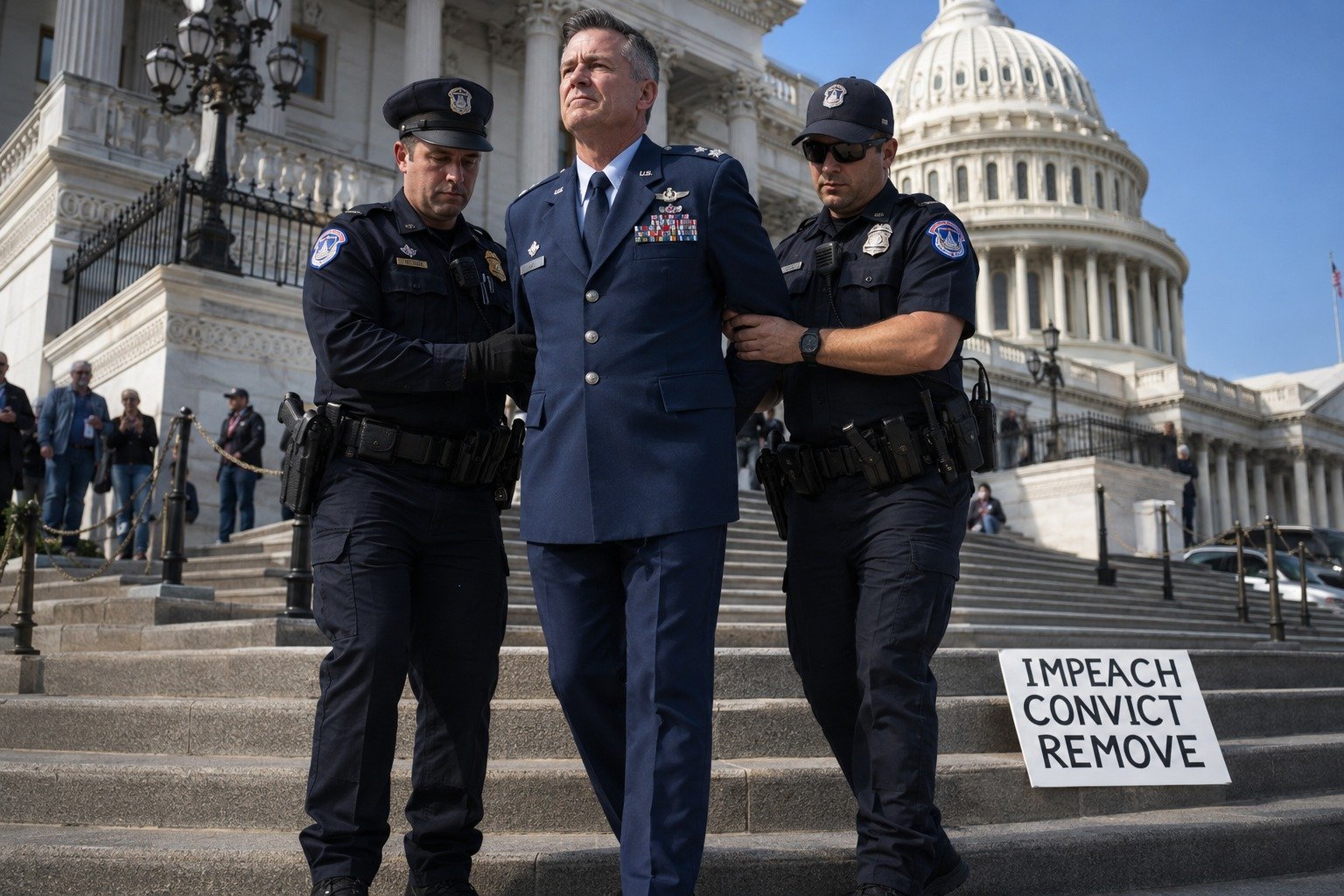
An active-duty United States Air Force officer has become the center of a national conversation about duty, conscience, and the right to dissent — after he was arrested in uniform on the steps of the U.S. Capitol while calling for accountability at the highest level of government.
Major Jason Watson, a decorated Air Force officer, was taken into custody on July 1, 2026, as he demonstrated outside the Capitol. Witnesses said Watson stood on the steps in his service uniform holding a hand-lettered sign reading “IMPEACH · CONVICT · REMOVE,” a direct call for President Donald Trump’s impeachment and removal from office. The striking image of a uniformed officer being led away by police quickly spread across the country.
What Happened on the Capitol Steps
According to accounts corroborated by CNN, NBC News, Military Times, and other outlets, Watson was arrested and charged with an unlawful-demonstration offense under D.C. Code 22-1307 — a statute that governs demonstrations in restricted areas. He was briefly detained and then released. The D.C. Superior Court subsequently indicated that no case would be filed against him, meaning he faces no criminal prosecution over the incident.
It is important to be precise about the facts: Watson was arrested, not convicted. He was not charged with a serious crime, and the court has signaled it does not intend to pursue the matter. The arrest itself, however, has set off a broader debate — because the person at the center of it is not an ordinary protester, but a serving military officer in uniform.
An Officer, In Uniform, Speaking Out
Members of the U.S. armed forces operate under strict rules governing political activity, particularly while in uniform. Longstanding Department of Defense regulations bar service members from participating in partisan political demonstrations while in uniform, precisely to preserve the military’s reputation for political neutrality. By demonstrating in his service dress, Watson knowingly stepped into contested territory.
The U.S. Air Force has confirmed it opened an investigation into Watson’s conduct. That review will examine whether his actions violated military regulations and what, if any, administrative consequences should follow. For now, Watson remains an active-duty officer.
A Divided Reaction
Supporters see Watson as a man of conscience who risked his career to speak out on an issue he believes is bigger than himself. To them, an officer who has sworn an oath to the Constitution — not to any individual — has every right, and perhaps a duty, to raise the alarm when he believes that Constitution is under threat. They argue that punishing him would send a chilling message to others who might consider speaking up.
Critics counter that the uniform is not a personal soapbox. They argue that the military’s credibility depends on its members staying out of partisan fights, and that allowing officers to stage political demonstrations in uniform — no matter how sincere — risks dragging the armed forces into the very political warfare they are meant to stand apart from.
Why It Resonates
Watson’s arrest lands at a moment of intense political tension, with multiple articles of impeachment against President Trump already filed in Congress. His single, silent act on the Capitol steps distilled that national argument into one unforgettable image: a decorated officer, in dress blues, willing to be handcuffed rather than stay silent.
Whatever one makes of his decision, the questions Watson has forced into the open are not going away. How much political speech should a service member be allowed? Where does personal conscience end and professional obligation begin? And what does it mean when someone sworn to defend the country decides the greatest threat is coming from within its own government?
Those are the questions now facing the Air Force, the courts, and the public — and they are the reason so many Americans are asking a simpler one of their own: do they stand with Major Jason Watson?