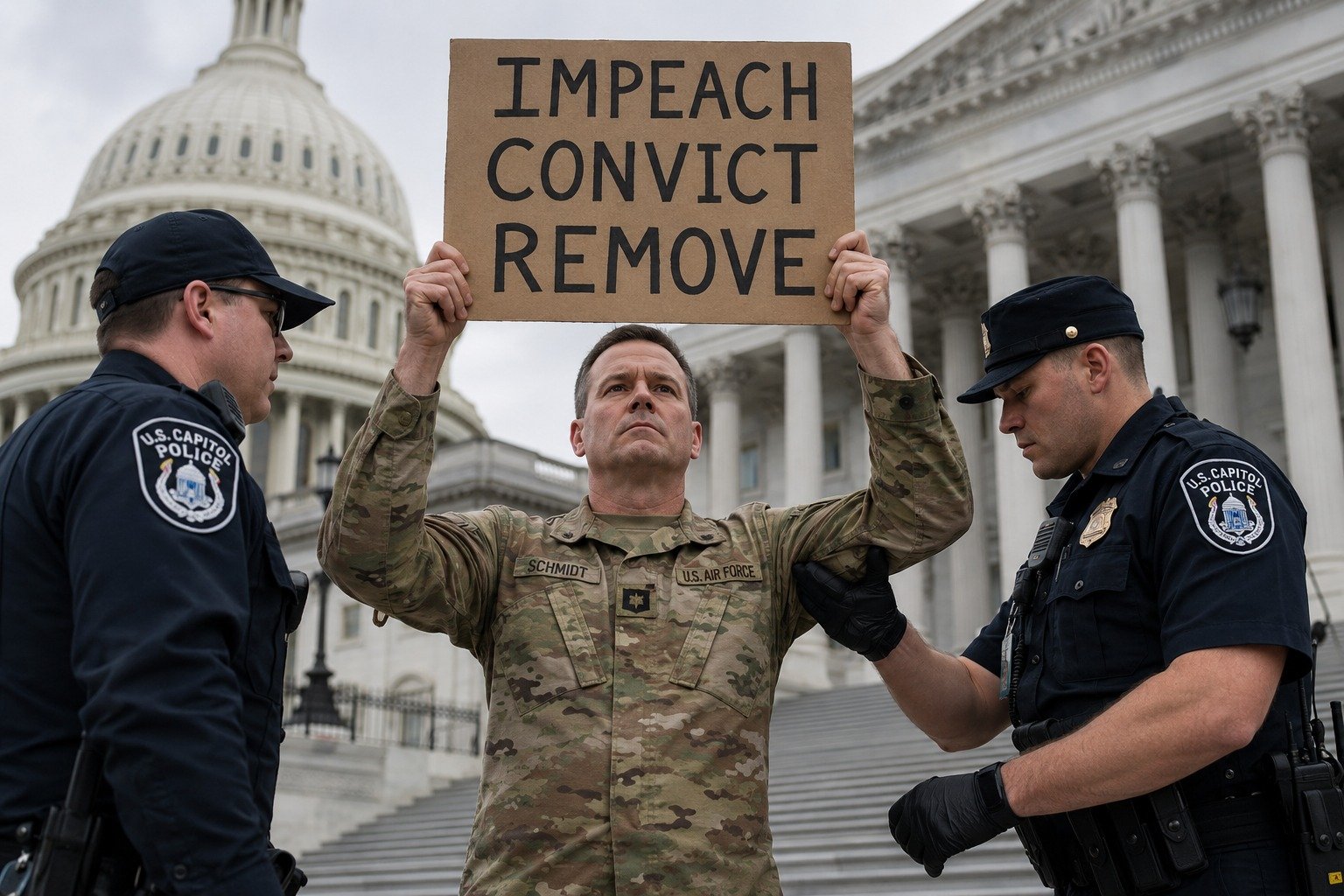
An active-duty United States Air Force major with more than two decades of service was arrested by U.S. Capitol Police on the steps of the U.S. Capitol earlier this month after standing in uniform and holding a protest sign that read “Impeach Convict Remove.” The arrest, and the questions it raises about the free-speech rights of service members, has drawn national attention.
Maj. Jason Watson, a career officer with more than 20 years in the Air Force, was taken into custody on July 1-2 as he demonstrated near the Capitol. According to accounts of the incident, Watson wore his uniform and held a hand-lettered sign calling for the impeachment, conviction and removal of President Donald Trump. Capitol Police charged him with “crowding, obstructing and incommoding” – a misdemeanor-level offense frequently used against demonstrators near the Capitol complex.
The Criminal Charges Were Dropped
In a significant development, the criminal charge against Watson was subsequently dropped, and he was released. That outcome is not unusual for “crowding and obstructing” citations, which are commonly resolved without prosecution. For Watson, however, the end of the criminal case does not necessarily mean the end of his jeopardy.
Because Watson is an active-duty officer who was in uniform at the time, he may now face scrutiny under the Uniform Code of Military Justice (UCMJ) – the separate legal system that governs members of the armed forces. Military regulations sharply restrict the political activities service members may engage in while in uniform, and a demonstration of this kind could trigger an internal investigation and, potentially, a court-martial.
Uniform, Speech, and the Limits of Military Political Activity
The rules governing when and how service members can express political views are longstanding and deliberately strict. Department of Defense directives generally prohibit active-duty personnel from participating in partisan political activities while in uniform, out of concern for keeping the military apolitical and separate from electoral politics. A uniformed officer holding a sign that names a sitting president and calls for his removal sits squarely in the territory those rules are designed to police.
Supporters of Watson argue that a decorated officer with more than 20 years of service should not lose his ability to speak as a citizen, and they frame the episode as a civil-liberties question: at what point does putting on the uniform mean surrendering the right to dissent? Critics counter that the very rules Watson may have run afoul of exist for good reason – to prevent the appearance that the armed forces are taking sides in a political fight.
Why This Case Resonates
Watson’s arrest lands at a moment of intense national debate over the boundaries of protest, the treatment of demonstrators near the Capitol, and the role of the military in American political life. The image of an officer in camouflage, flanked by Capitol Police, holding a cardboard sign, is a striking one precisely because it collides two institutions – the armed forces and the right to protest – that Americans usually think of as operating in separate spheres.
It also underscores how differently the civilian and military justice systems can treat the same act. A civilian who held that sign on the Capitol steps would, at most, face the same low-level obstruction citation that was ultimately dropped against Watson. For a service member, the same conduct can open the door to a military investigation with career-ending consequences, regardless of whether any civilian charge sticks.
What Comes Next
For now, Watson is out of criminal jeopardy but not out of the woods. Whether the Air Force opens a formal investigation – and whether any such inquiry escalates to a court-martial – remains to be seen. His case is likely to become a reference point in the broader conversation about the free-speech rights of the men and women who serve, and about how a democracy balances military discipline against the individual conscience of those in uniform.
The core facts are not in dispute: a real, active-duty Air Force major, in uniform, was arrested on the Capitol steps for a protest sign; the criminal charge was dropped; and the possibility of a military reckoning remains. What that reckoning looks like – and what it says about the space for dissent within the ranks – is the question now hanging over the case.