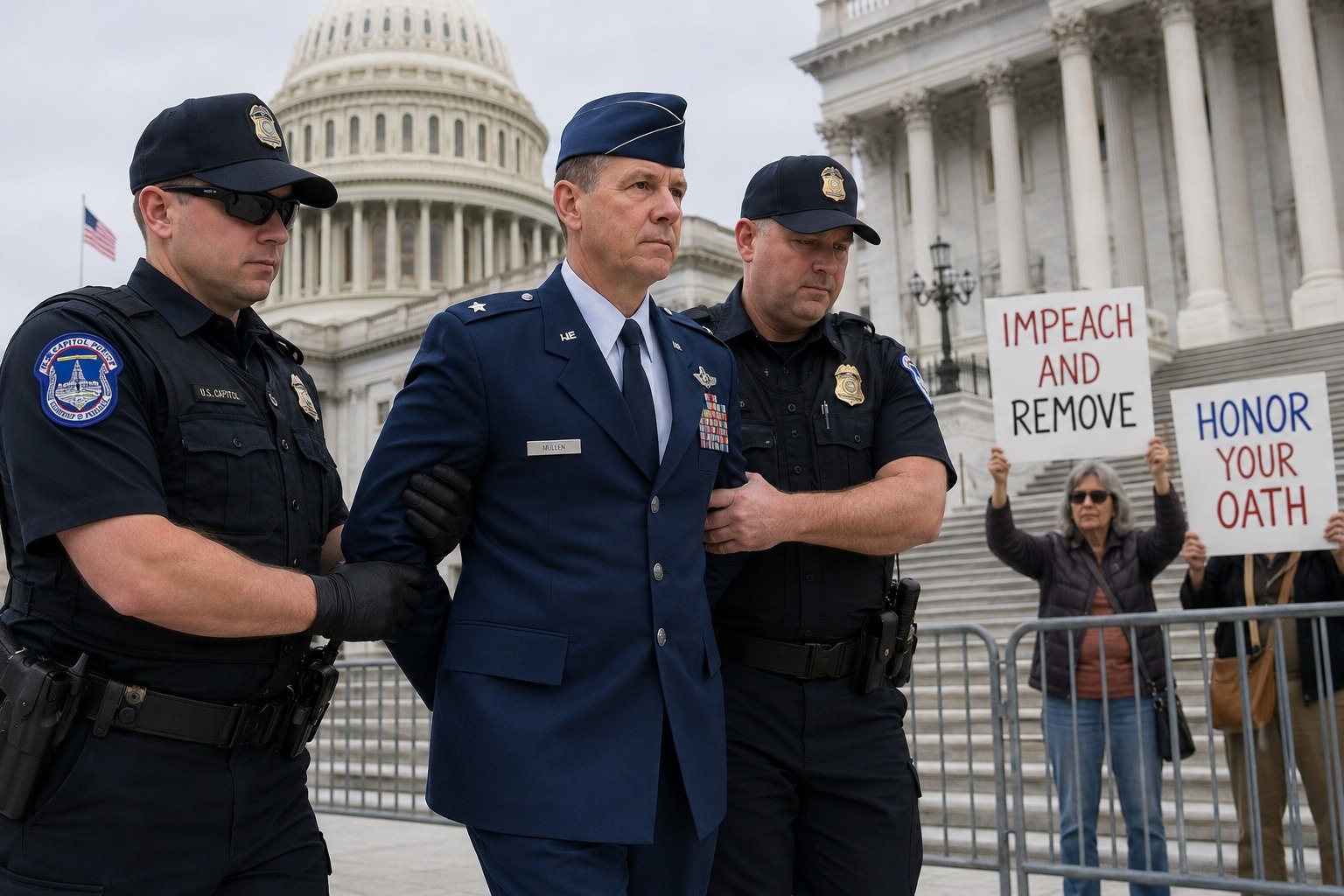
An active-duty U.S. Air Force officer was arrested on the steps of the U.S. Capitol on Wednesday, July 1, 2026, while demonstrating in support of impeaching President Donald Trump – a striking moment that put a serving military officer at the center of a constitutional argument he says he could no longer stay silent about.
Air Force Maj. Jason Watson was taken into custody by U.S. Capitol Police after appearing at a press conference organized by the “Removal Coalition,” an advocacy group pressing Congress to impeach and remove the president. Rep. Al Green, a Texas Democrat who has repeatedly forced impeachment votes to the House floor, attended the event alongside Watson.
What the arrest was actually for
The framing here matters, and it is worth being precise about. Watson was not arrested for the content of his political speech. According to accounts of the incident, after the press conference concluded and Rep. Green left the area, Capitol Police officers instructed Watson to stop demonstrating on Capitol grounds. When he refused those orders, he was arrested and charged under D.C. Code 22-1307 – “Crowding, Obstructing, and Incommoding.”
That statute governs where and how demonstrations may take place, and it is the same category of charge routinely applied to protesters who decline lawful dispersal orders on the Capitol plaza. In plain terms, the arrest was about the location and manner of the demonstration – not about the opinion Watson was expressing. Whatever one thinks of his cause, he was not jailed for holding a viewpoint.
The case he came to make
What Watson was saying, however, is precisely why the moment stands out. He accused Trump of violating the Constitution, pointing specifically to the War Powers Act and to U.S. military strikes on Iran and Venezuela that he argues were never properly authorized by Congress. The War Powers Resolution of 1973 requires the president to seek congressional authorization for sustained military action, and critics across the political spectrum have long complained that presidents of both parties have stretched or ignored it.
For a commissioned officer still in uniform and still serving, to publicly press that argument is unusual – and it carries real professional risk. Active-duty service members operate under significant restrictions on partisan political activity, and speaking out against the commander in chief can carry career consequences. Watson reportedly reached out to the Removal Coalition earlier this year because he wanted to add his voice to the impeachment movement, knowing what it might cost him.
A collision of duty and dissent
The image of a decorated officer being led away in handcuffs on the Capitol steps is the kind of scene that tends to stay with people, precisely because it sits at the intersection of two ideas Americans hold dear: the obligation of service members to remain apolitical, and the First Amendment right of every citizen – in or out of uniform – to petition their own government.
Reasonable people can and do disagree about whether an active-duty officer should be demonstrating at the Capitol at all. Supporters see Watson as a citizen exercising a fundamental right and raising a serious question about the limits of executive war-making power. Skeptics argue that the uniform is supposed to stay out of politics, and that the rules exist for good reason.
What is not in dispute is what happened: a serving Air Force major stood on the Capitol steps, called for the impeachment of the president, refused an order to disperse, and was arrested. Whether his War Powers argument gains traction in Congress remains to be seen. But the arrest ensured that his case – and the questions it raises about accountability and the rule of law – will be heard well beyond the crowd that gathered outside the Capitol that day.
The right to hold your government accountable is written into the Constitution. Watching a man in uniform pay a price to invoke it is a reminder of how seriously some Americans still take that promise.