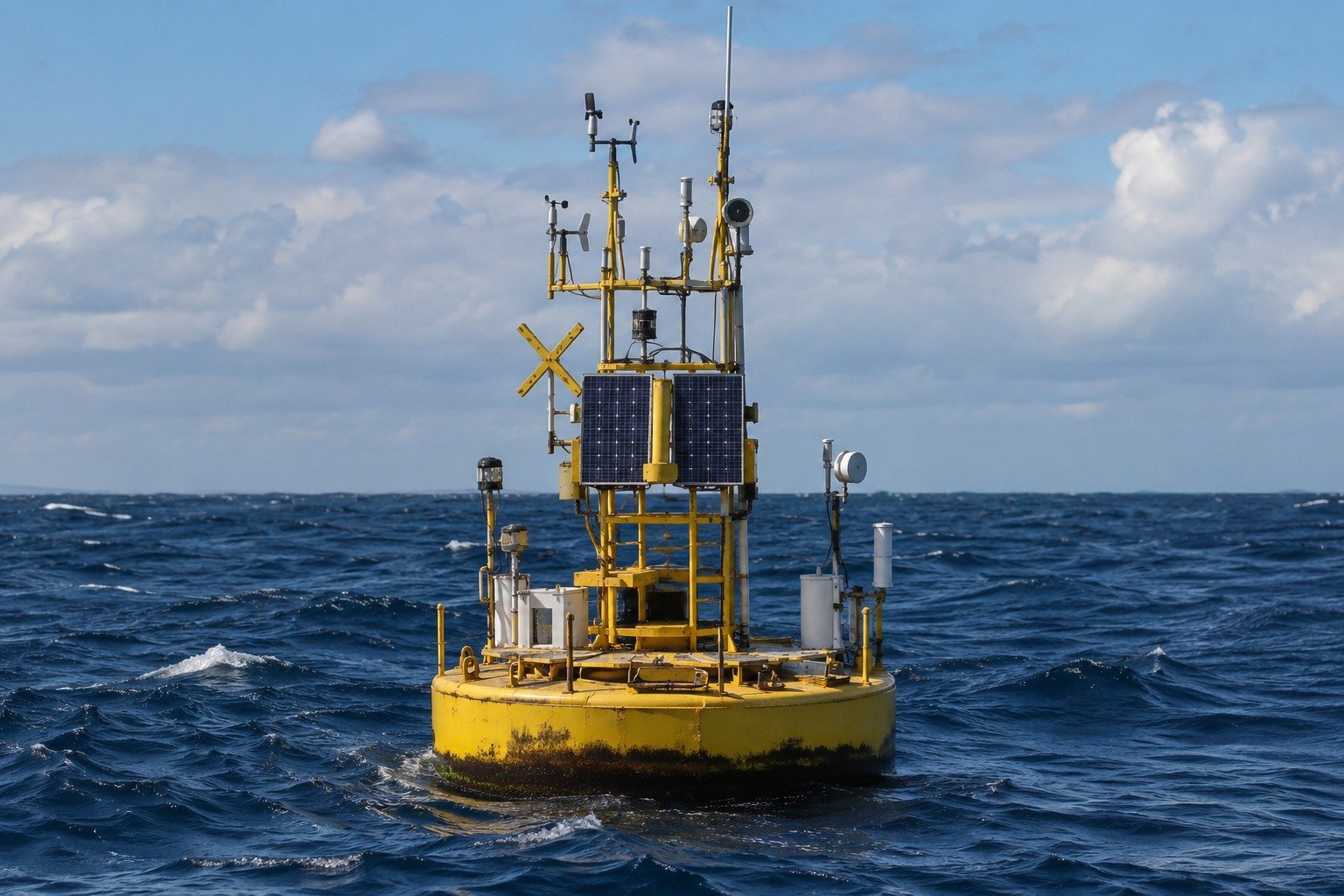
One of the country’s most important ocean monitoring networks was on the chopping block. After a wave of bipartisan pressure, it is staying alive. On June 18, the National Science Foundation reversed its decision to dismantle the Ocean Observatories Initiative, a roughly $368 million program that operates about 900 instruments and sensors spread across the world’s oceans.
What the Ocean Observatories Initiative Does
The Ocean Observatories Initiative is not a single buoy bobbing in the water. It is a sprawling, interconnected network of roughly 900 instruments anchored to the seafloor, suspended in the water column, and floating on the surface across multiple ocean regions. Those instruments continuously measure sea temperature, currents, salinity, oxygen levels, and the early warning signs of climate shifts and severe weather.
The data flows back to researchers, forecasters, and government agencies in near real time. It feeds into storm prediction, fisheries management, and a long list of scientific work that depends on an unbroken record of what the ocean is doing. Cutting the program would not just save a line item; it would punch a hole in years of accumulated data that cannot easily be rebuilt once the sensors go dark.
How the Reversal Happened
The decision to keep the network running did not happen on its own. It followed loud, sustained backlash from scientists, coastal communities, and lawmakers on both sides of the aisle who argued that gutting the program would leave the country blind to data it relies on every day.
Senators Jeff Merkley and Lisa Murkowski led a “Save Our Sensors” push in the Senate, a notably bipartisan pairing of a Democrat and a Republican. Their argument was straightforward: the information these sensors gather underpins storm forecasting, supports commercial and recreational fisheries, and even touches on national security, where understanding ocean conditions matters for navigation and defense planning. Walking away from that, they warned, would cost far more in the long run than it would ever save.
Faced with that pressure, the National Science Foundation announced it would not proceed with removing or scaling back the program. The reversal was confirmed by multiple national outlets, marking a rare instance of a planned cut being walked back after public scrutiny.
Reactions and What Comes Next
Supporters of the program framed the outcome as proof that public attention works. A decision that would have quietly stripped away years of scientific infrastructure got dragged into the light, and once it did, the pressure to reverse it became hard to ignore. For the researchers who depend on the network, the relief is real, but so is the unease about how close it came to disappearing.
The larger question now is how a program this consequential ended up on the cancellation list in the first place, and what else may be facing similar cuts without the same spotlight. Bipartisan attention saved this one. The worry among scientists is that other programs without high-profile defenders may not be so lucky.
What This Means for Americans
This is not an abstract science debate. The data these sensors collect feeds the storm forecasts that warn coastal residents before hurricanes hit, the fisheries science that protects food supplies and jobs, and the climate monitoring that shapes long-term planning. When that infrastructure is threatened, the people most affected are ordinary Americans who rely on accurate forecasts and healthy coastlines. The episode is a reminder that public pressure can still force accountability, and that paying attention to what gets quietly cut can make the difference between a program surviving and vanishing.
Stay informed on the stories that matter most. Follow Your Daily Updates on Facebook and bookmark yourdailyupdates.news for breaking news and analysis.