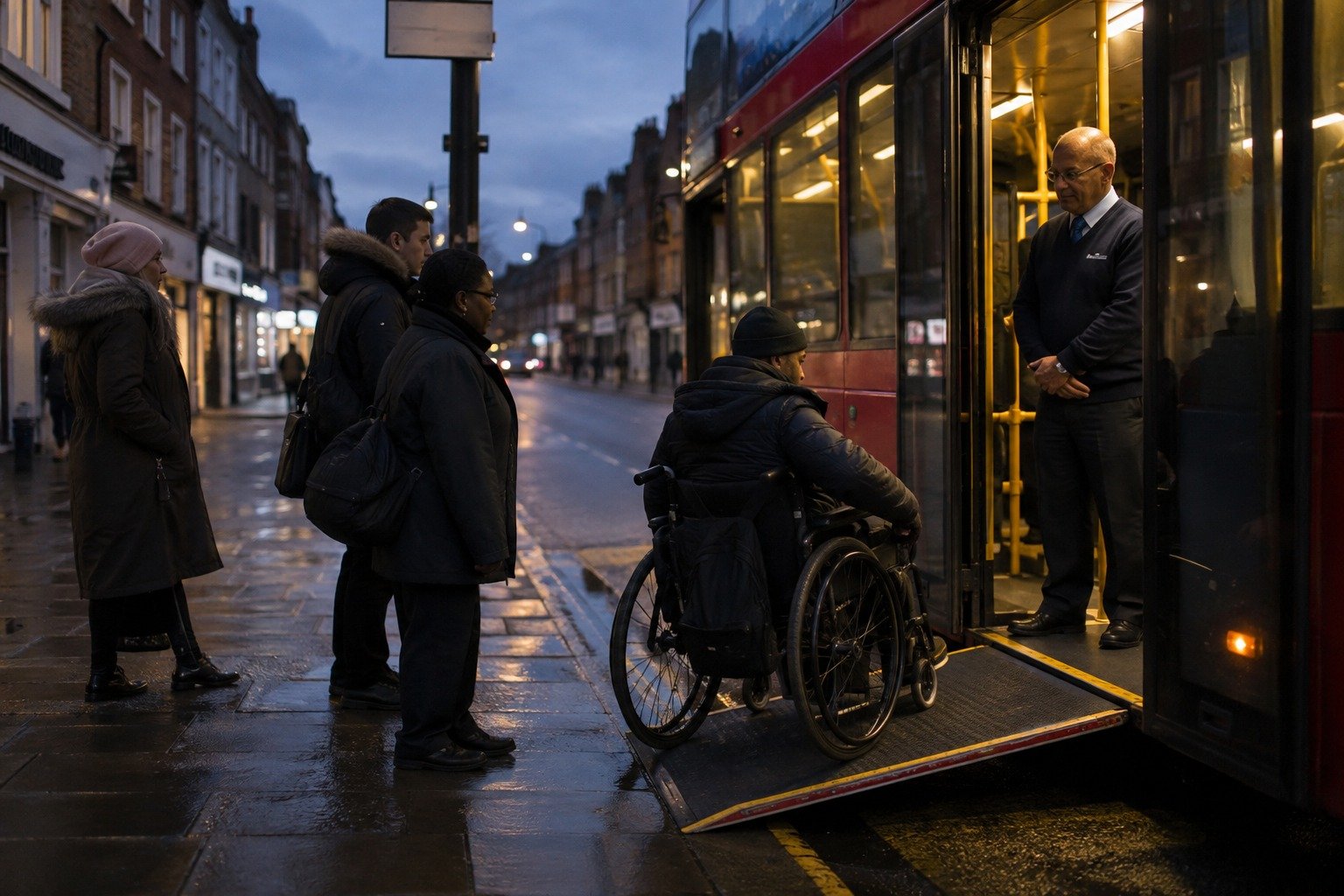
For a disabled worker in England with an early shift, the free bus pass in their pocket has come with a catch that made it close to useless: it does not legally work before 9:30 in the morning. If the job starts at 7, the pass does not get you there.
That restriction is being removed. The UK government announced this week that the time limits on England’s disabled person’s bus pass will be lifted entirely, giving eligible passholders free bus travel at any hour of the day. The change was announced by the Prime Minister’s Office at 10 Downing Street alongside the Department for Transport and the Department for Work and Pensions.
One detail matters more than any other in the coverage: this does not take effect now. The change is scheduled to begin on 1 April 2027, roughly 20 months away.
What the current rule actually does
Under the existing scheme, a disabled person’s bus pass in England is valid from 9:30am to 11pm on weekdays. It is already free all day on weekends and bank holidays. The only exception has been where an individual local authority chose to fund an extension of its own.
That is what created the gap the government is now closing. Whether a disabled person could actually use their pass to reach an early shift depended entirely on which council area they happened to live in. Greater Manchester Combined Authority permanently lifted the restrictions in March 2026. Most of England did not follow.
What officials said
Prime Minister Andy Burnham said: “Disabled people will now have unlimited free bus travel 24/7… I did it before in Greater Manchester and I’m proud to do it now for the whole country.”
Transport Secretary Heidi Alexander framed the change as a fairness measure, saying: “We’re putting an end to this postcode lottery.”
Work and Pensions Secretary Pat McFadden pointed directly at the employment problem: “For too long, disabled people have held a free bus pass in their pocket that didn’t always get them to work.”
How it is being paid for
The government put the cost at £60 million, drawn from existing departmental budgets rather than new spending. Of that, £40 million comes from the Department for Work and Pensions and £20 million from the Department for Transport.
Who qualifies
Eligibility is not universal, and the announcement does not change who qualifies. It is set by the Transport Act 2000, which defines seven statutory categories: people who are blind or partially sighted; people who are profoundly or severely deaf; people without speech; people who are unable or virtually unable to walk; people without arms or unable to use both arms; people with a learning disability; and people who have been refused a driving licence on medical grounds other than drug or alcohol misuse.
Local authorities administer the scheme and assess applications, so the practical route to a pass still runs through the council.
England only
The change applies to England alone. Concessionary travel is a devolved matter, and Scotland, Wales and Northern Ireland each run separate schemes on their own terms. Coverage describing this as a UK-wide or Britain-wide change is inaccurate.
The government placed the announcement alongside several other transport measures it has been pointing to: the £2 bus fare cap running through 2027, free bus travel for under-16s introduced this month, £3.5 billion in employment support for disabled people, and bus franchising devolution under the Bus Services Act.
One widely repeated figure deserves a caveat. The estimate that about one million people could benefit comes from PA and ITV reporting, not from the government press release itself.
Why this lands differently in the United States
There is no equivalent national program in the US. Whether a disabled worker can physically reach a job is not addressed by a federal concessionary travel scheme; it comes down to whatever a given city or transit agency chooses to fund. The English change is worth watching precisely because it treats transport access as an employment barrier rather than a transport perk.
The substance of the reform is narrow and specific: it removes a weekday morning cut-off that made a benefit unusable for exactly the people trying to work. It is a real win for disability rights and for disabled workers. It also does not arrive until April 2027.