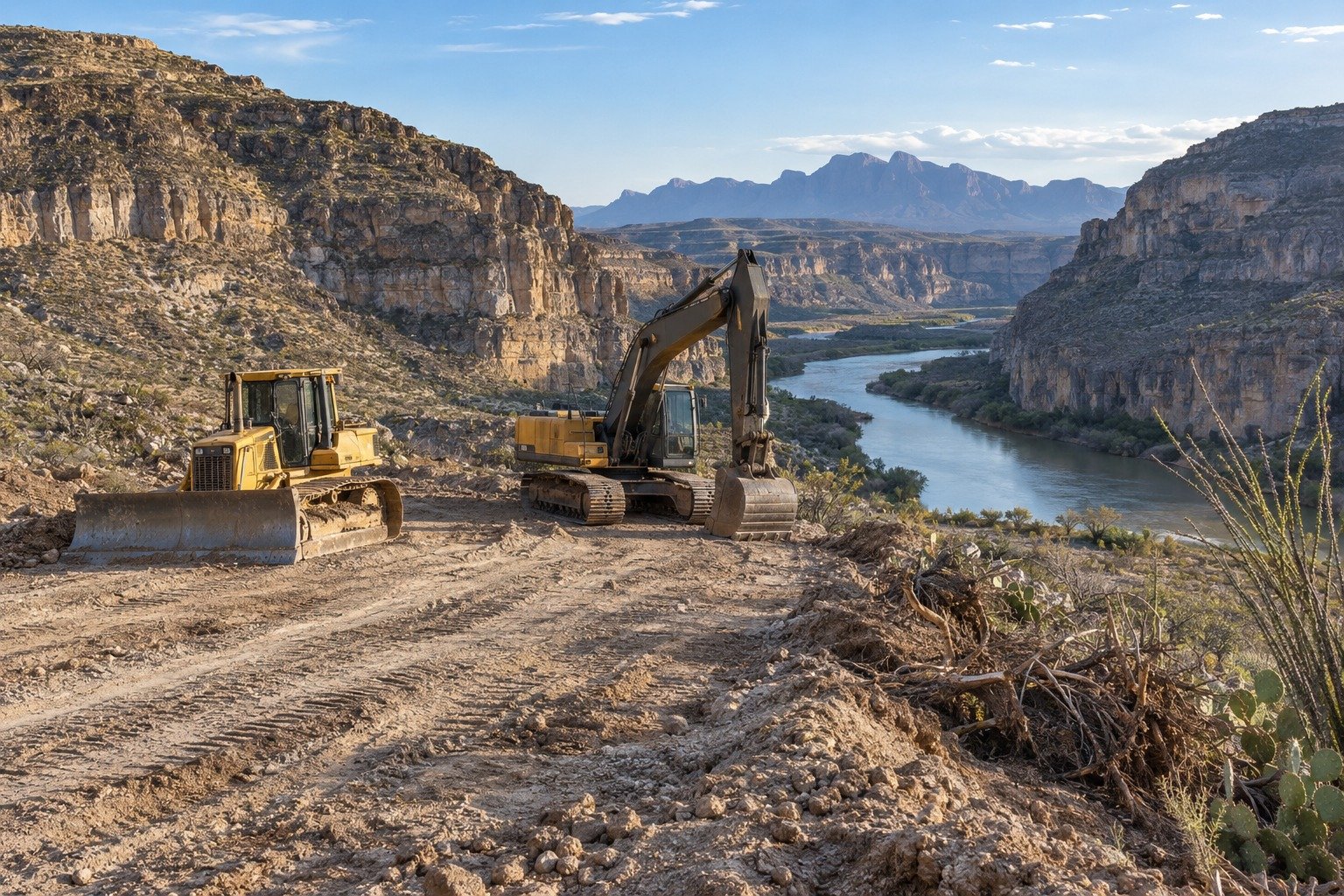
Customs and Border Protection Commissioner Rodney Scott ordered a halt Sunday night to border-barrier construction inside Big Bend National Park, announcing the decision Monday as he traveled to the remote West Texas site himself. The pause is voluntary and self-imposed. No court ordered it, and no end date has been set.
Scott said he had, in his words, “put a pause on all activity in that park as far as construction goes till I can get down there and do a personal evaluation, talk to some stakeholders, talk to some local law enforcement in that area.”
What Triggered the Pause
For roughly two weeks, images circulated of bulldozers and heavy machinery clearing land inside one of the most remote protected landscapes in the United States. Big Bend is a national park, and the sight of earthmoving equipment cutting through its Chihuahuan desert terrain generated sustained public backlash.
That backlash was not confined to one political party. Sen. John Cornyn, a Texas Republican, urged the Department of Homeland Security to consult local leaders and reconsider the proposed barriers in the greater Big Bend region. Cornyn pointed to the area rugged terrain, which he argued already functions as a natural deterrent without any need for constructed barriers.
What the Project Actually Involves
The work inside the park calls for new patrol roads cut across park land, plus the installation of 17 miles of steel vehicle barriers. Vehicle barriers are lower structures designed to stop cars and trucks, distinct from the taller pedestrian walls seen elsewhere along the southern border.
This is separate from a much broader effort already underway: a 30-foot steel border wall planned across the greater Big Bend region, stretching from Hudspeth County to Presidio County. That larger project is a different undertaking and was not affected by the commissioner order.
The numbers behind the project invite scrutiny. The Big Bend region takes in roughly 517 miles of the southern border along the Rio Grande, yet it accounts for only a tiny fraction of total border crossings. Crossings in the area have declined further over the past two years.
The Legal Picture Is Separate
Multiple lawsuits over the construction remain pending. Over the weekend, a local Indigenous group asked a federal judge to temporarily block the work. That request has not been decided, and it was not the reason construction stopped.
The distinction matters. A judicial order would carry legal force and would remain in effect until modified by a court. What happened here is an agency deciding, on its own, to stand down while one official looks at the site. It can be reversed the moment that official chooses to reverse it.
What This Means for Americans
National parks belong to the public. When heavy equipment starts clearing protected land, the people who own that land are entitled to know why, and to be heard before it happens rather than after. In this case sustained public attention and bipartisan pressure did what no lawsuit has yet managed to do: it stopped the machines. But it stopped them provisionally. Nothing has been canceled, no policy has changed, and the equipment remains on site. Anyone who cares how this ends should watch what the commissioner says after his visit, because that single decision determines whether the bulldozers stay parked or go back to work.
Stay informed on the stories that matter most. Follow Your Daily Updates on Facebook and bookmark yourdailyupdates.news for breaking news and analysis.