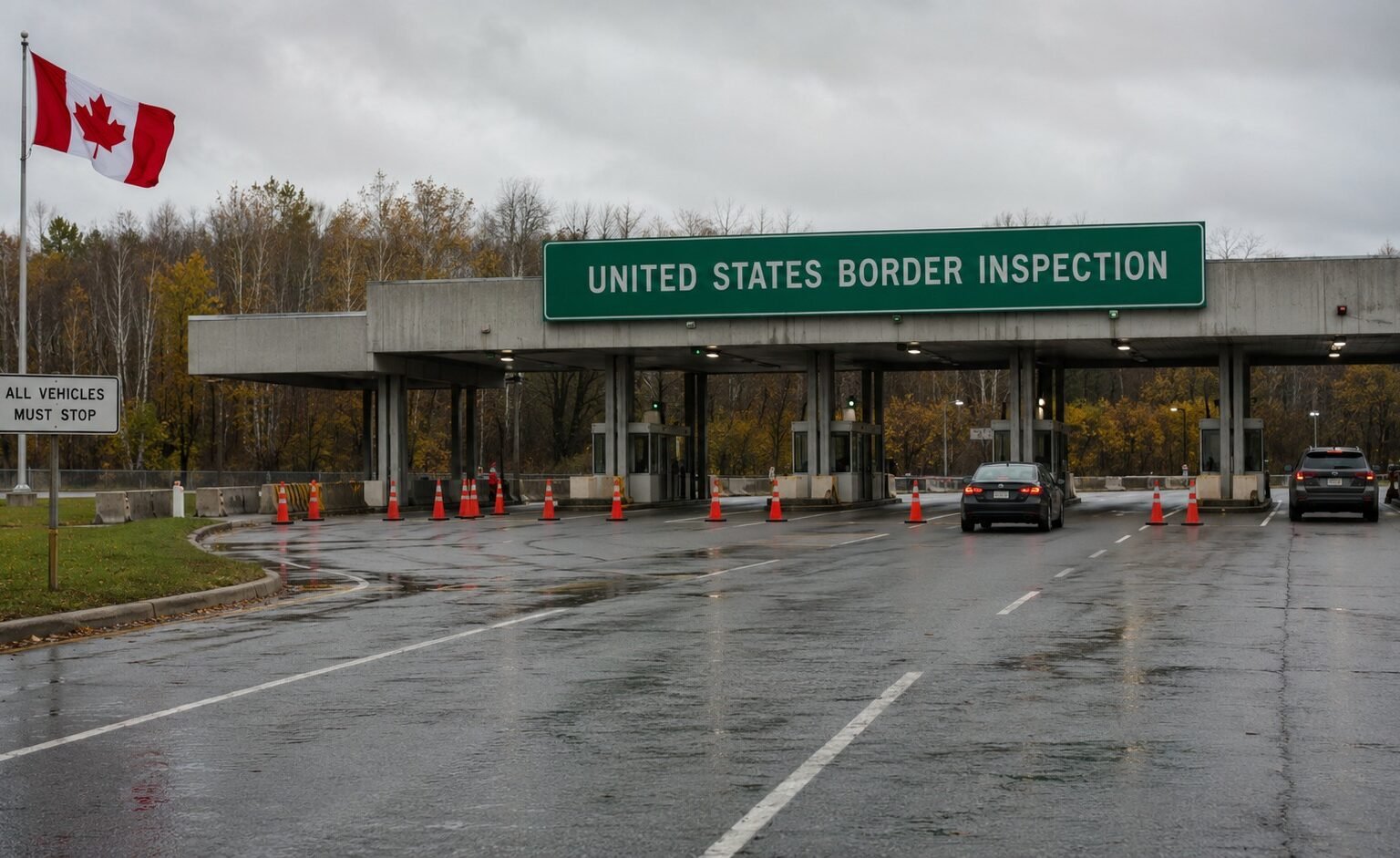
For 15 consecutive months, Canadians stopped coming. Statistics Canada’s Frontier Counts recorded year-over-year declines in Canadian-resident return trips from the United States every single month from roughly January 2025 through March 2026, and the agency did not hedge about why: it attributed the shift to political tensions between Canada and the United States.
The scale was hard to miss. In March 2026, Canadians made 2.6 million return trips from the U.S., down 6.4% from a year earlier. Measured against March 2024, before the tensions took hold, car trips were down 34.9% and air trips down 25.4%.
The financial damage landed squarely on American workers and small businesses. Canadians spent about $20.5 billion in the United States in 2024. The roughly 22% drop in 2025 erased about $4.5 billion of that. The U.S. Travel Association put its own tally at about $5.7 billion in losses tied to absent Canadian travelers. That figure is especially striking because the association had warned that even a 10% decline would cost $2.1 billion and 140,000 hospitality jobs. The actual decline was more than double what it had cautioned against.
The result showed up in global rankings. In 2025, the United States was the only major country to post a decline in international visitor spending while worldwide tourism grew. Inbound international travel to the U.S. fell about 6.3%.
The trend has partially reversed, but the hole has not been filled
Here is where the story gets more complicated than the headlines suggest. April, May, June and July of 2026 all posted year-over-year increases. Statistics Canada’s August 11, 2026 release showed 2,277,054 return trips from the U.S. in July 2026, up 10.2% from the year before and the fourth straight month of growth.
Statistics Canada itself supplied the caveat, noting the increase is largely due to a base-year effect. In plain terms, the 2025 comparison months were so depressed that a modest recovery looks dramatic in percentage terms.
Against the pre-tension baseline, the gap is still enormous. July 2026 car trips remained 28.9% below July 2024, and air trips 26.8% below. Air travel from Canada to the United States actually fell 1.4% year over year even during that fourth month of headline growth. Canadian travel to the U.S. is not collapsing anymore, but it is still running roughly a quarter to a third below where it was.
Where Canadians went instead
The best-supported destination numbers come from the countries themselves. Canadian arrivals in the Dominican Republic rose 13.3% in the first quarter of 2026. Costa Rica reported 26.5% growth in Canadian arrivals in the first half of 2026.
Beyond that, the picture comes from travel-industry booking data rather than any government agency, and it should be read accordingly. Figures compiled by Flight Centre, tour operators and trade press point to the Caribbean leading Canadian future-trip consideration at about 37%, Europe as the top international choice for roughly 25% of Canadians in 2026 with Portugal and Spain named repeatedly, Mexico flight volumes up roughly 26% compared with 2024, and Japan up sharply. These reflect industry bookings and stated intent, not official statistics.
Importantly, overseas travel did not simply absorb the displaced trips. Statistics Canada’s overseas numbers are modest, not explosive: overseas return trips were up just 3.3% year over year in May 2026, and in July 2026 overseas air return trips actually declined 1.4% to 988,900. A great deal of the travel that once went south instead became a domestic Canadian trip, or no trip at all.
One structural change is genuinely notable. For several months in 2026, more Canadians flew overseas than drove to the United States, reversing a pattern that had held for decades.
Traffic in the other direction is rising
The flow has not stalled on both sides of the border. U.S.-resident trips to Canada rose 6.5% in July 2026 to 2.7 million, the sixth consecutive month of year-over-year growth.
It is worth being precise about what this episode was and was not. No one was banned. No U.S. policy blocked Canadians from crossing. This was voluntary consumer behavior, millions of individual households responding to tariffs, annexation rhetoric and concerns about border and immigration enforcement by quietly booking somewhere else.
The people who absorbed the cost were not the officials who generated the tension. They were hotel housekeepers, restaurant servers, tour guides and shop owners in border towns and destination cities who lost billions in business over a dispute they had no part in starting. The numbers are recovering. For the workers who lost 15 months of income, that recovery is arriving late.