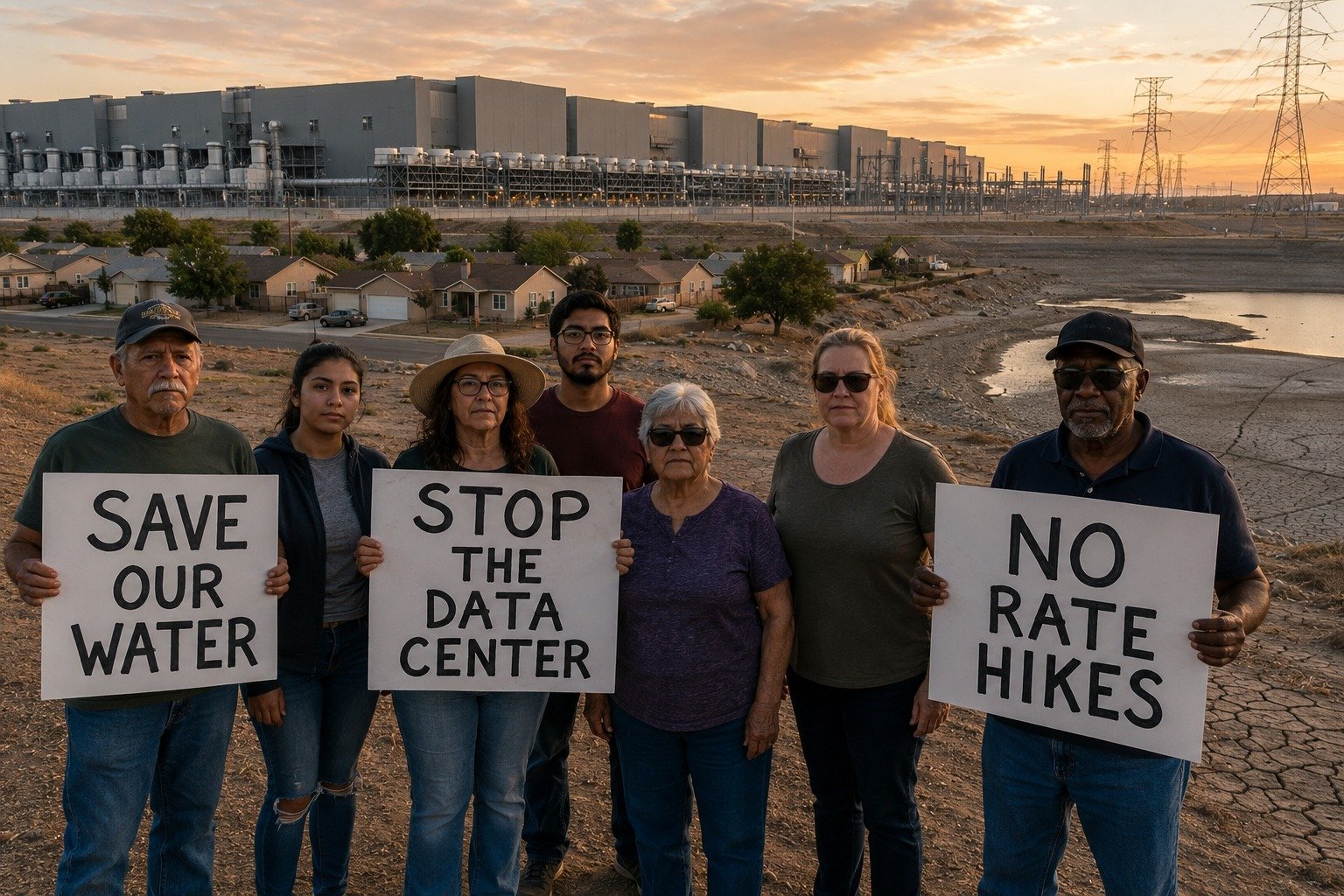
A grassroots revolt against AI data centers has gone national, and it is already reshaping where, and whether, the industry can build. Community opposition has blocked or delayed roughly $130 billion in data-center projects, with more than 75 build-outs halted in just the first months of 2026, according to a Data Center Watch study covered by NBC News and Fortune. This month, New York became the first state in the country to impose an outright ban on new AI data centers.
A Backlash That Crosses Party Lines
What makes this movement unusual is who is in it. In an era when almost every fight splits neatly along partisan lines, the pushback against data centers has drawn in residents on both the left and the right. Moratoriums have passed in county after county across Illinois, Missouri, Texas, Wisconsin, and Michigan. The people showing up at zoning meetings are not organized by a single national campaign. They are neighbors reacting to the same thing arriving on the same country roads: enormous, windowless server farms that run around the clock.
The tech industry describes these facilities as the backbone of the AI future, and the investment figures are staggering. But the Data Center Watch findings show that local communities are increasingly willing and able to say no. Roughly $130 billion in projects have been blocked or delayed, a number that would have been hard to imagine even a year ago.
The Two Grievances: Water and Power
Two complaints come up again and again, and both are intensely local. The first is water. Large data centers use enormous volumes of it to keep their servers from overheating, and residents in drought-strained regions say they are watching their aquifers drop as a new industrial neighbor draws from the same supply.
The second is electricity. These campuses consume vast amounts of power, and neighbors are convinced that surging demand is showing up on their own monthly bills. The broader numbers give the argument weight. U.S. residential electricity prices have climbed about 42 percent nationally over the past five years, with some regions hit far harder, roughly 74 percent in Maryland, 73 percent in Maine, and as much as 94 percent in Washington, D.C. Data centers are not the sole cause of those increases, but analysts agree that the rapid growth in AI-driven power demand is helping push costs higher.
New York Draws a Hard Line
Most of the fights so far have played out at the county level, one proposed campus at a time. New York changed the scale of the debate this month by becoming the first state to enact an AI data-center ban rather than a local moratorium. It is a marker other statehouses are likely to study closely, especially as the count of blocked and delayed projects keeps climbing.
What This Means for Americans
The AI boom is often described in abstract terms, but its costs land in very concrete places: a reservoir that runs low, an electric bill that keeps climbing, a rural landscape that suddenly hosts an industrial complex. What this movement really represents is ordinary people demanding a seat at the table before those tradeoffs are decided for them. The question at the center of every one of these local fights is blunt and fair: who pays for the AI build-out, and who gets to decide where it happens?
Stay informed on the stories that matter most. Follow Your Daily Updates on Facebook and bookmark yourdailyupdates.news for breaking news and analysis.