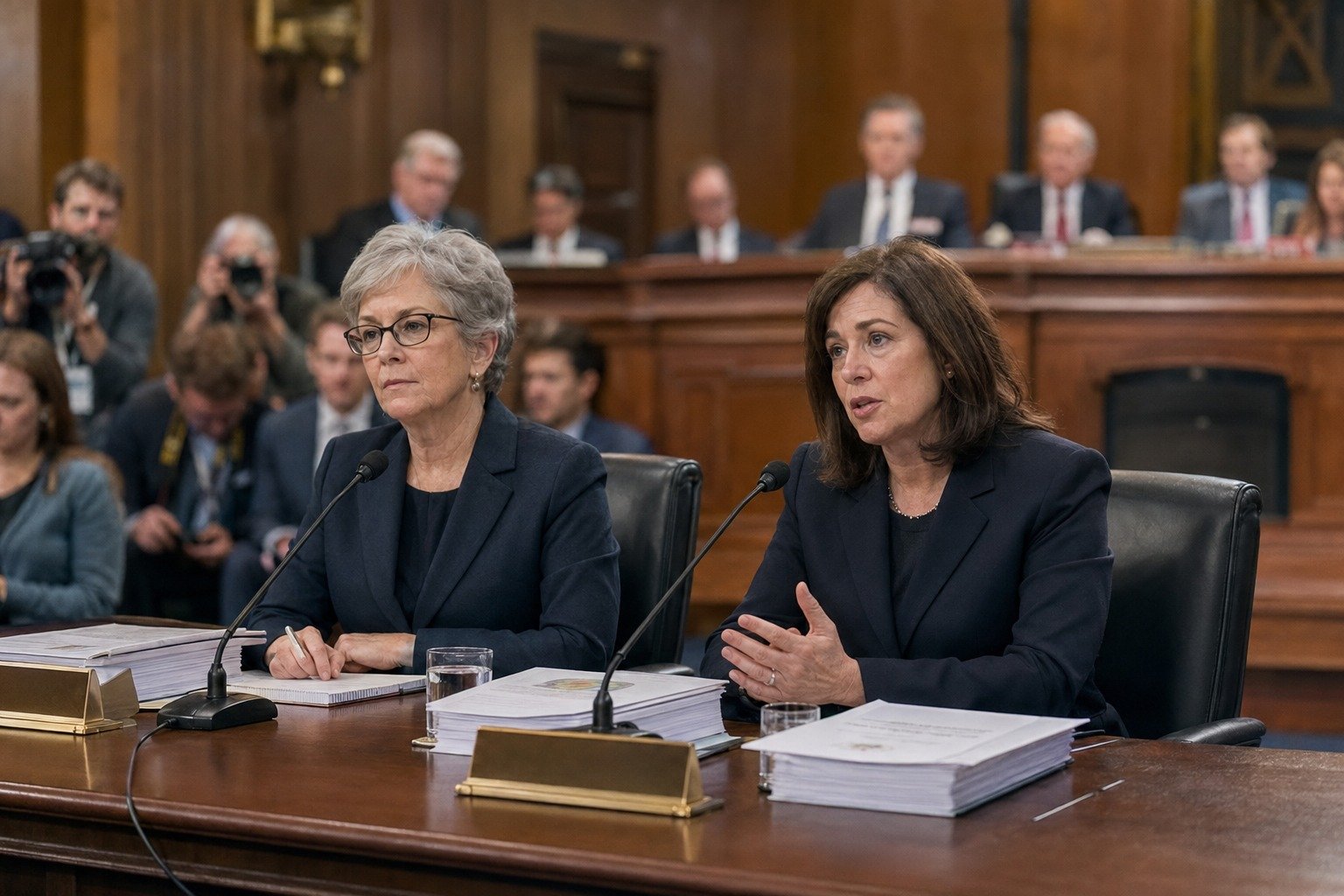
Two Supreme Court justices walked into a congressional hearing room on Tuesday and asked American taxpayers for more money. It was the first time any member of the high court has testified before Congress since 2019, and the subject was not ethics, not recusals, not a single one of the rulings that have reshaped American life. It was the budget.
Justice Elena Kagan and Justice Amy Coney Barrett appeared before the House Appropriations Subcommittee on Financial Services and General Government to present the Supreme Court’s funding request for fiscal year 2027. The pairing was deliberate: Kagan, one of the court’s liberals, and Barrett, one of its conservatives, appeared together as the institution’s designated budget representatives. That is the customary arrangement. They were not subpoenaed. They were not hauled in. They came to ask for an appropriation, which is a routine act made extraordinary only by how rarely the justices do it in person.
What the court is asking for
At the center of the request is security. The judiciary is seeking roughly $921 million in security funding overall, an increase of about $29 million. Inside that figure sits a $14.6 million increase for the Supreme Court Police, money earmarked for protective activities that extend beyond the marble building itself to the justices’ homes and their families.
Kagan made the case in personal terms, telling lawmakers that threats against the justices have risen sharply and that for some members of the court those threats have come very close. It is not a hypothetical concern. The federal judiciary has spent several years documenting a rise in threats against judges at every level, and the marshals who protect them have said repeatedly that the volume is climbing.
The broader picture is larger still. The Administrative Office of the U.S. Courts is requesting $9.7 billion in discretionary funding for fiscal year 2027, including $826.5 million in mandatory appropriations covering judicial salaries and retirement. The justices were also expected before Senate appropriators the same afternoon.
The question the hearing did not answer
Here is the tension that no appropriations subcommittee can resolve. The Supreme Court is asking the public to pay more to protect an institution that has spent years declining to answer to that same public on questions of accountability.
This is a court that operated for most of its history without a binding code of conduct, and that adopted one in 2023 with no enforcement mechanism attached to it. It is a court whose members have faced sustained questions about undisclosed gifts, luxury travel, and real estate transactions involving people with business before the bench. It is a court that has consistently resisted the idea that anyone outside of it should have a say in policing it. Public confidence in the institution has fallen to some of the lowest levels ever measured.
None of that was the subject of Tuesday’s hearing, and it is worth being precise about that. The justices were there to talk about line items, not legitimacy. But the two are not unrelated. Security funding is a request for the public’s trust in material form: taxpayers are being asked to underwrite the protection of officials who serve for life, are chosen by no election, and answer to no ethics body with teeth.
Why the threats are real regardless
It should be said plainly, because it matters: the danger to judges is genuine, and it is not a partisan issue. Judges across the ideological spectrum have been targeted. A man was arrested near Justice Brett Kavanaugh’s home in 2022. Federal judges handling politically charged cases have received threats serious enough to require protective details. Anyone who believes in the rule of law should want the people who administer it to be safe from violence, whether or not they agree with a single word those people have written.
So the request itself is defensible. The court needs protection. The marshals need resources. That can be true at the same time as the other thing is true.
Accountability runs both ways
The lesson of Tuesday is not that the justices were wrong to come to Capitol Hill. It is that they should come more often, and not only when they need a check written.
The appropriations process is one of the few points of contact where the elected branches can ask the court anything at all. That contact happened once in seven years. If the justices are willing to sit at a witness table and explain why they need $14.6 million more for their own protection, they should be equally willing to sit at that table and explain why the institution still cannot enforce its own ethics rules.
Congress will now decide what to fund. The justices made their case for the money. The case for accountability is still waiting for its hearing.