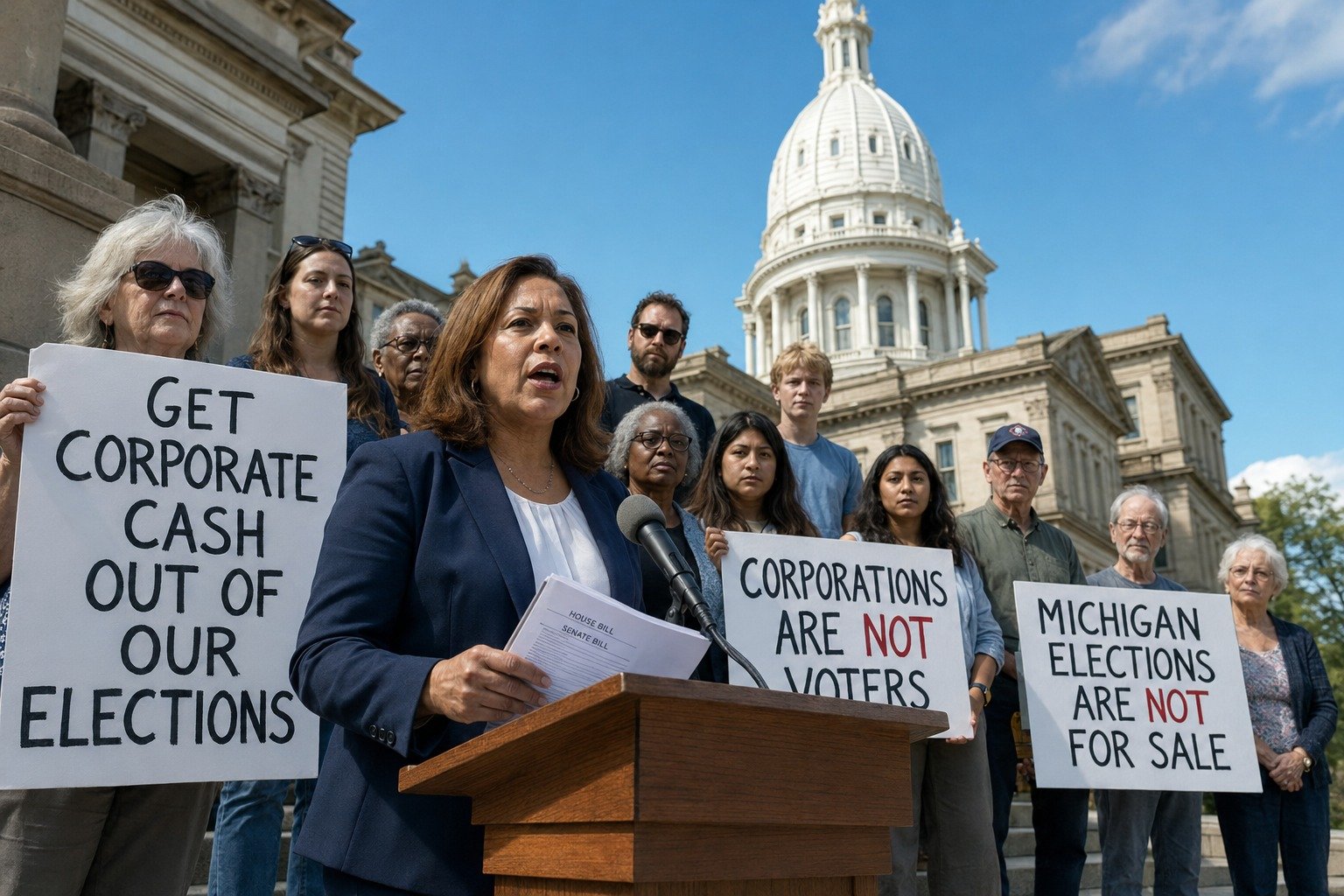
Two Michigan Democrats have introduced a package of bills that would strip every corporation, nonprofit corporation and limited liability company in the state of the power to spend money on elections. State Rep. Betsy Coffia of Traverse City filed House Bills 6216 through 6218 along with House Joint Resolution Z. State Sen. Sean McCann of Kalamazoo filed the Senate companions, Senate Bills 1085 through 1087 and Senate Joint Resolution L. McCann’s office announced the package on July 6, and Michigan Advance reported on it July 8.
The bills have been introduced. They have not passed. There has been no committee hearing and no floor vote, and nothing about their passage is a given.
What the Bills Would Actually Do
The operative language is blunt. The package would deny business corporations, nonprofit corporations and LLCs “any power to pay, contribute, or expend money or anything of value in support of, or in opposition to, a candidate, political party, political committee, or ballot question.”
That covers more than the obvious campaign check. It reaches party spending, political committees, and the ballot-question fights where corporate money has quietly become decisive in state after state. If enacted, a corporation chartered in Michigan would simply not possess the legal capacity to write that check in the first place.
The Legal Theory: Going Around Citizens United, Not Through It
This is the part that makes the package unusual, and it is worth being precise about it. The bills do not overturn Citizens United v. FEC, the 2010 Supreme Court decision that held corporate independent political spending is protected expression. A state legislature cannot overturn a Supreme Court ruling, and these bills do not pretend to.
Instead they lean on a different power the state does have: the power to create corporations in the first place. A corporation is not a natural person. It is a legal entity that exists because a state charters it and grants it a defined set of powers — to hold property, to sue and be sued, to enter contracts. The theory behind this package is that a state that grants those powers can decline to grant one of them. If the power to spend money on elections was never handed to the corporation, the argument goes, there is no corporate right being abridged.
Whether courts accept that reasoning is an entirely open question. It has not been tested at the Supreme Court, and any state that enacts a law like this should expect to defend it.
The Constitutional Amendment Route
The two joint resolutions — House Joint Resolution Z and Senate Joint Resolution L — are the heaviest lift in the package. They would write the change directly into the Michigan Constitution rather than leave it in statute, which would make it far harder to repeal or erode later.
That path is deliberately difficult. A joint resolution requires a two-thirds vote in both chambers of the Legislature. Only then does it go to Michigan voters for ratification at the ballot box. In other words, even in the best case for the sponsors, this does not become part of the state constitution without Michigan voters approving it themselves.
The Wall in Front of It
Michigan’s House is controlled by Republicans. A two-thirds threshold is steep in any chamber; it is steeper when the majority has shown no appetite for the underlying idea. The realistic near-term question is not whether this package becomes law, but whether it gets a committee hearing at all.
Michigan is not doing this alone. McCann has pointed to similar bills filed in California, Georgia, Iowa, Missouri and Virginia, and to Hawaii, where similar legislation was recently signed into law. That is the strategic point of a package like this even when it stalls: it builds a record, it forces legislators to take a position, and it moves the state-chartering theory closer to the test case its supporters want.
What This Means for Michigan Voters
Every dollar a corporation spends to support or oppose a candidate or ballot question is a dollar spent by an entity that cannot vote, cannot be drafted, and does not live in any district. Michiganders competing with that money for their lawmakers’ attention have been told for sixteen years that Citizens United settled the matter. This package is a test of whether that is actually true — or whether a state that hands out corporate charters can attach conditions to them.
For now, nothing has changed. The bills sit where they were filed, waiting to see whether anyone in the majority will give them a hearing.
Stay informed on the stories that matter most. Follow Your Daily Updates on Facebook and bookmark yourdailyupdates.news for breaking news and analysis.