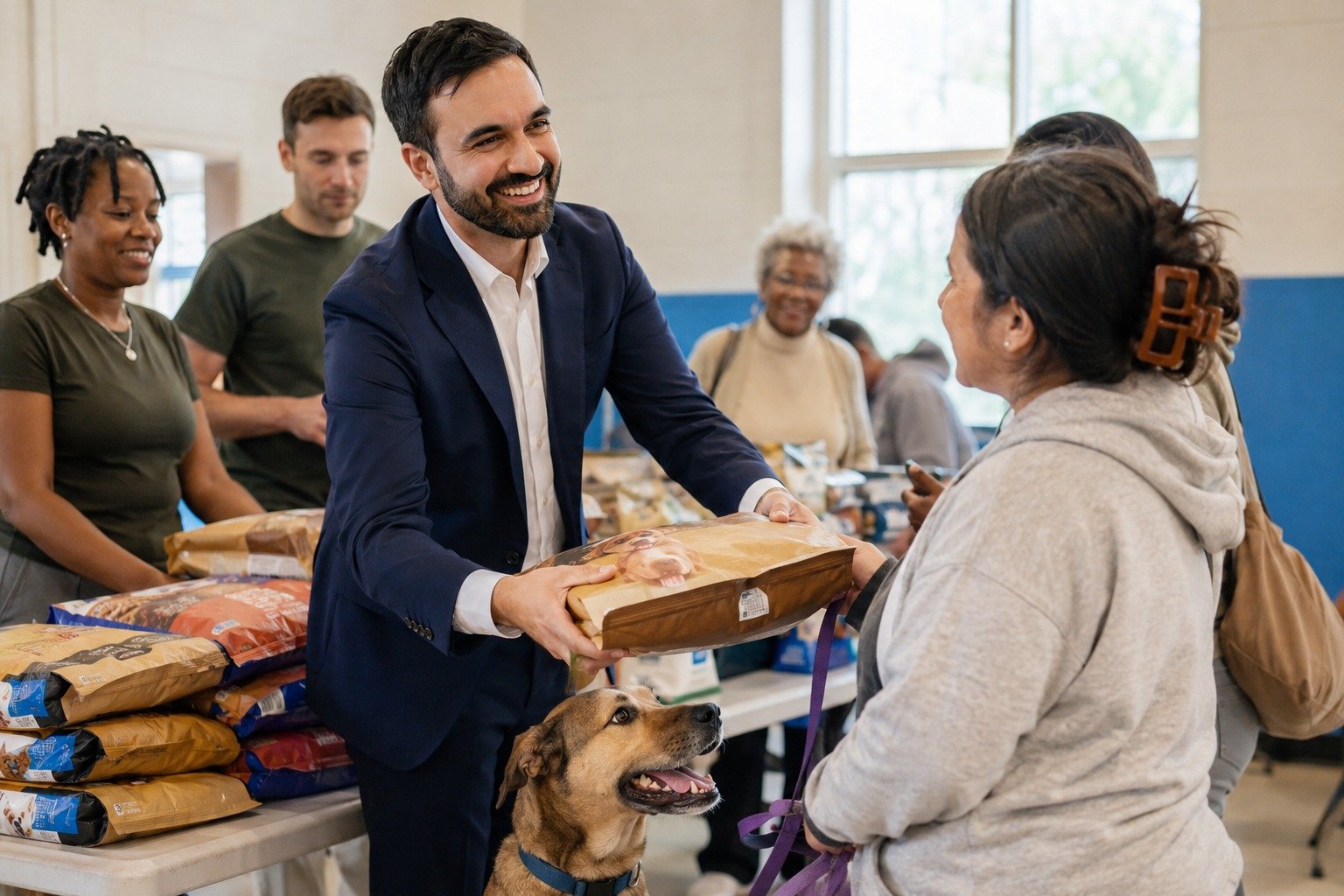
For the first time in its history, New York City is putting real money behind a promise to keep families and their pets together. Mayor Zohran Mamdani’s administration has funded the city’s first-ever pet food pantry program, a modest but historic line item tucked into the FY2027 budget that animal-welfare advocates have been fighting for over years.
The budget sets aside $750,000 specifically to help pet owners who can no longer afford to feed their animals, plus another $750,000 for affordable spay and neuter services. That is $1.5 million in total, dedicated to a problem that most municipal budgets across the country have simply ignored for decades. It is not a large sum in the context of a city budget measured in the tens of billions, but it represents something that did not exist before: a dedicated, recurring commitment to the idea that no New Yorker should have to give up a beloved pet because money got tight.
Why a pet food pantry matters
To understand why advocates pushed so hard for this, you have to look inside the city’s animal shelters. They are packed, and a growing share of the animals inside them were not abandoned by people who stopped caring. They were surrendered by owners who loved them deeply but simply could not afford food or a basic veterinary visit anymore. Rising rents, rising grocery bills, and stagnant wages have forced heartbreaking choices on thousands of households, and pets are often the ones who pay the price.
A pet food pantry is a direct, practical answer to that crisis. The logic is simple: help people cover the cost of feeding their animals, and fewer of those animals end up caged in an overcrowded shelter or, in the worst cases, euthanized. Keeping a pet in a loving home is not only more humane, it is also far cheaper than housing, feeding, and caring for that same animal after a surrender. Every family kept together is one less strain on a shelter system already stretched to its limits.
A first step, not the finish line
The push came from advocates at Voters for Animal Rights and the nonprofit Flatbush Cats, who laid out a full policy plan and asked the city for roughly $15.3 million to seriously tackle the pet affordability crisis. Measured against that request, this first commitment is a fraction of what they wanted. Supporters are candid about that. This is a real start, they say, not the finish line.
But there is a strong case that this is exactly how lasting programs are built. Going from zero dedicated dollars to a funded, first-of-its-kind initiative is the hardest step to take. Once a line item exists in the budget, it becomes something that can be defended, expanded, and pointed to in future years. Advocates have seen this pattern before with other social programs that started small and grew as they proved their worth.
The debate now is whether $1.5 million is enough for a city the size of New York, home to millions of pets and pet owners. Critics of the smaller figure argue that a bigger investment up front would actually save the city money down the line by keeping far more animals out of overloaded shelters in the first place. Others counter that starting with a manageable, well-run pilot is the responsible way to prove the model works before scaling it up.
Either way, New York has drawn a line it never drew before. A pet food pantry is no longer just an idea championed by volunteers and rescue groups. It is now, for the first time, a funded priority of the nation’s largest city, and other cities watching the experiment may soon face the same question for their own residents and their animals.