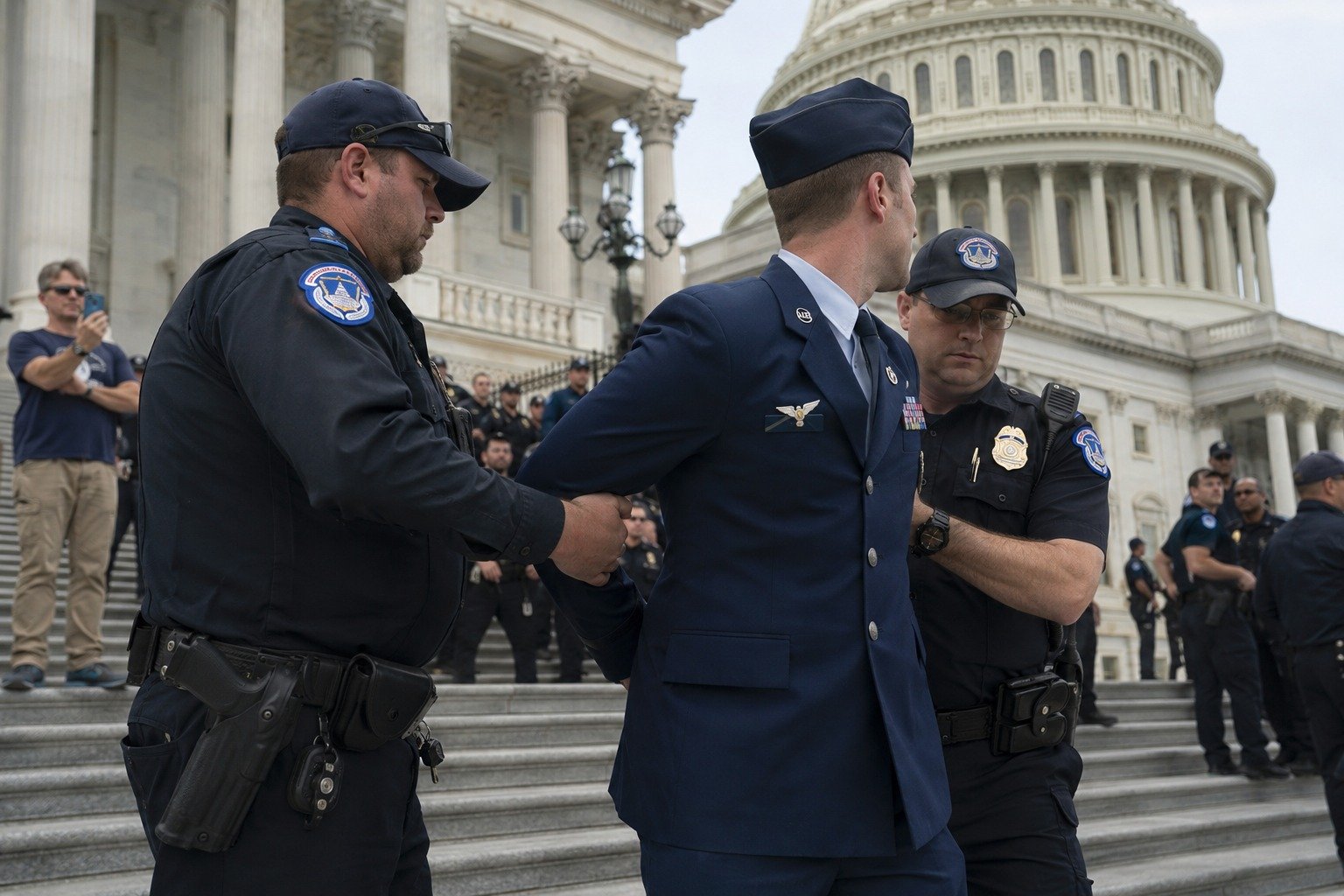
He didn’t throw a punch. He didn’t try to breach a door. An active-duty U.S. Air Force major stood on the steps of the United States Capitol in full uniform, refused a police order to move, and was arrested — a quiet act of defiance at the very seat of American government.
Maj. Jason Watson was taken into custody on the Capitol steps around July 1, 2026, during a demonstration calling for President Donald Trump’s impeachment. According to police, he was arrested for an unlawful demonstration under the District of Columbia code — the charge of “crowding, obstructing, and incommoding” — after he ignored repeated orders to clear the area. He was not accused of any violent act.
What Happened on the Steps
The scene was striking in its simplicity: a service member in dress uniform, hands secured behind his back, escorted away by Capitol Police as onlookers watched. There was no melee, no property damage, no charge of assault. The arrest stemmed entirely from Watson’s refusal to leave a restricted area after officers directed the crowd to disperse — a routine enforcement matter under D.C. law that governs demonstrations at the Capitol.
The “crowding, obstructing, and incommoding” statute is a misdemeanor frequently used to clear demonstrators from Capitol grounds. It is not a felony, and it is a world away from the charges brought against those accused of violence at the building. Watson, by every available account, was arrested for standing his ground and speaking — not for harming anyone.
The Uniform Raises the Stakes
What sets this arrest apart is the uniform itself. Members of the U.S. armed forces are barred from taking part in partisan political activity while in uniform. The rule is meant to keep the military out of politics and to prevent any impression that the armed forces are endorsing a candidate, party, or cause. Wearing the uniform to a demonstration calling for a president’s impeachment crosses that line on its own.
That means Watson faces a potential reckoning that has nothing to do with the D.C. charge. Regardless of how the arrest is resolved in court, the decision to appear in uniform at a partisan protest can carry consequences within the military justice system. Watson, an officer, would have understood that risk before he ever set foot on the steps.
A Divided Reaction
Supporters see a service member willing to put his career, his rank, and his freedom on the line for a political conviction he holds deeply. To them, the image of a uniformed officer accepting arrest is a powerful statement about conscience and the cost of speaking out.
Critics counter that the uniform should never appear at a partisan protest, no matter the cause. The rules exist, they argue, precisely to keep the military neutral — and they apply to everyone equally, regardless of whether one agrees with the message. Bend them for one cause, the argument goes, and they mean nothing for the next.
What This Means for Americans
The case sits at the intersection of two principles Americans hold dear: the right to speak and the tradition of a military that stays out of politics. It forces a hard question about where individual conscience ends and institutional rules begin — and whether a person in uniform gives up a measure of their political voice by putting it on. However it resolves, it is a reminder that the freedom to protest and the responsibility that comes with public office are not always easy to hold at once.
Stay informed on the stories that matter most. Follow Your Daily Updates on Facebook and bookmark yourdailyupdates.news for breaking news and analysis.