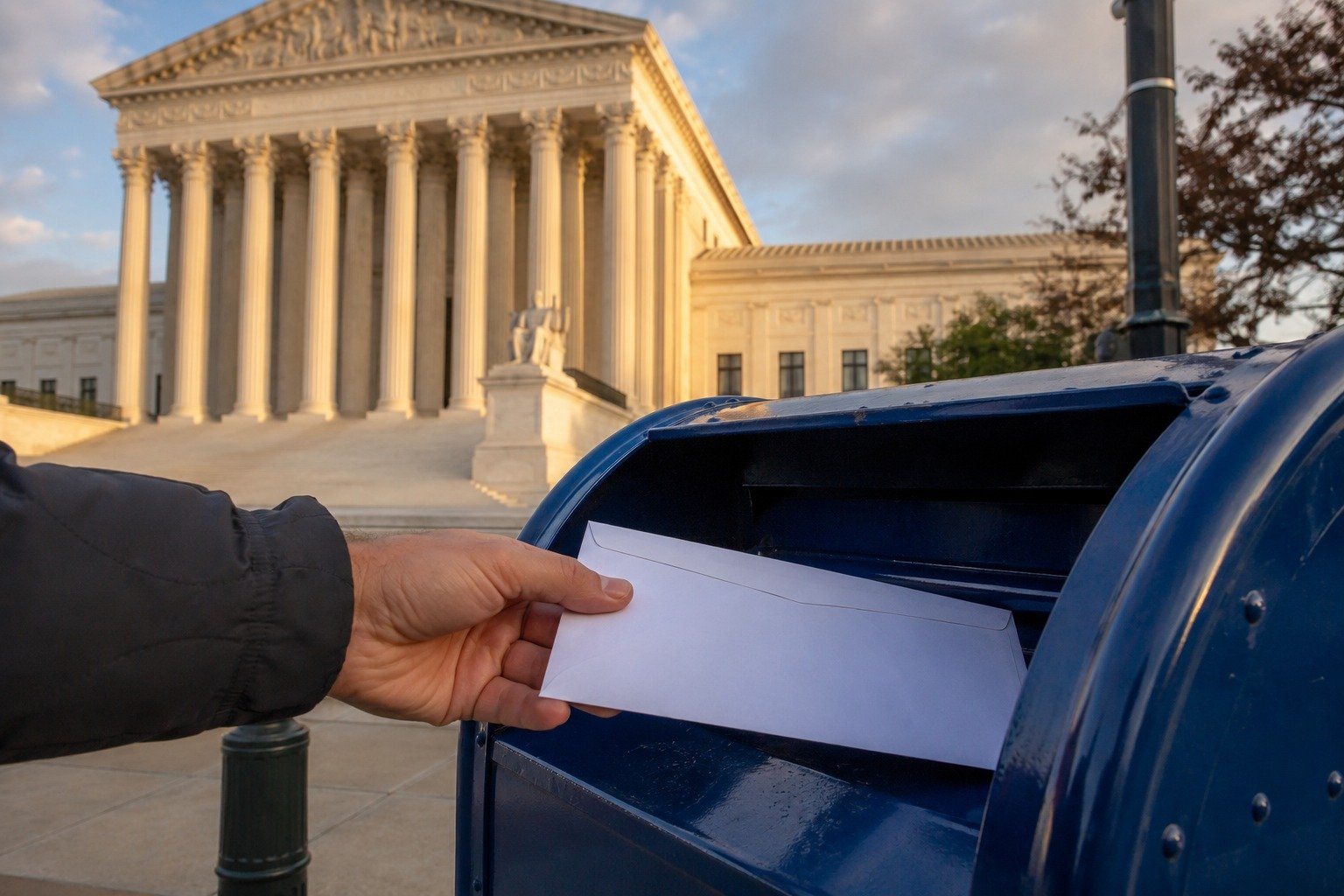
The Supreme Court has handed voting-rights advocates a significant win. In a 5-4 decision issued on June 29, 2026, the justices upheld a Mississippi law that allows election officials to count mail-in ballots as long as they are postmarked by Election Day and arrive within five days afterward. The ruling rejected a challenge brought by the Republican National Committee, which had asked the Court to invalidate state grace periods for late-arriving ballots.
The case, known as Watson v. RNC, centered on whether states have the authority to keep counting ballots that voters mailed on time but that the postal system delivered a few days after Election Day. The RNC argued that federal law sets a single national Election Day and that any ballot arriving afterward should not be counted, regardless of when it was sent. The justices disagreed.
One of the most closely watched aspects of the decision was the lineup of justices in the majority. Justice Amy Coney Barrett wrote the majority opinion, and she was joined by Chief Justice John Roberts along with the Court’s three liberal justices – Sonia Sotomayor, Elena Kagan, and Ketanji Brown Jackson. That cross-ideological coalition surprised many observers who had expected the Court’s conservative majority to side with the RNC.
What the ruling actually does
It is important to be precise about the scope of the decision. The ruling does not require every state to count late-arriving ballots. Instead, it preserves the ability of states that already have grace periods to keep using them. In practical terms, the decision protects the status quo in the roughly one-third of states that permit ballots postmarked by Election Day to be counted if they arrive within a defined window.
These grace periods exist for practical reasons. Mail does not always move quickly or predictably. Voters who cast their ballots on time can still see them delayed by postal backlogs, rural delivery routes, or the sheer volume of election mail. Grace periods are designed to ensure that a voter is not disenfranchised simply because the Postal Service took an extra day or two to deliver an envelope that was dropped in the mail on schedule.
Among the groups most affected are military service members stationed overseas, Americans living abroad, and voters in rural areas where mail can take longer to reach election offices. For these voters, a hard Election Day cutoff could mean that a properly and punctually cast ballot never gets counted.
The challenge and the response
The RNC’s lawsuit was part of a broader, years-long effort to tighten the rules around when and how ballots can be counted. Supporters of a strict Election Day deadline argue that it provides certainty and speeds up the reporting of results. Critics counter that such a cutoff would throw out legally cast ballots on a technicality, punishing voters for delays entirely outside their control.
By declining to strike down Mississippi’s law, the Court left those grace-period rules intact and signaled that states retain meaningful authority to structure their own election administration within constitutional bounds. Voting-rights organizations described the outcome as a critical safeguard against efforts to invalidate ballots that were mailed on time.
Why the coalition matters
Justice Barrett’s authorship of the majority opinion, joined by both Chief Justice Roberts and the three liberal justices, underscored that the question was not a straightforward partisan divide. The 5-4 split does not map neatly onto the Court’s usual ideological lines, and the decision suggests that at least some members of the conservative majority were unpersuaded that federal law demands a uniform, no-exceptions Election Day cutoff.
The ruling was confirmed and reported by SCOTUSblog, NPR, PBS, and The Washington Post. For now, the bottom line is straightforward: in states that allow it, a ballot mailed on time but delivered a little late still counts.
The decision lands at a moment of heightened scrutiny over election rules across the country, and it is likely to shape how future challenges to ballot-counting procedures are argued. But the immediate effect is clear – the grace periods that dozens of states rely on to protect on-time voters remain firmly in place.