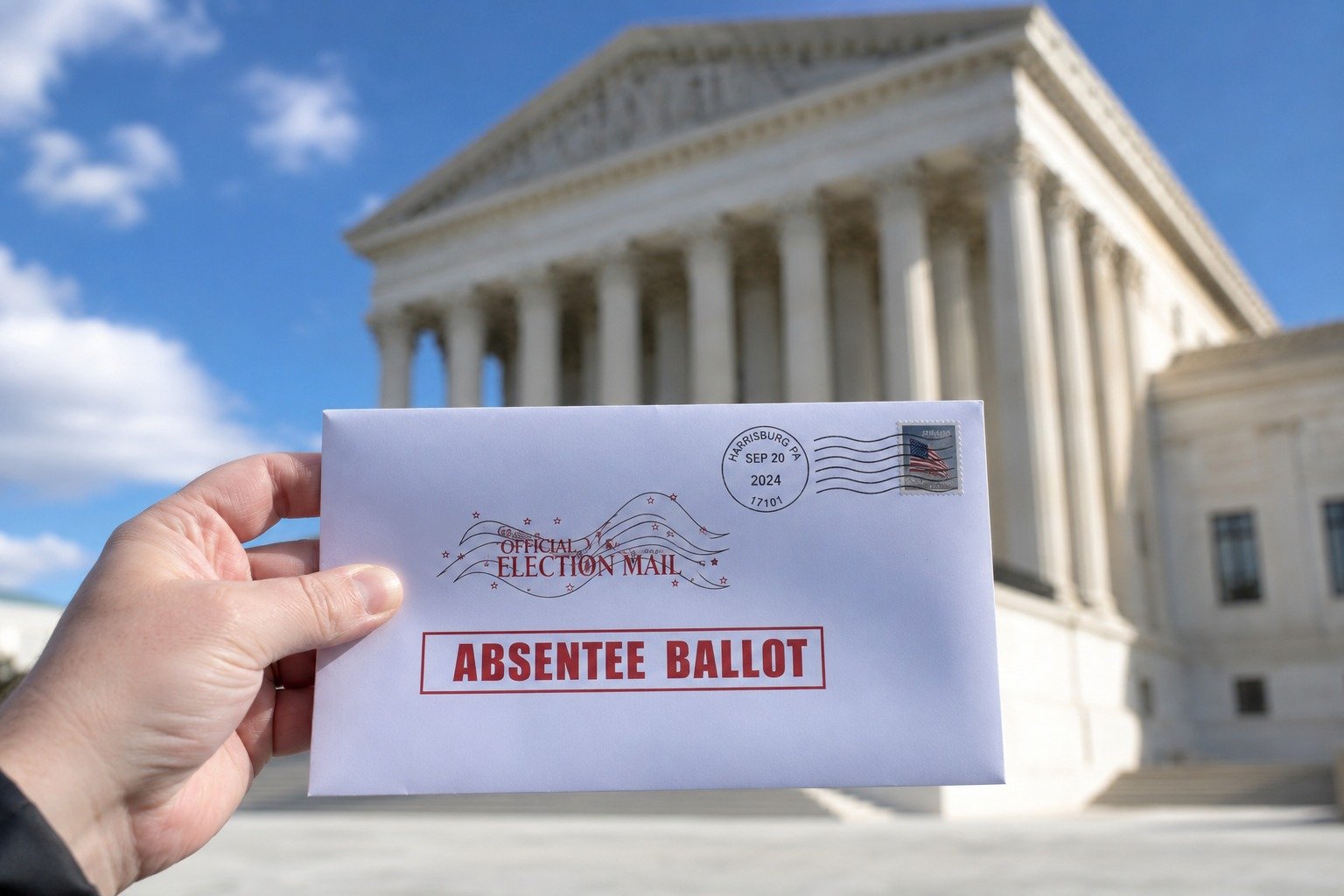
The right to have your vote counted survived a significant test at the U.S. Supreme Court this week. In a closely divided 5-4 decision handed down on June 29, 2026, the justices upheld a Mississippi law that allows mail-in ballots postmarked by Election Day to be counted as long as they arrive within five days. The ruling rejected an effort by the Republican National Committee, backed by the Trump administration, to require that every ballot be physically in election officials’ hands by Election Day itself.
The case, Watson v. Republican National Committee, centered on whether federal law sets a hard Election Day deadline for the receipt of ballots, or whether states retain the authority to count ballots that voters mail on time but that are delayed in transit. The RNC argued that the federal statutes establishing a uniform Election Day implicitly require ballots to be received by that date. A coalition of voting-rights advocates, along with the state of Mississippi, countered that nothing in federal law bars states from accepting timely-postmarked ballots that arrive shortly afterward.
A Cross-Ideological Majority
The composition of the majority drew immediate attention. Justice Amy Coney Barrett wrote the Court’s opinion, joined by Chief Justice John Roberts and the Court’s three liberal justices. Justices Samuel Alito, Clarence Thomas, Neil Gorsuch, and Brett Kavanaugh dissented. The lineup underscored that the question was not a simple partisan split but one that divided the Court’s conservative wing.
Writing for the majority, the Court reasoned that the federal Election Day statutes fix the date by which voters must cast their ballots, not the date by which every ballot must be counted or received. States, the majority concluded, retain longstanding authority to administer the mechanics of elections, including reasonable grace periods that account for the realities of mail delivery.
Why the Ruling Reaches Far Beyond Mississippi
Although the dispute arose from a single state’s law, its practical impact is national. Roughly 29 states currently allow some version of a grace period for ballots that are mailed on time but delayed in transit. These policies vary in length, from one day to more than a week, but share a common purpose: ensuring that a voter who follows the rules and mails a ballot before the deadline is not disenfranchised by circumstances beyond their control, such as slow or backlogged postal service.
Had the RNC prevailed, those grace periods could have been swept away in one stroke, forcing tens of millions of voters to navigate a stricter receipt deadline. The voters most likely to be affected include rural residents served by slower mail routes, military families stationed overseas who depend on international mail, elderly and disabled voters, and anyone whose ballot is caught in a postal delay during a high-volume election period.
The Stakes for Voting Access
Voting-rights organizations welcomed the decision as a meaningful safeguard against ballot-counting rules that, in their view, would have punished voters for delays they did not cause. Mail voting has grown substantially over the past several election cycles, and grace periods have become an increasingly important backstop in states where postal timelines are unpredictable.
Supporters of the RNC’s position maintained that a firm Election Day deadline promotes uniformity and reduces uncertainty in close races. But the majority’s reasoning leaves the door open for states to continue setting their own reasonable windows, preserving a patchwork that reflects local conditions rather than a single national cutoff.
For now, the bottom line is straightforward. A ballot that is mailed on time is a ballot that counts, even if it lands in an election office a few days later. By a one-vote margin, and with an unusual cross-ideological coalition, the Supreme Court left that principle intact for roughly 29 states and the voters who rely on it.