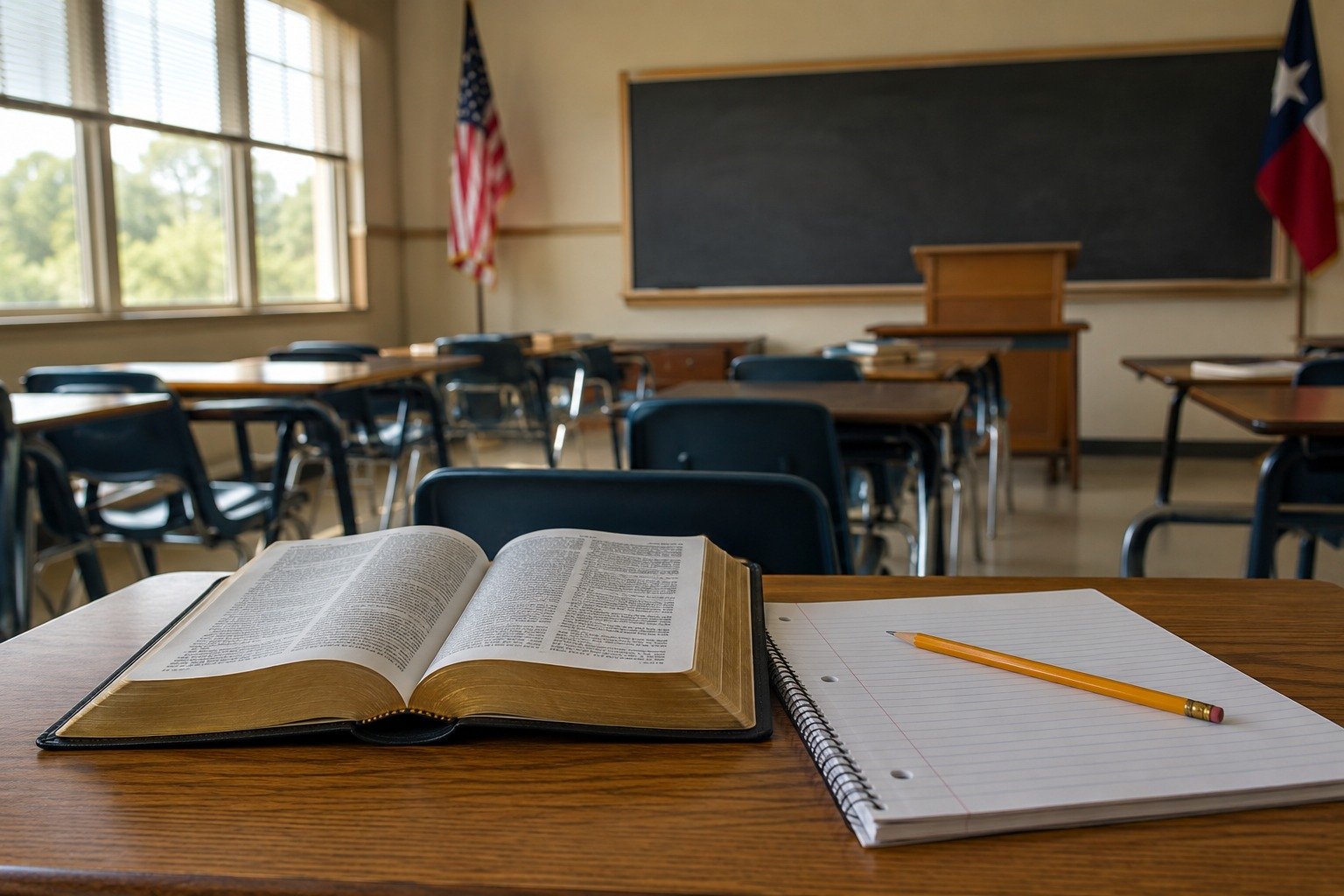
The Texas State Board of Education has voted to put the Bible into the required reading list for the state’s public schools, drawing an immediate line in the long-running fight over religion in taxpayer-funded classrooms.
On June 26, 2026, the board approved a reading list of roughly 200 texts intended for more than 5 million public school students. Woven into that list are well-known Bible passages: David and Goliath, Daniel in the lion’s den, the Sermon on the Mount, and the parable of the prodigal son. They are included not as part of a comparative-religion survey, but as assigned reading. The vote was confirmed by national outlets including CNN and PBS.
What the Board Actually Approved
It is important to be precise about the timeline, because the headline can make this sound like it is happening in classrooms tomorrow. It is not. The mandate is scheduled to take effect in 2030. That leaves years of rulemaking, district-level implementation, almost certain legal challenges, and sustained public pressure between now and the day any student is handed one of these passages as homework.
Still, the vote itself is the signal. A state education board has decided, on the record, that scripture belongs in the curriculum for every child in the system — regardless of that child’s faith or whether the family practices any faith at all. Once a body like the Texas State Board of Education establishes that principle, it tends to shape what comes next.
Why Church and State Are at the Center
Public schools in Texas serve a sprawling, diverse population: Christian students, Muslim students, Jewish students, Hindu students, and students from no religious tradition whatsoever. The First Amendment’s Establishment Clause exists in large part to keep the government out of the business of deciding which holy book those children should read.
Supporters of the new reading list frame it as a matter of cultural and literary literacy, arguing that biblical stories are foundational to Western literature and history and that students should recognize the references. Critics see something narrower and more pointed: a state government endorsing one religion’s sacred text inside classrooms that every family is required by law to fund and, in most cases, to attend.
A Familiar Fight in the Courts
This is not the first time Texas has tested the boundary between scripture and public education, and the courts have a long record of pushing back on state-sponsored religion in schools. From mandated prayer to posted religious displays, federal courts have repeatedly held that public schools cannot promote a particular faith. Legal observers expect the 2030 effective date to give opponents ample runway to challenge the policy before it ever reaches a student’s desk.
The practical questions are still unanswered: How will the passages be taught? Will teachers be required to present them devotionally, historically, or literarily? What happens when a family objects? Each of those questions is a potential flashpoint, and each could end up in front of a judge.
What This Means for Texas Families
For parents, the stakes are concrete. The decision touches what their children are taught, who decides it, and whether a public institution should be in the position of assigning religious texts to kids of every background. For the millions of Texas families who send their children to public schools, the message from the board is that this is the direction the state intends to go — and the time to weigh in is now, not in 2030.
Stay informed on the stories that matter most. Follow Your Daily Updates on Facebook and bookmark yourdailyupdates.news for breaking news and analysis.