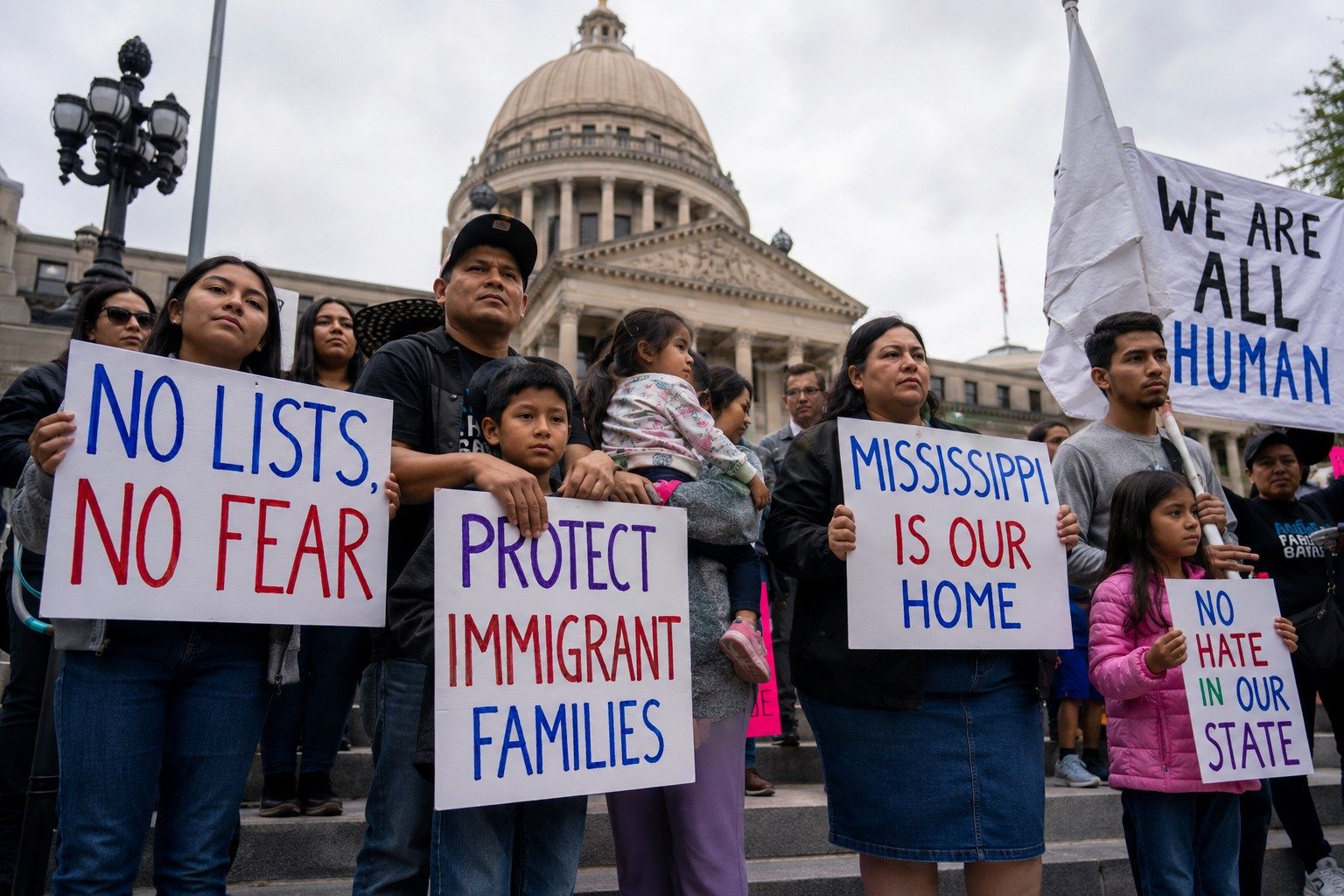
Starting Wednesday, July 1, Mississippi will have the legal authority to do something immigrant families across the state have feared for years: build a government list of people living there without legal status. A new law taking effect that day authorizes the Mississippi Department of Public Safety to compile the names, home addresses, and countries of origin of undocumented immigrants living anywhere in the state.
In plain terms, the state can now assemble a registry of who these families are, where they live, and where they came from. And immigrant rights advocates say that prospect is alarming.
What the New Law Actually Does
The measure hands the state’s top public safety agency the power to gather and maintain detailed personal information on immigrants believed to be living in Mississippi illegally. That includes full names, residential addresses, and nationality – the kind of granular, identifying data that, once collected in one place, can be searched, sorted, and shared.
Supporters frame the law as a straightforward immigration enforcement tool, arguing the state has a right to know who is living within its borders. But the design of the law – a centralized catalog of a specific, vulnerable population organized by name and location – is what has civil rights groups deeply worried.
Why Advocates Are Sounding the Alarm
Immigrant rights organizations warn that a list like this does not simply sit in a filing cabinet. It becomes a tool. Advocates describe it as a roadmap for surveillance, a shortcut for racial and ethnic profiling, and an open door to harassment – whether that harassment comes from the state itself or from anyone who manages to gain access to the records.
The central, unanswered questions are about access and accountability. Who, exactly, will be allowed to see the list? How will the information be used, and by which agencies? What safeguards, if any, will prevent the data from being leaked, misused, or weaponized against the very people it catalogs? As of the law’s effective date, those answers remain far from clear.
The Human Stakes
For families across Mississippi, the fear is not abstract. It is personal and immediate. Parents worry about being separated from their children. Workers fear that a knock at the door could be coming. Entire communities – many of them longtime residents, many of them raising U.S.-citizen children – are now left wondering whether their own home addresses have landed on a government list.
That anxiety reaches beyond those without legal status. Mixed-status households, where some members are citizens or legal residents and others are not, are common. A registry that targets one member can cast a shadow over an entire family, including children who were born in the United States and know no other home.
What This Means for Americans
The debate playing out in Mississippi is bigger than one state. When a government begins compiling lists of residents by name, address, and national origin, it raises questions that touch on privacy, due process, and the limits of state power that affect everyone – not just immigrants. Critics see in it an echo of older, more dangerous practices: a government cataloging a population it deems undesirable. The protections that stand between these families and those who might use their information against them will determine whether this is enforcement or something far more troubling.
Stay informed on the stories that matter most. Follow Your Daily Updates on Facebook and bookmark yourdailyupdates.news for breaking news and analysis.