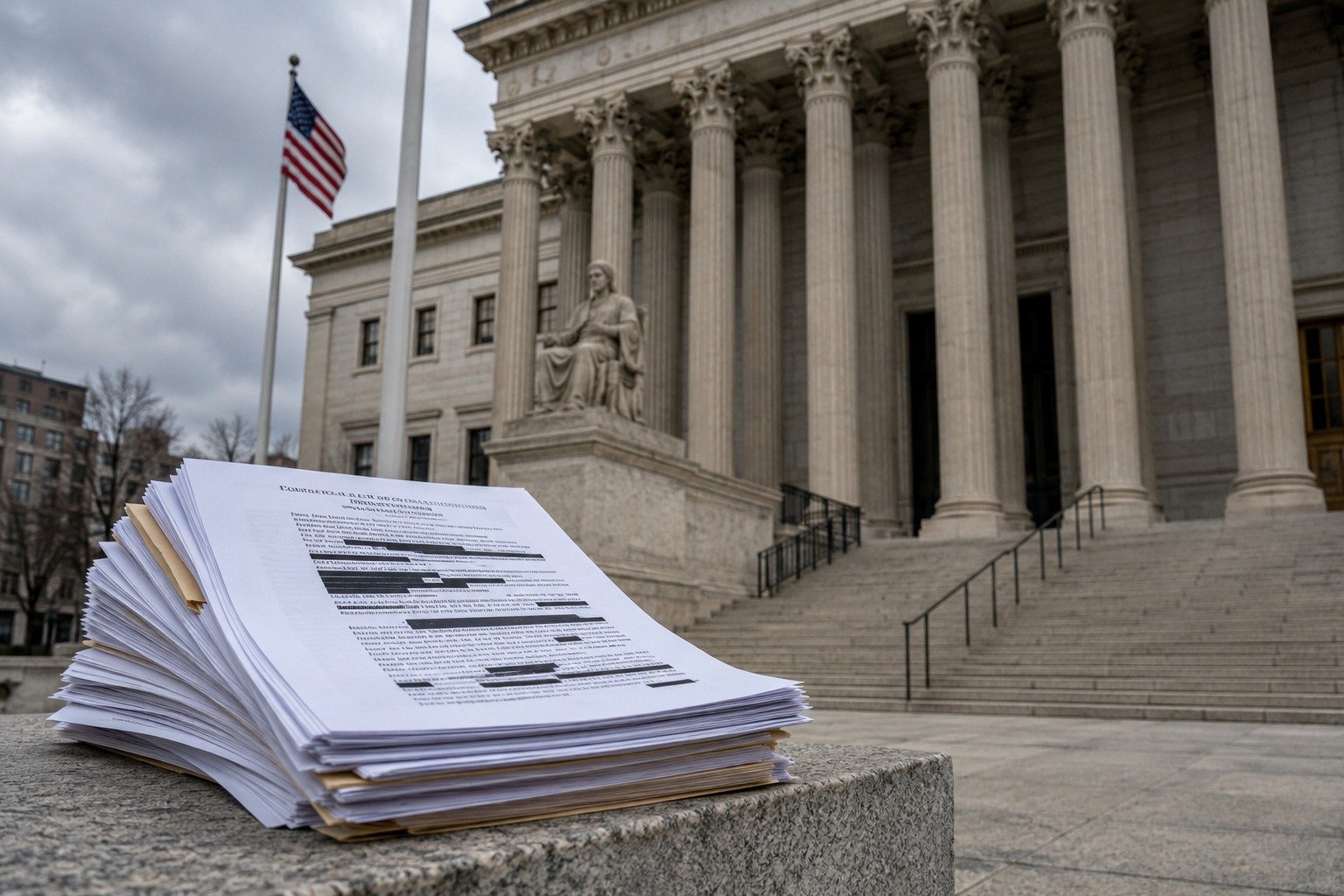
A federal judge has given the Justice Department a hard deadline and a simple choice: hand over less-redacted versions of key Jeffrey Epstein documents by Thursday, July 2, 2026, or explain in writing the justification for every single redaction it wants to keep. U.S. District Judge Emmet Sullivan issued the order in late June, putting the government on the clock over files the public has been promised for years.
What the Judge Ordered
The order is specific rather than sweeping. It targets eight emails in which the sender or recipient was blacked out, a draft indictment of Epstein in which the names of potential co-conspirators were obscured, and a 2019 email that referenced several of those same names. For each of these, the Justice Department must either produce a less-redacted version or file a written explanation defending the blackout.
Sullivan went a step further. He also ordered the department to produce a full log accounting for every redaction it has made to the Epstein files it has already released publicly. That kind of redaction log is not a novel demand – it is a transparency step the law already contemplates – but it forces the government to show its work rather than simply asserting that material must stay hidden.
How the Case Got Here
The ruling stems from a lawsuit filed in April 2026 by journalist Katie Phang, who argued that the Justice Department had failed to comply with the Epstein Files Transparency Act. That law was designed to pry loose records connected to one of the most scrutinized criminal cases in recent memory, and the suit contends the government leaned too heavily on redactions to keep names and details out of public view.
Sullivan’s order is, in effect, a preliminary check on that practice. Instead of accepting the redactions at face value, the court is requiring the department to either lift them or defend each one individually and on the record. A Justice Department spokesperson said the agency plans to appeal.
Why It Matters
For years, the story around the Epstein files has followed a familiar rhythm: officials promise disclosure, and what actually surfaces is page after page with names and key passages blacked out. This order pushes back on that cycle. By demanding a written justification for every blackout, the court shifts the burden onto the government to prove that secrecy is warranted – not on the public to prove it is not.
The redactions at issue are not trivial details. They include the names of potential co-conspirators in a draft indictment and the identities behind a set of emails. Whether those names stay hidden or come to light is exactly the kind of question transparency law is meant to answer.
What This Means for Americans
At its core, this is a fight about the public’s right to know what its own government is keeping secret – and on whose behalf. Transparency is not supposed to depend on whether the powerful find disclosure convenient. When a court forces an agency to either release records or explain each blackout in writing, it restores a basic principle: the people who paid for these investigations are entitled to see the results, with secrecy as the exception, not the default.
The question now is whether the Justice Department complies by the July 2 deadline, or fights to keep the names in the dark.
Stay informed on the stories that matter most. Follow Your Daily Updates on Facebook and bookmark yourdailyupdates.news for breaking news and analysis.