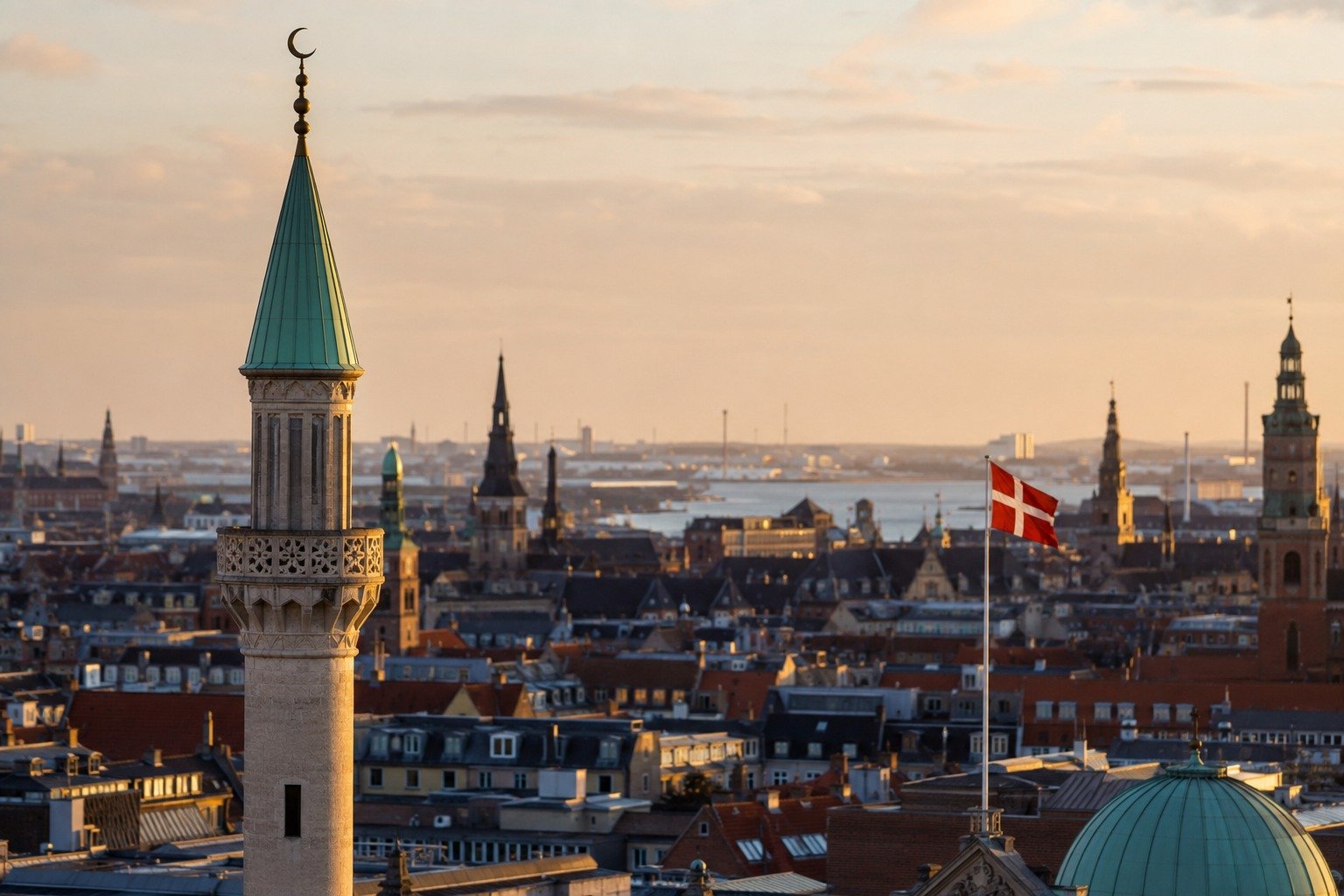
Denmark’s center-left government has reopened one of the most divisive questions in the country’s modern political life: whether the Islamic call to prayer, known as the adhan, can be legally banned from being broadcast in public spaces nationwide. Immigration and Integration Minister Morten Bodskov, a member of the governing Social Democrats, confirmed this week that he is restarting an official investigation into whether such a ban would even be lawful under Danish law.
It is important to be precise about what this actually is. This is not a passed law. It is not an enacted ban. It is a legal review and a policy proposal – an inquiry into whether a nationwide restriction could survive Denmark’s own constitutional protections. In fact, it is the third time a Danish minister has gone down this road since 2020, and neither of the two previous attempts ever reached the parliamentary stage.
What the minister said
Bodskov did not mince words. He stated bluntly that the call to prayer “has no place in Denmark,” framing the issue around national identity and the country’s public soundscape. Supporters of the proposed restriction argue it would defend Denmark’s secular public space. The government’s review, announced on June 25-26, 2026, will examine whether a national ban can be introduced without violating constitutional guarantees of religious worship.
Some Danish municipalities, including the capital Copenhagen, already restrict outdoor religious broadcasts through local noise ordinances. Those existing rules are content-neutral on paper – they govern sound levels, not specific faiths. A nationwide measure aimed explicitly at the adhan would be a categorically different proposition, and that is precisely where the legal and civil-rights questions become sharp.
The civil-liberties stakes
Denmark’s constitution protects freedom of religion and worship. Civil-liberties advocates warn that a ban singling out one faith’s practice – while leaving, for example, the ringing of church bells untouched – runs directly into that protection. Critics argue the proposal targets Muslims specifically and treats a religious minority as a problem to be managed rather than as citizens entitled to equal treatment under the law.
The concern is not abstract. When a government begins deciding which prayers are allowed to be heard in public, it sets a precedent that reaches far beyond any single community. Religious freedom that applies only to the majority’s faith is not religious freedom at all. The principle at issue – that the state should not police worship based on whether the majority finds it familiar or convenient – is one that protects everyone, regardless of belief.
A recurring political flashpoint
That this is the third such effort since 2020 is telling. Each previous attempt stalled, in part because the legal obstacles are significant and in part because singling out a single religion invites exactly the constitutional challenge now being studied. The fact that a center-left government led by Prime Minister Mette Frederiksen is the one pursuing it underscores how immigration and integration politics in Denmark have shifted across the political spectrum.
For now, the adhan continues to be governed by the same local noise rules that have applied for years. Whether the new review produces a concrete legislative proposal – and whether any such proposal could withstand constitutional scrutiny – remains to be seen. What is clear is that the debate touches something larger than sound levels: it asks what kind of religious pluralism Denmark is willing to protect, and for whom.
The investigation is expected to take months. Until it concludes, the headline-grabbing language about a “ban” should be read for what it is: a proposal and a legal probe, not a settled outcome.