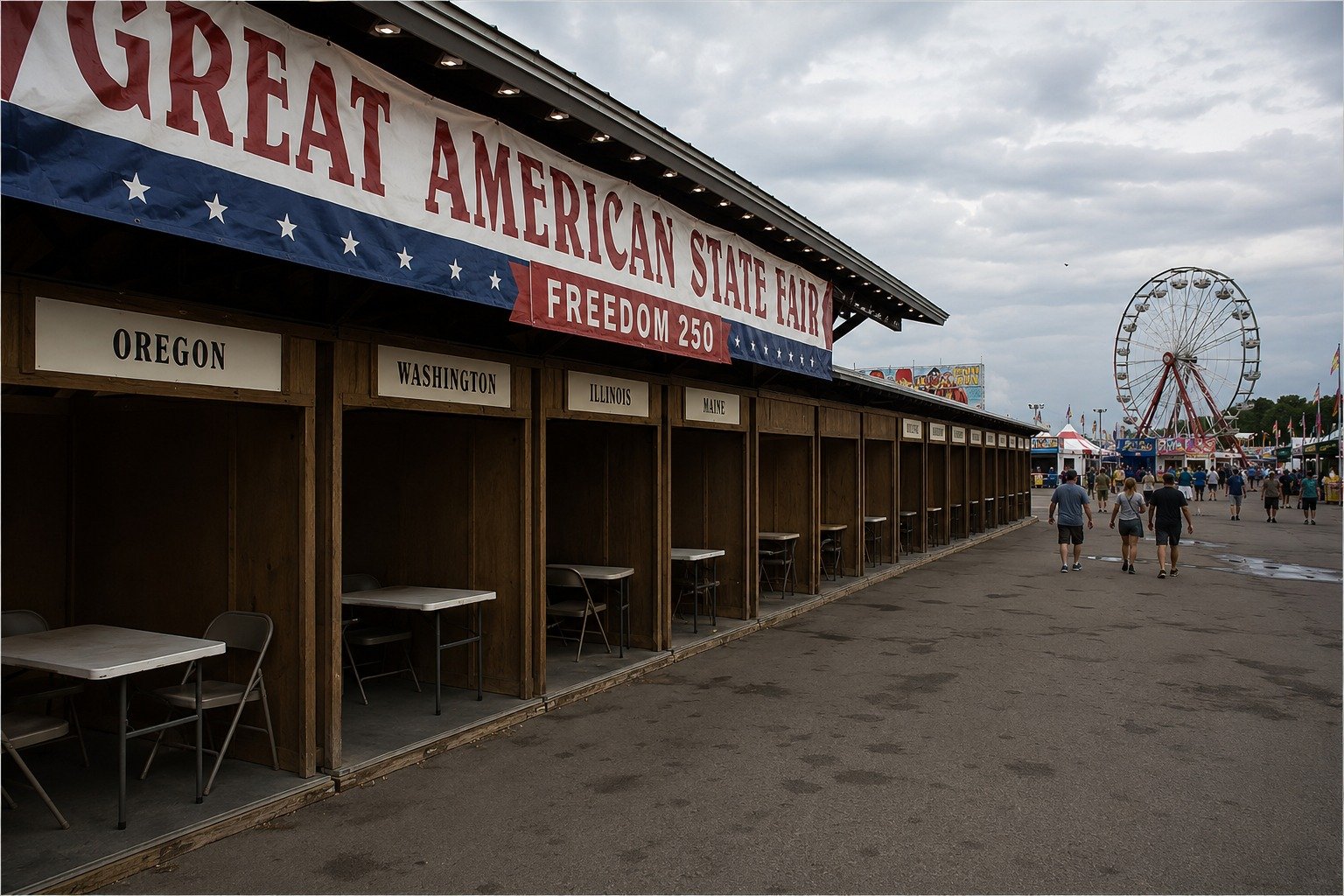
The invitations went out from the White House. The answer, from a growing list of states, is no.
At least seven states have now declined to send official delegations to President Trump’s “Great American State Fair,” the centerpiece event of his Freedom 250 celebration. Oregon, Washington, Massachusetts, Illinois, North Carolina, Maine, and Connecticut have all turned down the request, with Pennsylvania still weighing its decision.
The pattern is impossible to miss: every one of the states that said no is led by a Democratic governor. What the White House framed as a unifying, distinctly American showcase is fast becoming a visible measure of just how divided the country remains heading into the festivities.
Cost and partisanship at the center of the refusals
The reasons the declining states are citing are straightforward: cost and partisanship. With state budgets already stretched thin, several officials questioned why taxpayers should foot the bill to staff, build, and transport a delegation to a federal spectacle tied so closely to the President’s personal brand.
For governors who are already balancing tight fiscal years, the math is hard to justify. Sending an official delegation is not a symbolic gesture alone — it requires staffing, exhibits, travel, and logistics, all paid for out of state coffers. When the event in question is seen as a political celebration rather than a neutral national gathering, the calculation tips quickly toward staying home.
A $68 million price tag
And the cost of the event itself is hard to ignore. The administration funneled roughly $68 million into Freedom 250 to pull the fair together. To the states stepping back, that figure reads less like a national celebration and more like a politically charged production dressed up as patriotism.
Supporters of the fair argue it is meant to mark a milestone moment in the nation’s history and to bring Americans together around shared traditions. But the wave of refusals has reframed the conversation. Instead of a coast-to-coast lineup of state pavilions, organizers are now facing the prospect of conspicuous gaps where some of the country’s largest and most populous states would have stood.
A split-screen celebration
The result is a split-screen image of the event before its gates even open: red-state participation on one side, and a wall of empty booths from blue states on the other. For a celebration billed as a tribute to national unity, the optics cut in the opposite direction.
With Pennsylvania still undecided, the list of holdouts may not be finished growing. If the Keystone State joins the refusals, it would add another major delegation to the absentee column and deepen the divide the fair was supposed to bridge.
For now, the snubs stand as a pointed statement from states that see the Great American State Fair less as a moment of shared pride and more as an expensive, partisan undertaking they would rather not bankroll. Whether the White House can win any of them back before the event begins remains an open question.