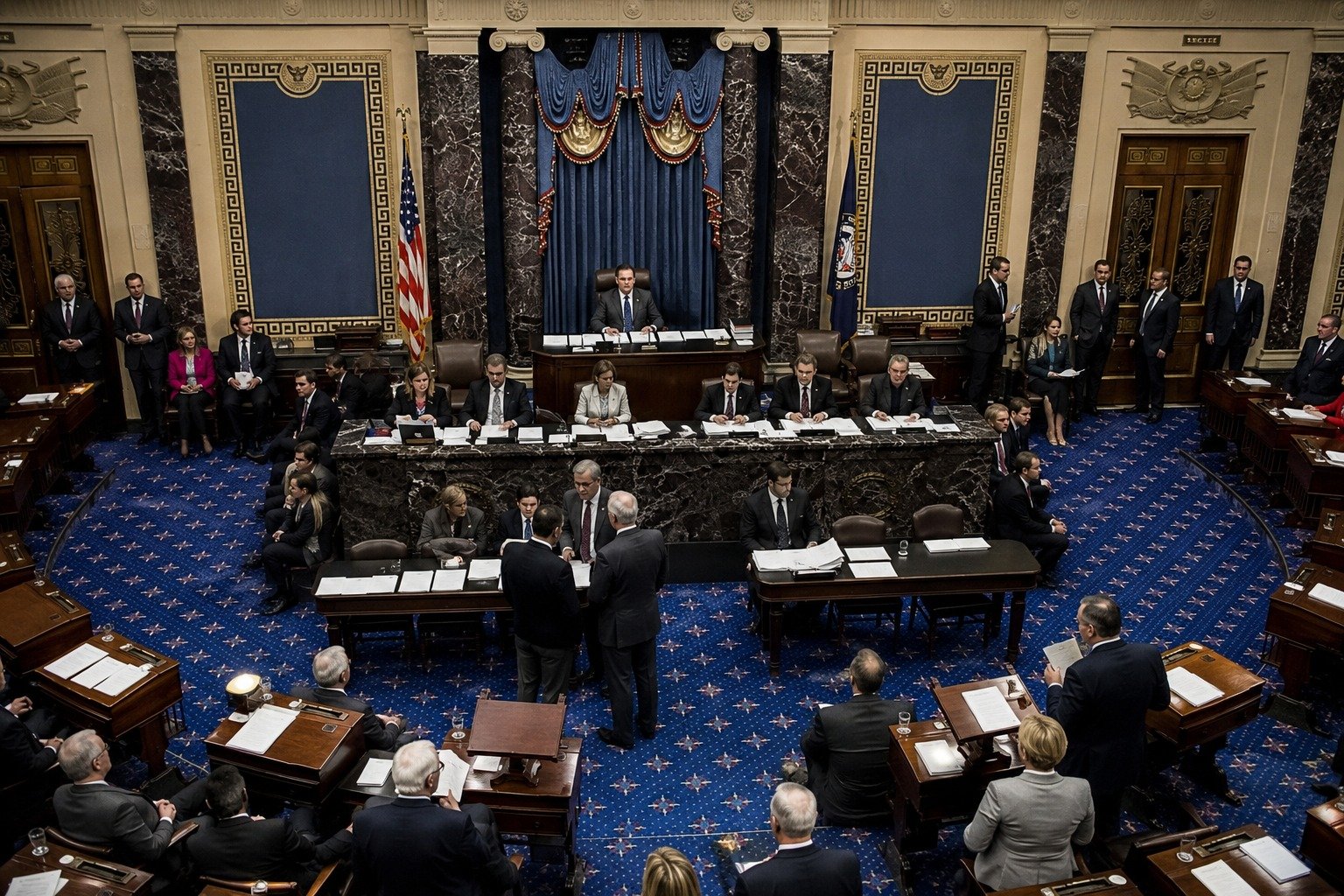
The U.S. Senate voted 50-48 on Monday, June 23, to advance a war powers resolution aimed at limiting the president’s ability to take military action against Iran without congressional approval. In a rare break from party lines, four Republicans crossed the aisle to join every Senate Democrat.
Senators Bill Cassidy of Louisiana, Susan Collins of Maine, Rand Paul of Kentucky, and Lisa Murkowski of Alaska were the four Republicans who voted with Democrats to move the measure forward. In a chamber where party loyalty almost always determines the outcome, their votes turned a routine procedural step into a notable moment of bipartisan pushback on the question of war powers.
What the Resolution Actually Does
It is important to be precise about what this vote does and does not accomplish. The resolution is non-binding. It will not be sent to the White House for the president’s signature, and on its own it does not legally stop, restrict, or override any military decision the executive branch chooses to make. In practical terms, it is a symbolic rebuke – a formal statement of where a majority of the Senate stands – rather than an enforceable check on the war powers the executive already claims.
That distinction matters. A binding war powers resolution, of the kind authorized under the 1973 War Powers Act, can force the removal of U.S. forces from hostilities if it passes both chambers and survives a presidential veto. This measure does not carry that legal weight. What advanced on Monday was the Senate’s expression of principle, not a law that ties the president’s hands.
Why It Still Matters
Even a symbolic vote carries weight in Washington. The Constitution gives Congress – not the president – the power to declare war. For decades, presidents of both parties have stretched that line, ordering airstrikes, deploying troops, and launching operations without a formal vote from the legislative branch. Each time it happens, Congress’s constitutional role erodes a little further.
This resolution is the Senate reminding the country, and itself, that the decision to send Americans into a war is supposed to belong to the people’s elected representatives. The 50-48 margin shows just how divided the chamber remains, but the presence of four Republican votes signals that unease about unchecked executive war-making is not confined to one party.
The Four Republicans Who Crossed Over
Rand Paul has long been one of the Senate’s most consistent voices against foreign military intervention without congressional authorization, a position rooted in his libertarian-leaning views. Susan Collins and Lisa Murkowski are both known for their willingness to break from their party on high-profile votes. Bill Cassidy’s vote adds a fourth Republican to a coalition that, while small, was enough to push the resolution past the 50-vote threshold.
All four are likely to face pressure from within their own party for the vote. Crossing the aisle on a matter tied to the president’s authority is rarely cost-free in today’s political climate.
What This Means for Americans
For ordinary Americans, the deeper issue is about who decides when the country goes to war – and whether that decision should rest with one person or with Congress as a whole. Wars cost lives and tax dollars, and they are fought in the public’s name. A symbolic vote does not bind a president who believes he can act alone, but it does force the question into the open and put senators on the record.
The real test now is whether Monday’s vote is a one-time gesture or the beginning of a more serious effort by Congress to reclaim a power it has spent years giving away.
Stay informed on the stories that matter most. Follow Your Daily Updates on Facebook and bookmark yourdailyupdates.news for breaking news and analysis.