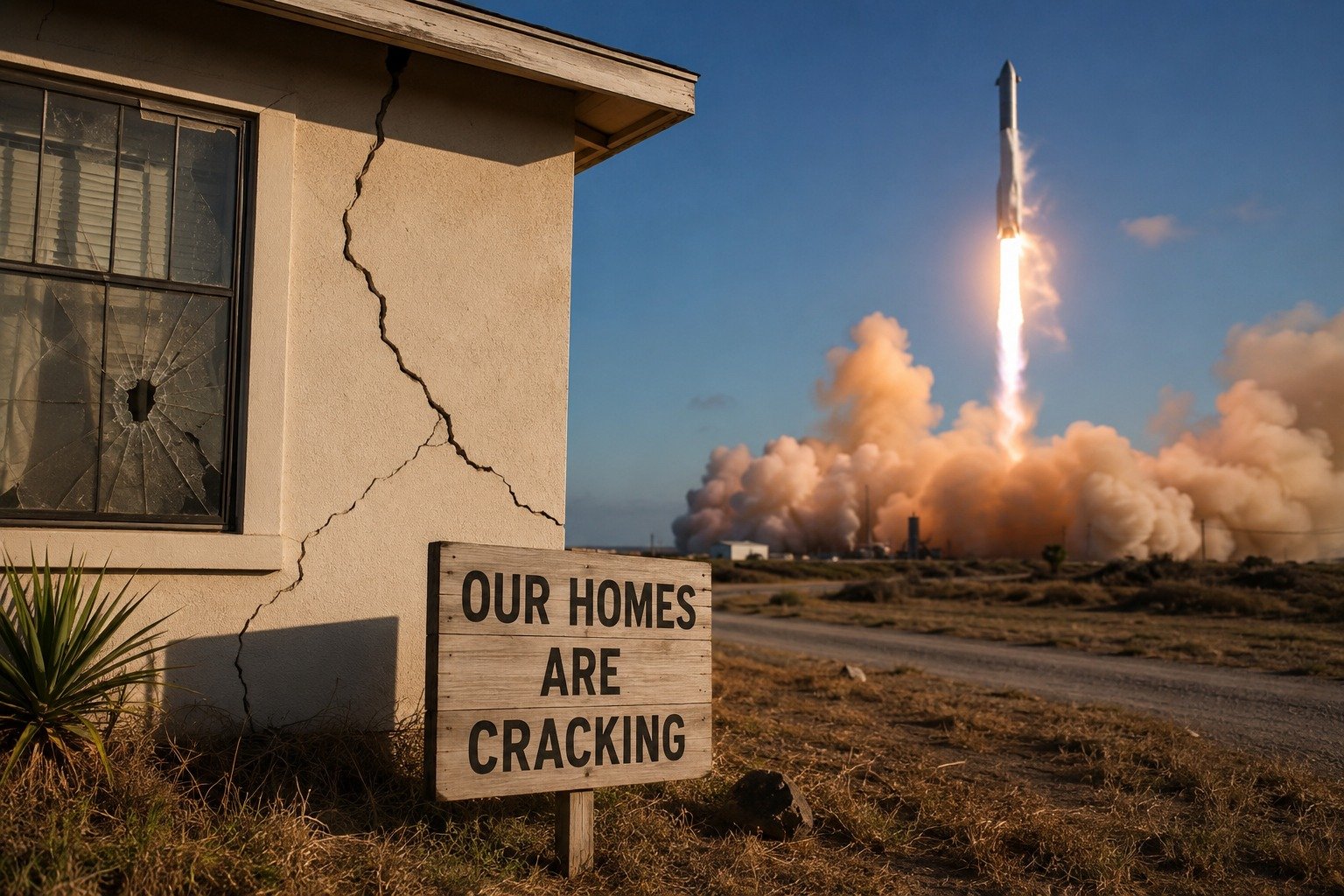
Eighty residents of South Texas have taken Elon Musk’s SpaceX to federal court, alleging that the relentless cadence of rocket launches from the company’s Starbase facility is literally shaking their homes apart. The class-action lawsuit, filed on May 1 in the U.S. District Court for the Southern District of Texas, accuses SpaceX of negligence, gross negligence, and trespass.
The roughly 60 households behind the complaint live in Port Isabel, Laguna Vista, and South Padre Island – small coastal communities that sit within earshot, and shaking distance, of one of the most powerful rocket programs on Earth. According to the suit, repeated Starbase launches have sent sonic booms, vibrations, and overpressure waves rolling through their neighborhoods, allegedly cracking walls, shattering windows, damaging roofs, and breaking the foundations beneath their feet.
A $100,000 crack in the foundation
For one Port Isabel woman, the damage has been catastrophic. She lives less than six miles from the launch pad and says she is now staring down an estimated $100,000 in foundation repairs – more, she says, than her house is even worth. Her story is at the emotional center of a case that pits ordinary homeowners against one of the most valuable private companies in the world.
It is a familiar dynamic in towns that grow up alongside heavy industry: the jobs and prestige arrive first, and the bill for the side effects lands later – usually on the people with the least power to absorb it. The plaintiffs argue they never agreed to have their homes serve as a buffer zone for rocket testing, and that the company has a responsibility to make them whole.
What the lawsuit claims
The complaint centers on 11 rocket tests conducted between April 2023 and October 2025. It cites one October 2024 launch that registered noise levels above 110 decibels – a threshold the plaintiffs say is consistent with the kind of structural damage described throughout the filing. Researchers at Brigham Young University, the suit notes, have found that a single Starship launch can equal four to six of NASA’s most powerful Space Launch System rockets in terms of acoustic energy.
That comparison matters. Starship is not a conventional rocket; it is the largest and most powerful launch vehicle ever built, and each test fires an enormous wall of sound and pressure across the surrounding landscape. The residents allege that energy does not simply dissipate harmlessly over open water – it travels into their living rooms, their walls, and their foundations.
The legal claims are pointed. Negligence alleges SpaceX failed to take reasonable care to prevent foreseeable harm. Gross negligence raises the stakes, suggesting a reckless disregard for the safety of nearby residents. And trespass argues that the booms and vibrations crossing onto private property amount to a physical intrusion the company had no right to inflict.
An allegation, not yet a verdict
It is important to be clear about where this stands. SpaceX has not been found liable. These are allegations in a lawsuit that is only just getting started, and the company will have every opportunity to contest them in court. Lawsuits like this often take years to resolve, and the burden will be on the plaintiffs to prove that the launches – and not ordinary wear, weather, or shifting Gulf Coast soil – caused the damage to their homes.
Still, the case raises questions that extend well beyond these three towns. As commercial spaceflight expands and launch sites multiply near populated areas, communities across the country may find themselves asking the same thing: when a company’s operations damage the homes of the people next door, who is responsible for putting them back together?
For the families in Port Isabel, Laguna Vista, and South Padre Island, that question is not abstract. They say they are watching cracks spread across their walls in real time – and they are asking a court to decide whether the company launching rockets over their rooftops should be the one to pay for it.