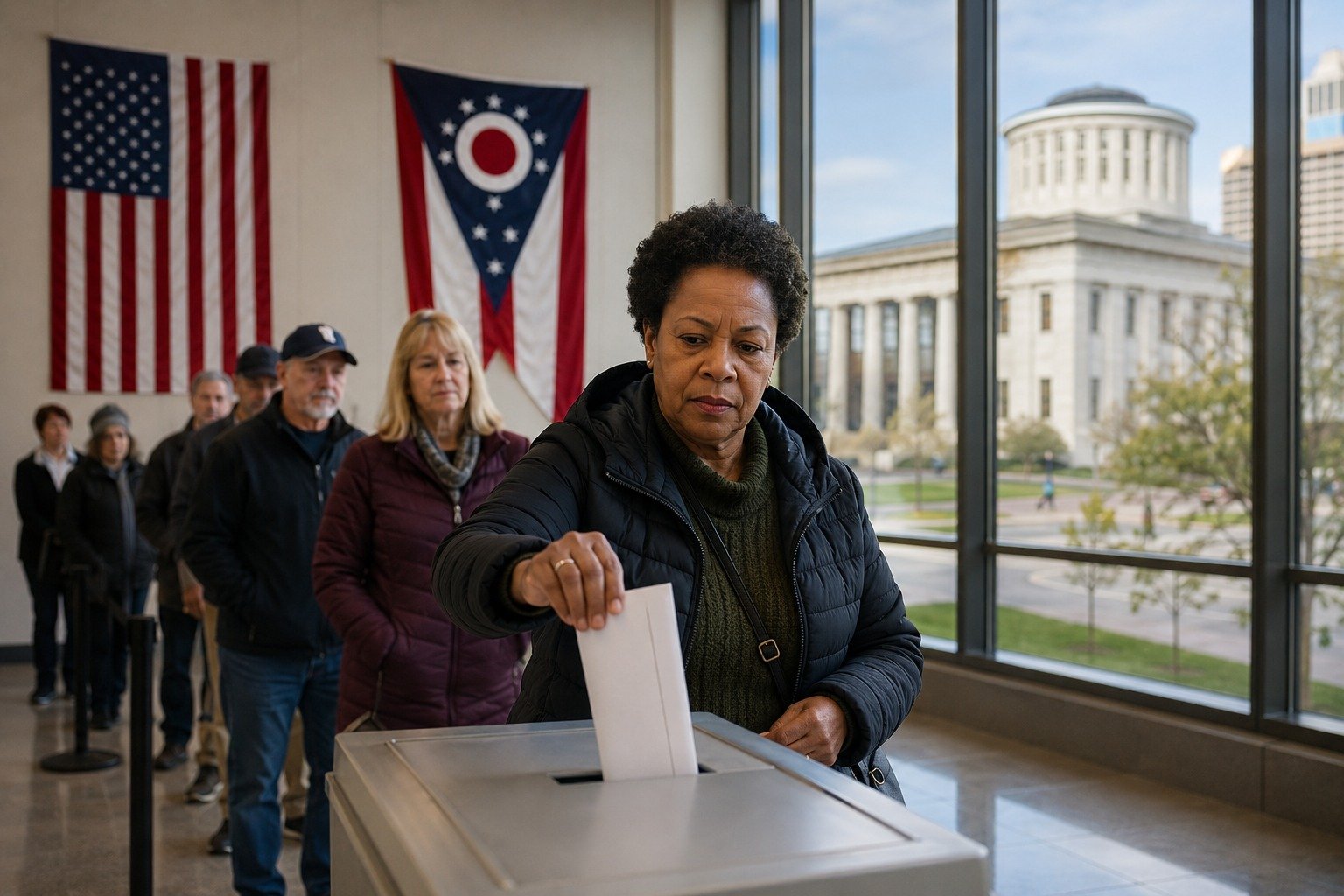
Ohio has voted Republican in three straight presidential elections, and for years national strategists treated it as safely red. A new poll out of Bowling Green State University suggests that label may be slipping. Both of the state’s marquee 2026 races – the contest for governor and a U.S. Senate special election – have tightened into a near dead heat, with Republicans holding only the narrowest of leads.
What the Numbers Show
In the governor’s race, Republican Vivek Ramaswamy leads Democrat Amy Acton by a single percentage point. In the Senate special election, Republican Jon Husted is ahead of former Senator Sherrod Brown by three points. Both margins fall well inside the poll’s 3.9-point margin of error, meaning either race could realistically break in either direction.
It is important to be precise about what this poll says and what it does not. Republicans are still ahead in both contests. No recent survey shows Sherrod Brown leading. But “narrowly ahead” is a remarkable position for the GOP to occupy in a state that delivered comfortable margins for Donald Trump in 2016, 2020 and 2024. The story here is not a Democratic victory – it is a Democratic comeback that has put two red-state races genuinely in play.
A Shifting Trend Line
The movement is what has strategists in both parties paying attention. An Emerson College survey late last year actually showed Acton edging Ramaswamy by a point in the governor’s race, while Husted held a similar lead over Brown. Taken together with the latest Bowling Green numbers, the picture is of two contests that have remained stubbornly competitive for months – not a brief polling blip.
For a state long written off by national Democrats, simply being within striking distance changes the math of the 2026 map. Competitive Senate and gubernatorial races force both parties to spend money, time and attention they might otherwise direct elsewhere.
Trump’s Standing in Ohio
Perhaps the most striking finding has little to do with the candidates themselves. The poll shows President Trump’s approval slipping in Ohio, and roughly 15% of his own 2024 voters now express some degree of regret about their vote. Respondents pointed to the economy, the conflict with Iran, and the overall state of American democracy as their leading concerns.
That erosion among the president’s own base helps explain why races in a reliably Republican state have grown so close. When even a small slice of a winning coalition cools off, the cushion that once made a state “safe” can disappear quickly.
Why It Matters
Analysts who once filed Ohio under “solid Republican” are now quietly relabeling it “purple.” For ordinary Ohioans, the practical takeaway is that their votes in 2026 will carry real weight. Competitive races mean candidates have to listen, campaigns have to show up, and the outcome is not a foregone conclusion. Control of the U.S. Senate and the direction of state government in a major industrial state could hinge on a margin smaller than a rounding error.
The open question is whether this is a temporary wobble or the start of a longer shift – and Ohio voters will be the ones to answer it.
Stay informed on the stories that matter most. Follow Your Daily Updates on Facebook and bookmark yourdailyupdates.news for breaking news and analysis.