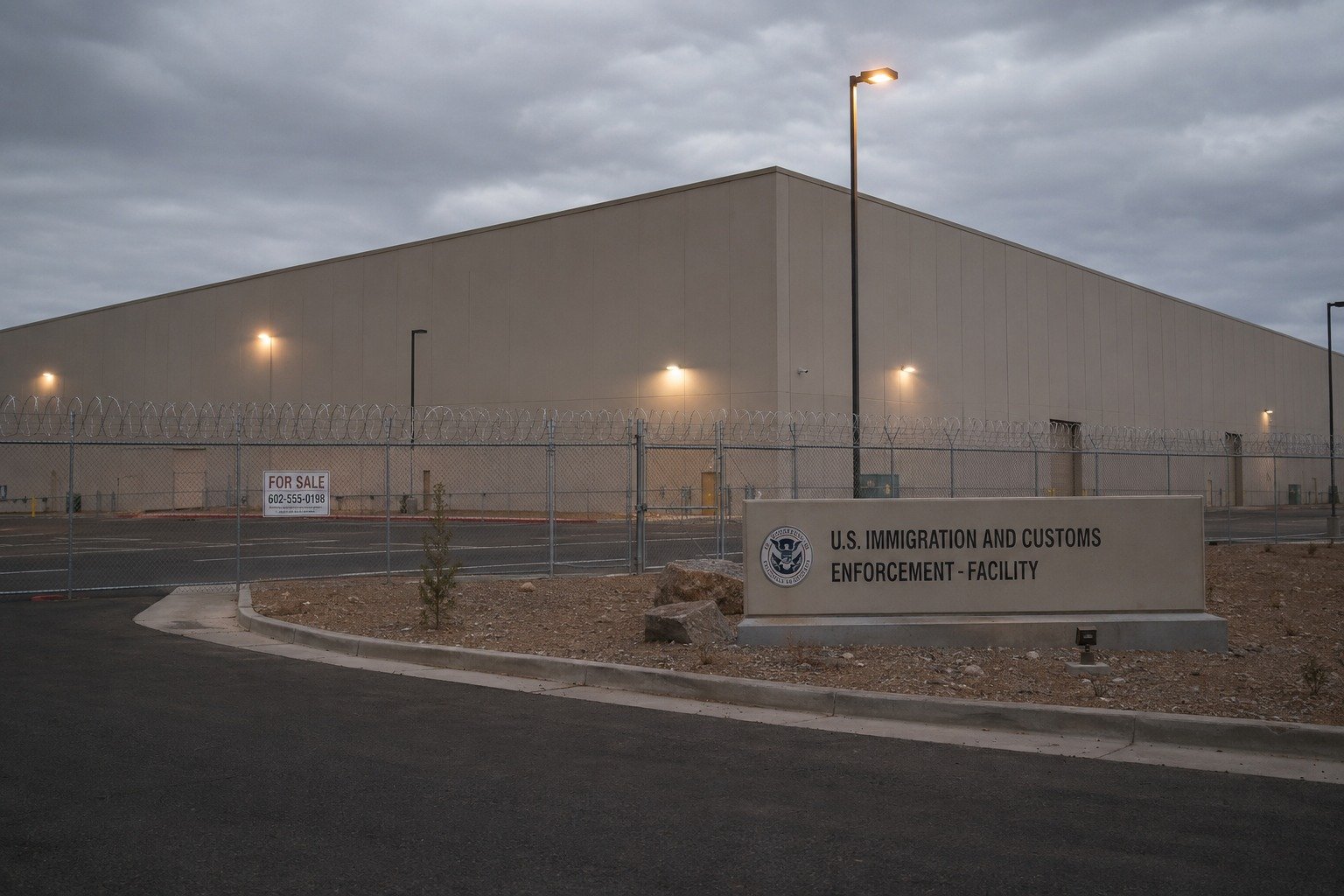
Immigration and Customs Enforcement is moving to sell off or hand away at least seven of the eleven warehouses it bought to detain migrants, according to internal documents obtained by The New York Times — a quiet retreat from one of the most expensive detention initiatives in the agency’s history.
The facilities were part of a roughly $1 billion, eleven-property buildup launched under former Department of Homeland Security Secretary Kristi Noem, with the stated goal of expanding ICE’s capacity to detain as many as 100,000 immigrants at once. The agency spent more than $700 million acquiring the warehouses alone. Now, according to the reporting, ICE plans to either sell the properties or transfer them to other federal agencies.
A signature initiative, reversed
The warehouse program was pitched as the backbone of a dramatically larger detention network — a physical expansion that would let the government hold tens of thousands more people than its existing system could handle. Instead, the documents indicate ICE is reverting to the same patchwork of private prisons and state and local jails it already relied on, the arrangement the warehouse buildup was supposed to replace.
That reversal raises an obvious question for taxpayers: what happened to the money? More than $700 million went toward buying warehouses that, by the agency’s own internal planning, will now be offloaded before they ever served their intended purpose at the promised scale. Selling real estate rarely recovers what the government paid for it, and transferring the buildings to other agencies does nothing to recoup the immigration-enforcement spending they were justified by.
What the documents show
According to the internal records, the disposal plan covers at least seven of the eleven facilities — a majority of the portfolio, though not the entire set. The framing matters: this is a reported policy reversal affecting most of the warehouses, not a wholesale liquidation of every property. Some facilities may remain in ICE’s hands. But the direction is unmistakable. The agency that spent close to a billion dollars assembling a new detention empire is now drawing up paperwork to dismantle a large part of it.
The episode is a case study in how quickly an ambitious enforcement plan can collapse under its own cost and logistics. Building a detention network capable of holding 100,000 people is not just a matter of buying buildings — it requires staffing, oversight, medical care, legal-access infrastructure, and sustained funding. When those pieces do not materialize, the warehouses become expensive liabilities rather than functioning facilities.
The accountability gap
For immigrant-rights advocates and budget watchdogs alike, the reversal underscores a recurring pattern: enormous sums committed to expanding detention with little public scrutiny of whether the spending is justified or effective. Hundreds of millions of dollars were obligated on the promise of a vast new system. The system never fully arrived, and now the public is left holding properties the government is trying to unload.
It also highlights the human stakes behind the line items. The warehouses were meant to hold people — families, asylum seekers, longtime residents swept up in enforcement. A plan to cage up to 100,000 immigrants at once was always going to draw fierce opposition on civil-rights and humanitarian grounds. Its quiet unwinding spares the country that particular expansion, even as the financial questions remain.
For now, the documents make clear the trajectory: a costly mass-detention buildup, launched with fanfare, is being reversed with paperwork. The warehouses are going on the market, and the bill has already been paid.