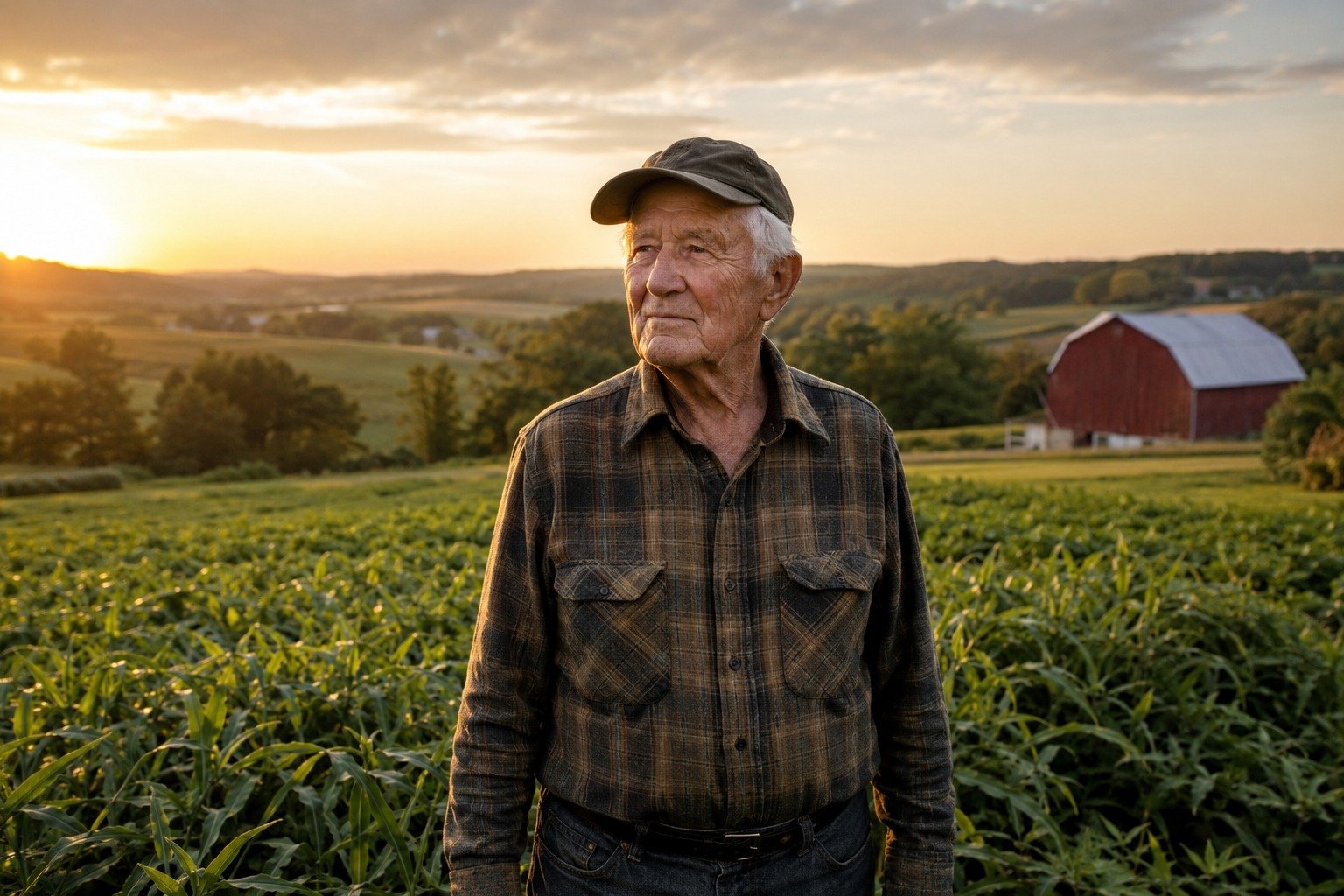
An 86-year-old farmer near Harrisburg, Pennsylvania has walked away from one of the largest paydays of his life. Mervin Raudabaugh turned down a $15.7 million offer for his 261-acre farm – roughly $60,000 an acre – and instead sold the development rights to a land trust for under $2 million to keep the property in farming forever.
The buyer had a very modern plan for the land: an artificial intelligence data center, one of the sprawling, energy-hungry server complexes now multiplying across rural America. Raudabaugh said no.
A Choice That Defies the Math
On paper, the decision looks almost impossible to understand. A $15.7 million check would have rewritten the financial future of Raudabaugh and his family many times over. Few people, at any age, would turn that down. Fewer still at 86, when the temptation to cash out and rest would be entirely reasonable.
Instead, Raudabaugh chose a path that pays far less in dollars but, in his view, far more in legacy. He sold a conservation easement – the development rights to the land – to the Lancaster Farmland Trust for under $2 million. That is a fraction of what the data center deal was worth. But the easement carries a permanence that money cannot buy: no matter who owns the farm in the future, it can never be developed. The soil stays in agriculture, period.
What a Conservation Easement Actually Does
A conservation easement is a legal agreement that permanently limits how a piece of land can be used. When a farmer sells the development rights to a trust like the Lancaster Farmland Trust, they keep ownership of the land and can continue to farm it, sell it, or pass it to their heirs. What changes is that the right to pave it over, subdivide it, or build on it is extinguished for good.
For farmland in fast-developing regions, these agreements have become one of the few tools strong enough to hold the line against sprawl. Pennsylvania has one of the most active farmland preservation programs in the country, but the pressure on its open land has rarely been more intense than it is now.
The AI Data Center Land Rush
The offer Raudabaugh rejected was not a fluke. Across the country, technology companies are racing to build data centers to power the artificial intelligence boom, and they are paying eye-popping prices for large, flat, well-connected parcels – exactly the kind of ground that makes good farmland. These facilities consume enormous amounts of electricity and water, and they often strain local power grids that were never built to carry that kind of load.
That collision – between the digital economy’s appetite for land and power, and rural communities’ desire to hold onto their farms – is playing out in county after county. Raudabaugh’s farm became a small but vivid example of what is at stake when a single landowner decides which future the land will serve.
Why He Said No
For Raudabaugh, the decision was never really about the money. It was about the soil his family has worked for generations and a conviction that some land is worth more in crops than in concrete and server racks. Preserving the farm means the next generation – and the ones after that – inherit working ground rather than a memory of it.
His stand has struck a nerve well beyond Lancaster County. To many, it is a once-in-a-lifetime act of stewardship and a quiet rebuke to the idea that everything has a price. To others, it is simply hard to fathom leaving that kind of fortune on the table.
What This Means for Americans
As AI infrastructure spreads, communities everywhere are facing the same questions Raudabaugh faced on a personal scale: what happens to farmland, to power bills, to the character of a place when the data economy comes knocking? His choice does not stop that wave, but it does keep 261 acres of Pennsylvania ground growing food instead of humming servers – and it puts a human face on a debate that will shape rural America for decades.
Stay informed on the stories that matter most. Follow Your Daily Updates on Facebook and bookmark yourdailyupdates.news for breaking news and analysis.