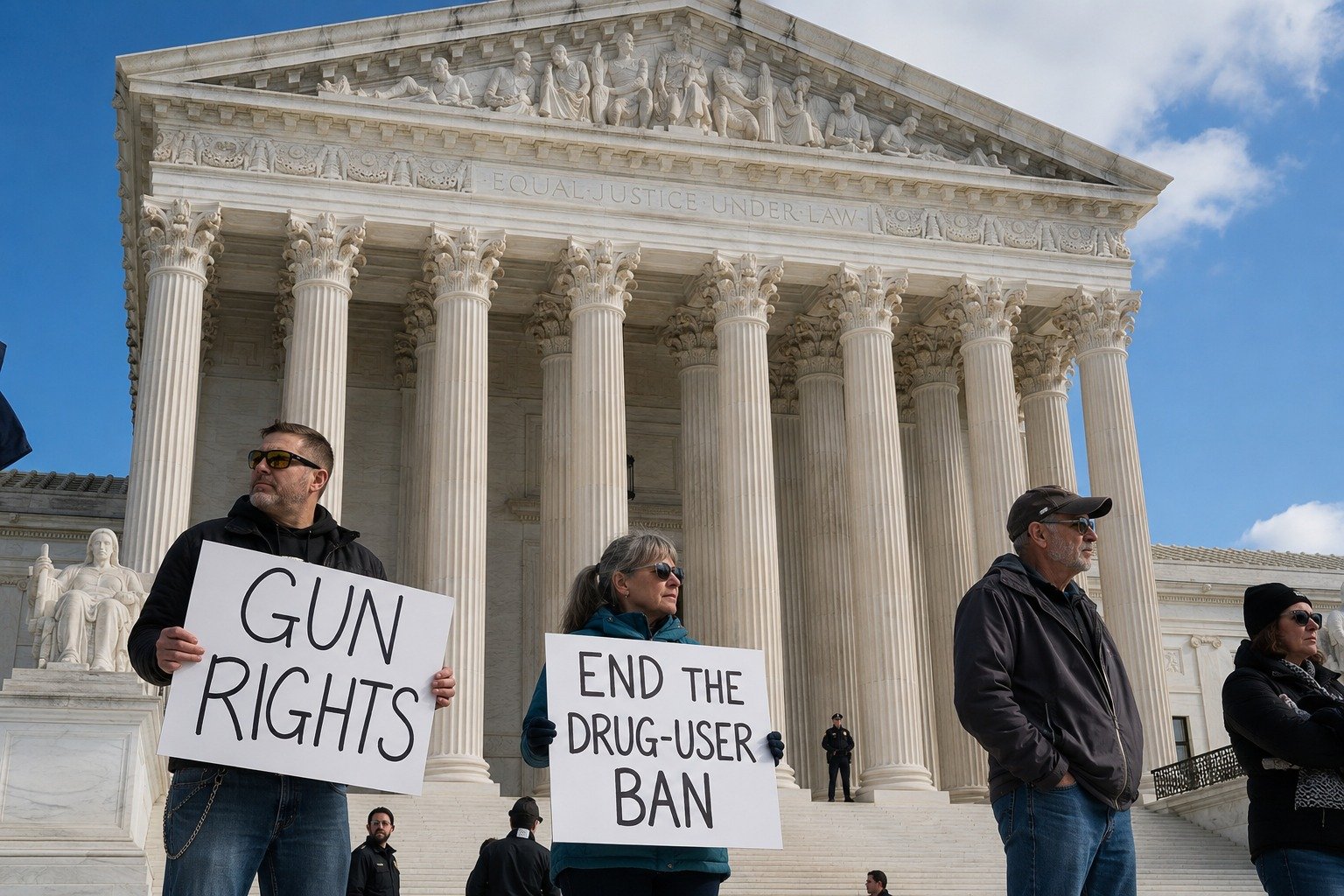
The Supreme Court has put a significant limit on one of the federal government’s broadest gun restrictions, ruling in favor of a marijuana user who was prosecuted for owning a firearm. On June 18, 2026, the justices held in United States v. Hemani that the decades-old federal law barring “unlawful users” of controlled substances from possessing guns is unconstitutional as applied to the man at the center of the case.
The decision is narrower than some of the headlines suggest. The Court did not declare that every marijuana user in the country has an unrestricted right to own a firearm. Instead, it ruled that a history of marijuana use, standing alone, is not enough to strip a person of their Second Amendment rights for life and send them to prison.
The Case Behind the Ruling
The challenge came from Ali Danial Hemani, a Texas resident who told federal agents he used marijuana roughly every other day. When law enforcement searched the family home in 2022, Hemani cooperated. He surrendered a firearm he kept in the house, pointed agents to marijuana on the property, and agreed to an interview in which he described his marijuana use. He was then charged with illegal possession of a firearm under the federal statute that prohibits “unlawful users” of drugs from owning guns.
A federal appeals court tossed out the indictment, finding that the ban, as applied to Hemani, was unconstitutional. The Supreme Court agreed. Justice Neil Gorsuch, writing for the Court, framed the principle bluntly: unlawful drug use by itself cannot be grounds to imprison someone and force them to give up their firearms permanently.
What the Court Did Not Decide
Just as important as what the Court ruled is what it deliberately left untouched. The justices were careful to say they were not deciding the case of someone who is actively addicted to or intoxicated by drugs. The opinion draws a line between a person with a history of marijuana use and a person whose impairment might present a genuine danger while armed.
In other words, the decision narrows the statute rather than erasing it. Federal prosecutors can still bring charges in some circumstances, but they can no longer rely on past marijuana use alone to justify a lifetime firearms ban. That distinction is likely to be tested in lower courts for years as judges work out exactly where the boundary falls.
A Growing Conflict Between State and Federal Law
The ruling lands in the middle of a widening gap between state and federal policy. Marijuana is now legal in some form across most of the country, whether for medical or recreational use. Yet under federal law it remains a controlled substance, and the firearms ban has applied to anyone who uses it, regardless of whether their state has legalized it.
That mismatch has created a legal trap for millions of Americans who follow their state’s laws but could still face federal prosecution for owning a gun. The Hemani decision narrows that trap, at least for people whose only offense is a history of marijuana use rather than active intoxication or addiction.
Why It Matters
For years, the drug-user firearms ban has been a tool prosecutors could use against gun owners with a documented history of drug use. The Supreme Court has now signaled that the tool has limits. Supporters of the ruling see it as a long-overdue check on a law that swept too broadly, punishing conduct that has been decriminalized in much of the country. Critics worry about how courts will distinguish between casual use and genuine impairment.
The central question now is one the Court did not answer: where exactly is the line between someone who has used marijuana and someone too impaired to safely own a gun? That debate is just beginning, and the Hemani decision has set the terms for it.