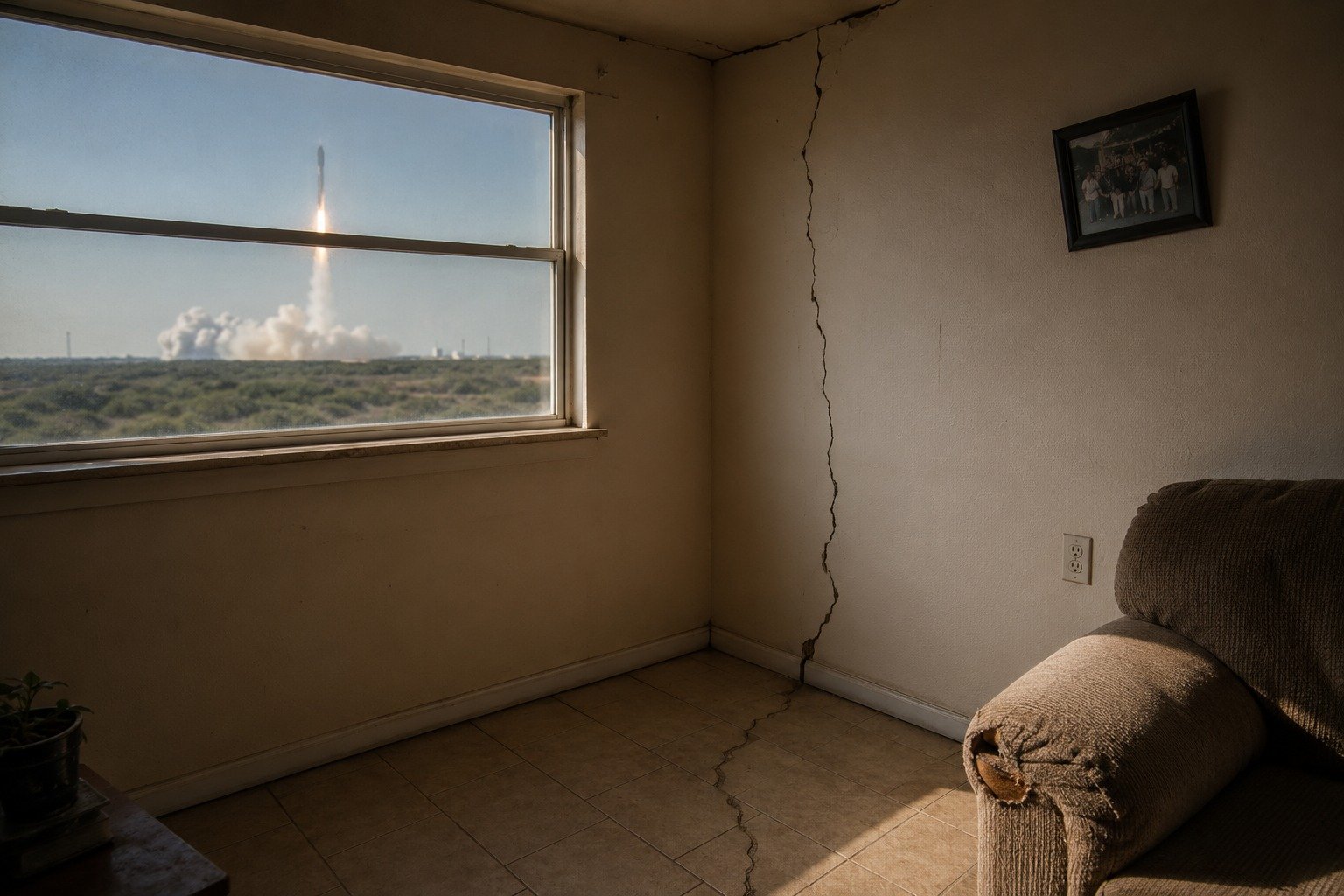
For the families who live in the shadow of Elon Musk’s Starbase, the cost of America’s race to Mars is showing up in the most intimate place imaginable: the walls of their own homes. Now 80 of those Texans are taking SpaceX to court.
According to a federal class-action lawsuit filed in Cameron County, residents of Port Isabel, Laguna Vista, and South Padre Island allege that the noise, vibrations, and sonic booms generated by SpaceX’s Starship test program have cracked their walls, shattered windows, damaged roofs, and split foundations and floors. The 80 named plaintiffs say the damage is the direct result of 11 Starship test flights conducted between April 2023 and October 2025 from the company’s Boca Chica launch site near the southern tip of Texas.
What the residents are claiming
The lawsuit accuses SpaceX of gross negligence and trespassing. The trespassing claim rests on a striking argument: that the overpressure and shockwaves rolling off each launch physically intrude into private homes, rattling structures hard enough to leave lasting damage. In plain terms, the residents say a billionaire’s rocket company has been reaching across property lines with every test flight — and that the people next door have been left to absorb the cost.
And that cost, they say, is not small. One plaintiff estimates roughly $100,000 in foundation repairs alone. For a working-class community along the Gulf Coast, where many residents have lived for decades, a six-figure repair bill is not an abstraction. It is the difference between a home that is safe and one that is slowly coming apart.
It is important to be clear about where this case stands. These are allegations contained in a freshly filed lawsuit, not findings by a court. SpaceX has not been found liable for anything, and the company will have its chance to respond and contest the claims. A judge and, potentially, a jury will ultimately weigh the evidence. But the filing itself lays out a detailed, organized account from dozens of households who say they have watched the same pattern unfold flight after flight.
A community that grew up next to a launch pad
The communities named in the suit sit just miles from the launch site. When SpaceX chose this stretch of South Texas, the towns were already there — modest, tight-knit, and built long before Starship existed. Residents did not move next to a rocket factory. The rocket factory moved next to them.
Starship is the most powerful rocket ever built, and the test flights that power it produce concussive force that travels well beyond the pad. Each launch sends a wall of sound and pressure across the flat coastal landscape. The plaintiffs argue that repeated exposure to that force — not a single dramatic event, but 11 flights over more than two years — is what has worn their homes down to cracked plaster and separated foundations.
The bigger question of accountability
At its core, this lawsuit is about a familiar imbalance: an enormously wealthy company pursuing an enormously ambitious goal, and the ordinary people who live close enough to bear the side effects. SpaceX has received favorable treatment from regulators eager to keep American spaceflight on American soil. The residents of Cameron County are asking a simple question in response — who pays when the pursuit of the future damages the homes of the present?
The plaintiffs are not asking to stop space exploration. They are asking to be made whole. Their argument is that a company valued in the hundreds of billions of dollars should not be able to shake a community’s houses apart and treat the damage as someone else’s problem. If the courts agree, the case could set an expensive precedent for how SpaceX — and any operation like it — has to account for the people living at the edge of its launch zone.
For now, the lawsuit moves forward, and the residents wait. They have filed their claims, documented their cracks, and put their names on the record. What happens next is up to a federal court. But the message from 80 of their neighbors is already clear: when the ground under your home keeps shaking, someone has to be held accountable.