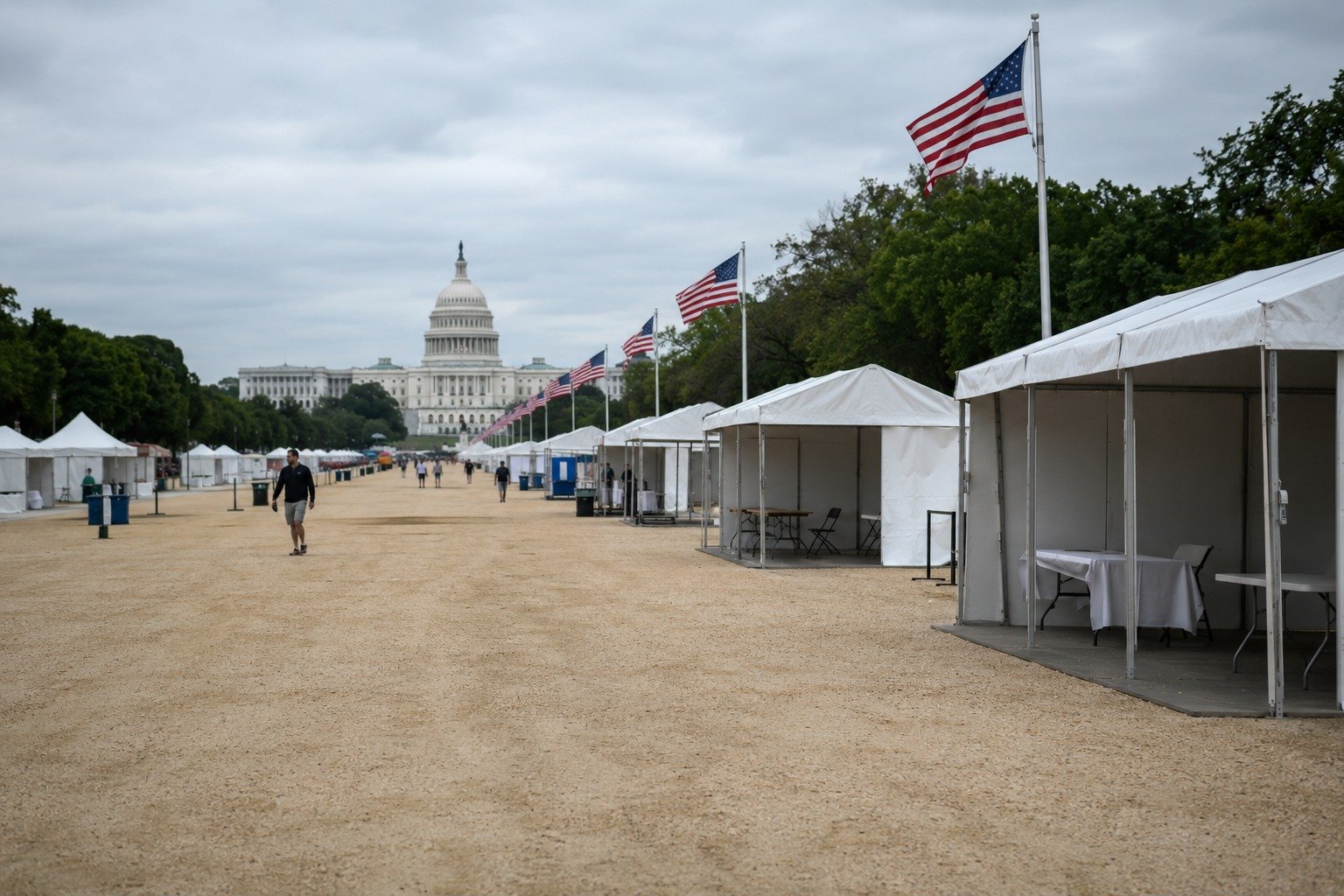
With the opening just two weeks away, Trump’s $68 million “Great American State Fair” on the National Mall is missing something fundamental: states. At least six have now declined the White House’s invitation to send an official delegation, and the list of no-shows keeps growing as the June 25 start date approaches.
According to NOTUS, the states that have so far said no include Oregon, Washington, Massachusetts, Illinois, North Carolina, Maine, and Connecticut. Their reasons are practical rather than dramatic, but together they paint a picture of a marquee federal celebration struggling to fill its own fairgrounds.
What the Fair Is Supposed to Be
The “Great American State Fair” is a 16-day national exposition planned for the National Mall, running June 25 through July 10. It is billed as a centerpiece of the country’s 250th-birthday festivities, with each state invited to build and staff a booth showcasing its culture, products, and history.
The roughly $68 million price tag comes from the administration’s “Freedom 250” fund. That is a separate pot of money from the Congress-created “America 250” commission, a distinction that matters as questions mount over how the event is being organized and paid for. The vision is a sweeping, unifying celebration on the nation’s most symbolic stretch of public land. The reality, two weeks out, is more complicated.
Why States Are Bowing Out
The most common reason states cite is cost. Building and staffing a booth on the National Mall for more than two weeks is expensive, and many state officials would rather put that money toward their own state fairs and local events back home. For governments watching every dollar, a lengthy federal showcase hundreds of miles from their constituents is a hard sell.
There is also a question of priorities. Summer is peak season for state-level fairs and community events, the kind of programming that directly serves the people who fund it through their taxes. Sending a delegation to Washington for sixteen days means pulling staff and resources away from those obligations.
Oregon went a step further than the others. State officials there raised concerns that the fair had drifted into something more partisan than what was originally pitched to them. That objection points to a deeper unease: an event sold as a nonpartisan birthday party for the country can look very different once the politics around it come into focus.
Who Is Still Deciding
Not every state has made up its mind. Maryland and Pennsylvania have been listed among those still weighing their options, and Washington appeared as undecided in some reporting before declining the official invitation. With the clock running down, those decisions will determine just how full or how empty the Mall looks when the gates open.
For a project designed to bring the nation together, a wave of states quietly opting out sends a loud message. Empty booths are not just a logistical headache; they are a visible sign that the federal government’s pitch did not land with the very states it was meant to feature.
What This Means for Americans
At its core, this is a story about how public money gets spent and who decides what counts as a national priority. States are signaling that a $68 million federal spectacle is not worth diverting funds from the local events their own residents actually attend. When governments closest to the people make that call, it is worth asking whether the bigger, costlier celebration was the right use of resources in the first place.
The fair will still open on June 25. But whether it becomes a genuine showcase of the whole country or a half-filled fairground will depend on choices being made right now, in statehouses far from the National Mall.
Stay informed on the stories that matter most. Follow Your Daily Updates on Facebook and bookmark yourdailyupdates.news for breaking news and analysis.