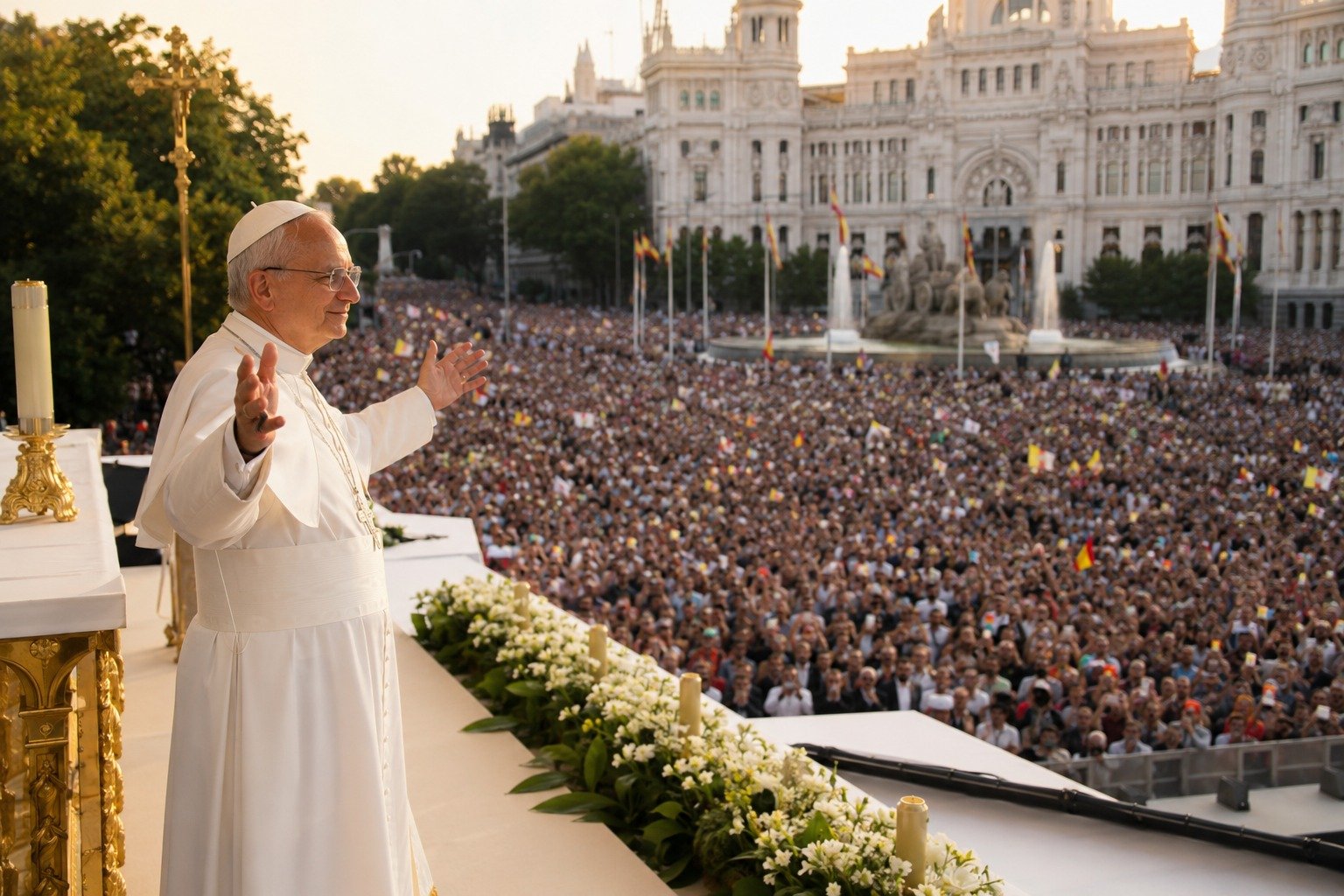
An estimated 1.2 million people poured into the heart of Madrid on Sunday, June 7, 2026, as Pope Leo XIV celebrated a Corpus Christi Mass and led a Eucharistic procession through the Spanish capital — one of the largest crowds drawn to a single event in the early months of his pontificate.
The faithful packed the grand Plaza de Cibeles and spilled out into the broad avenues that radiate from it, transforming one of Madrid’s most iconic squares into a sea of worshippers. Many waved small Spanish and Vatican flags, while others simply stood shoulder to shoulder beneath the early-summer sun, waiting for a glimpse of the pontiff. The turnout was reported by major news outlets including the Associated Press, NPR and OSV News, with the 1.2 million figure spanning both the open-air Mass and the procession that followed through the city’s streets.
A Mass That Became a Procession
Corpus Christi — the solemnity that celebrates the Catholic belief in the real presence of Christ in the Eucharist — has deep roots in Spain, where it has been marked for centuries with elaborate public processions. In keeping with that tradition, the Mass in Madrid gave way to a procession that wound over carpets of flower petals laid across the pavement, a striking visual hallmark of Spanish popular piety. The petals, arranged into intricate patterns by local communities, are one of the oldest and most beloved expressions of the feast in the country.
For a single liturgical celebration to draw a crowd on this scale speaks to both the moment and the setting: a historic plaza, a centuries-old tradition, and a new pope still introducing himself to the wider world. The sheer density of the gathering offered a vivid snapshot of the public enthusiasm that has accompanied the opening chapter of Leo’s papacy.
‘Not a Museum of the Past’
In his homily, Pope Leo leaned directly into the theme of living faith. He urged Spain to keep its centuries-old Eucharistic devotion alive rather than treat it as a historical artifact, warning that the country’s religious traditions must not become “a museum of the past to be visited,” but should instead remain “a school of faith from which to draw even today.”
The message was pointed in a country where, like much of Western Europe, regular religious practice has declined in recent decades even as cultural and devotional traditions endure. By framing the Eucharist as a source of ongoing nourishment rather than nostalgia, Leo signaled a pastoral emphasis on renewal — encouraging the faithful to see ancient practices as something to be lived, not merely preserved.
Part of a Broader Journey to Spain
The Madrid Mass was a centerpiece of Pope Leo’s apostolic journey to Spain, a trip that also took him to other historic Catholic sites across the country. Visits of this kind serve multiple purposes: they reinforce ties between the Vatican and one of the historically Catholic nations of Europe, they give the pontiff a chance to address local concerns directly, and they offer a public stage for the themes a new pope wants to define his tenure.
It is worth being precise about the numbers. The 1.2 million estimate, as reported by news organizations covering the event, accounts for the combined crowd across the Mass and the procession through the city rather than a single fixed point in time. Crowd estimates for open-air religious gatherings are inherently approximate, but even at the conservative end, the turnout ranks among the most significant of Leo’s pontificate to date.
Whatever one’s own faith or politics, a gathering of more than a million people in a single square is the kind of event that commands attention — a reminder of the enduring pull of public ritual and shared tradition in an age that often feels fragmented. For the Catholic Church, the images out of Madrid offered an unmistakable show of strength; for the wider public, they offered a remarkable scene of a city briefly united around a single moment.