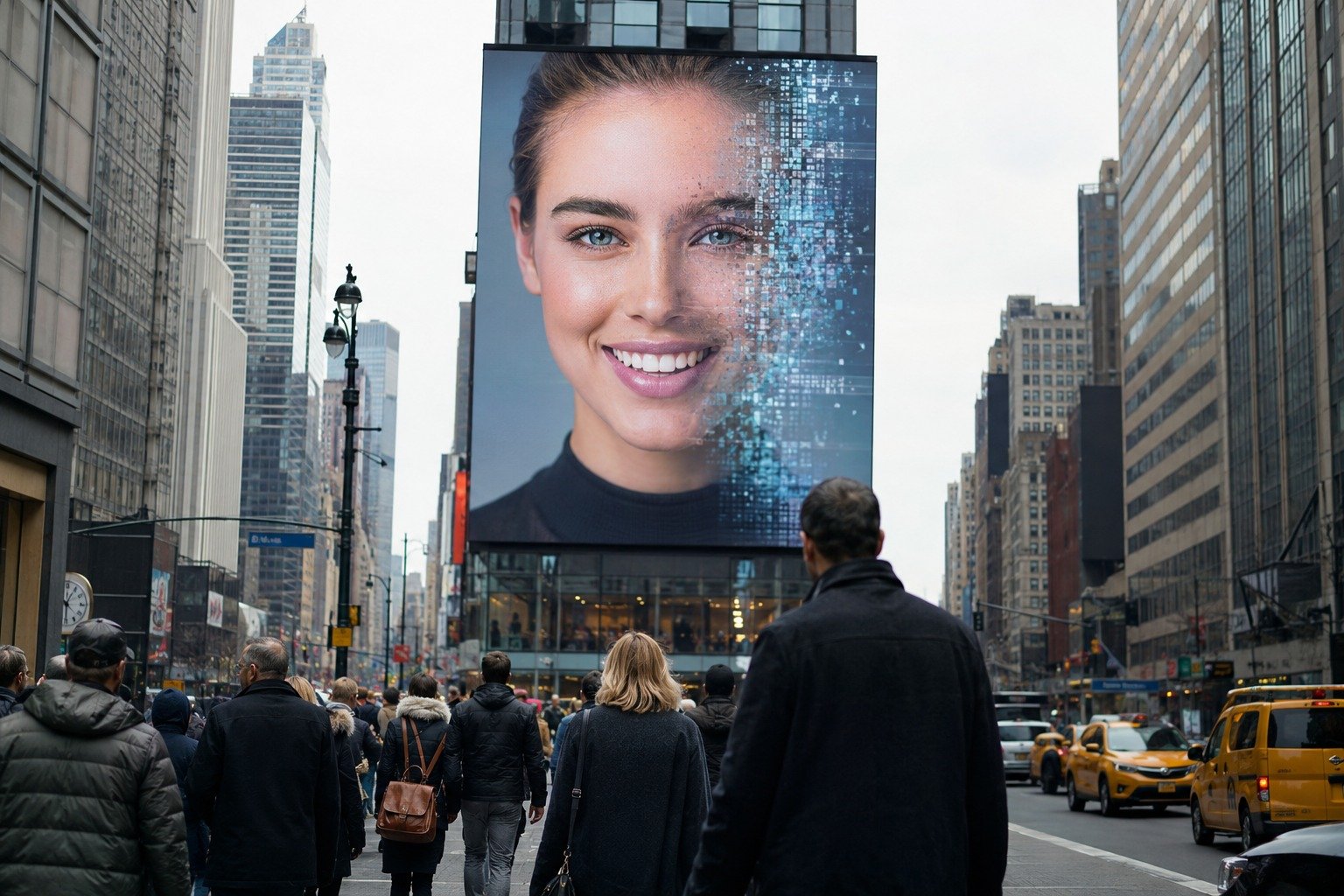
New York has become the first state in the nation to require advertisers to tell you when the “person” in their ad isn’t a person at all. A new law signed by Governor Kathy Hochul forces companies to conspicuously disclose when they use AI-generated “synthetic performers” in advertisements, and it takes effect June 9, 2026.
The measure, passed as S.8420-A / A.8887-B, amends New York’s General Business Law and lands at a moment when generative AI has made it cheap and easy to manufacture flawless human faces that never existed. For the first time, an American consumer in New York will have a legal right to know when the smiling model selling them a product was conjured by an algorithm.
What Counts as a “Synthetic Performer”
Under the law, a synthetic performer is a digital asset created with generative artificial intelligence that is designed to look like a natural human being performing in an advertisement, but does not actually represent any real, identifiable person. In plain terms: a computer-generated actor with a human face and no human behind it.
If an ad uses one of these AI-built characters, the company now has to say so, and the disclosure cannot be hidden. The statute requires the notice to be “conspicuous,” meaning it must be prominent, noticeable, and unavoidable. No burying it in microscopic gray type at the bottom of the screen, and no flashing it for a fraction of a second. The whole point is that an ordinary viewer should actually be able to tell that what they are watching is artificial.
The Penalties
The law carries real financial teeth, though they start modest. A first violation brings a civil penalty of $1,000. Every violation after that climbs to $5,000. For small advertisers, the costs could add up quickly across a campaign; for large national brands, the bigger risk may be the reputational hit of being publicly flagged for trying to pass off a fake human as the real thing.
There are limits to what the law covers. Advertisements and promotional materials for expressive works, such as movies, television shows, and video games, are exempt, as long as the use of a synthetic performer in the ad is consistent with how the character is used in the work itself. Audio-only advertisements are also excluded, since the law is aimed squarely at the visual deception of a manufactured human face.
A Direct Clash With Washington
The timing of the signing was striking. On the very same day Hochul signed the disclosure requirement into law, the White House pushed an executive order aiming to halt state-level AI regulation in favor of a single, yet-to-be-determined federal standard. The result is a head-on collision between a state trying to protect its consumers right now and a federal effort to put the brakes on that exact kind of action.
That tension is likely to define the next phase of the fight over artificial intelligence. States have historically been the first movers on consumer protection, from data privacy to product safety, often acting years before Congress. New York’s law is a test of whether that tradition survives in the AI era, or whether Washington succeeds in freezing the states out.
What This Means for Americans
For the average person scrolling past dozens of ads a day, the change is simple but meaningful: you gain the right to know when you are being sold to by a machine wearing a human face. As synthetic media gets more convincing, that transparency becomes the difference between an informed choice and a quiet manipulation. New York’s bet is that consumers deserve to know what is real, and that companies profiting from realistic fakes should be the ones who carry the burden of telling the truth.
Whether other states follow, and whether the federal government tries to stop them, will shape how much control any of us has over the AI-generated images flooding our screens. For now, New York’s answer is blunt: if it’s fake, you have a right to know.
Stay informed on the stories that matter most. Follow Your Daily Updates on Facebook and bookmark yourdailyupdates.news for breaking news and analysis.