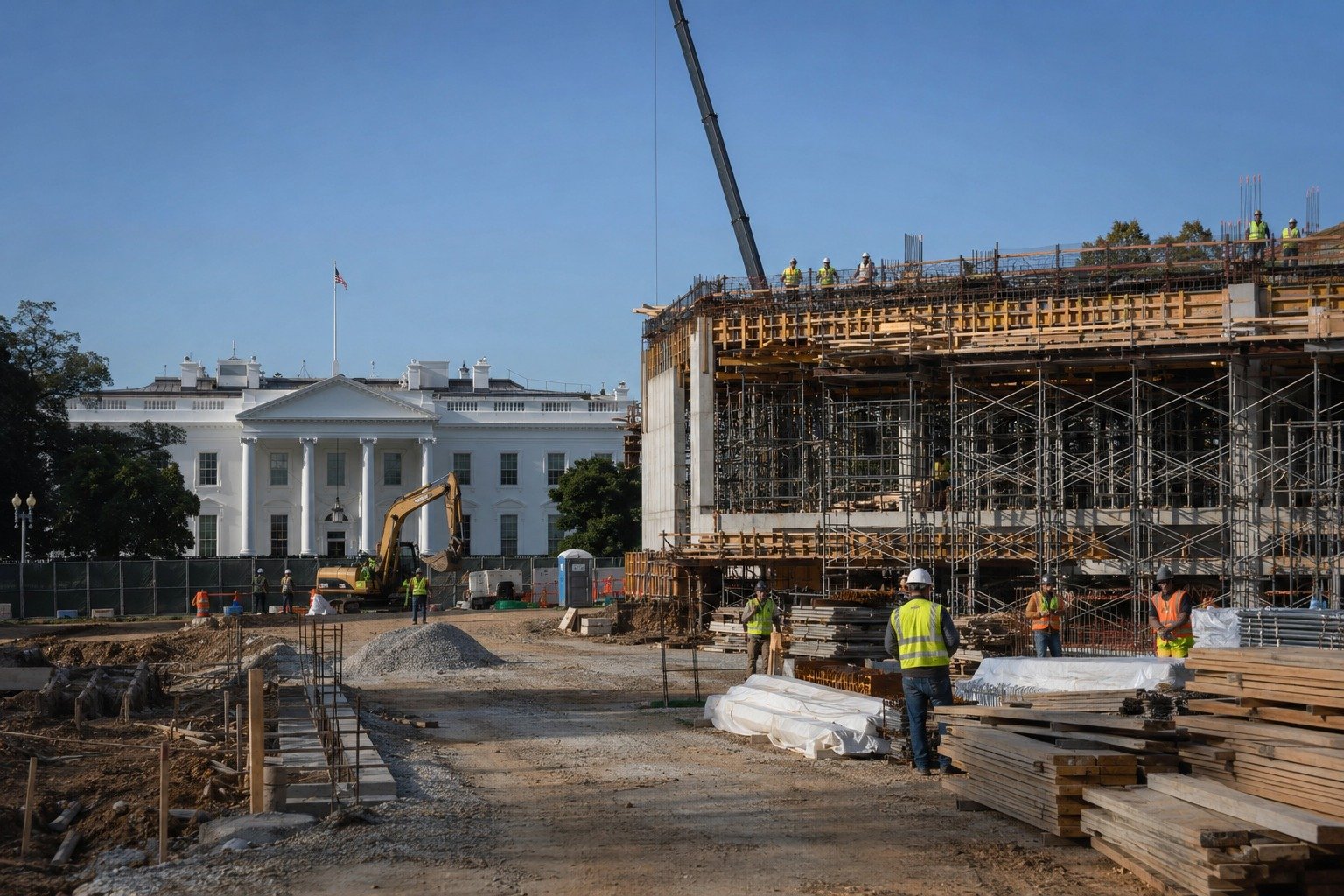
A new report from the watchdog group Public Citizen has put hard numbers behind a question that has shadowed President Trump’s $400 million White House ballroom from the start: who is paying for it, and what are they getting in return? According to the report, released June 4, 14 of the 27 publicly identified corporate donors to the ballroom project received new or expanded federal contracts worth more than $50 billion in the roughly six months since the East Wing was demolished to make room for it.
What the Watchdog Found
The single largest beneficiary, by a wide margin, was defense giant Lockheed Martin, which Public Citizen ties to $43.8 billion in federal contracts. Consulting firm Booz Allen Hamilton followed with more than $4.2 billion, and data-analytics company Palantir picked up over $1 billion. The donor roster reads like a roll call of corporate America: Amazon, Microsoft, Google, Caterpillar, and T-Mobile all appear among those who helped underwrite the president’s signature renovation.
The overlap stretches back further than the past six months. Public Citizen found that 19 of the 27 donors have collected a combined $338 billion in federal contracts since fiscal 2021. The report also notes that 16 of the 27 are currently facing federal enforcement matters or have seen scrutiny of their business operations eased — a detail the group argues compounds the appearance of a system where access and influence travel together.
The Ballroom Project
The ballroom itself has been one of the most visible — and most debated — building projects on the White House grounds in decades. To make room for the roughly $400 million structure, the historic East Wing was demolished, a move that drew criticism from preservationists and members of both parties. The administration has financed the project in part through private corporate donations rather than appropriated funds, which is precisely what has drawn watchdog attention.
Crucially, the administration has not released a full, official list of who donated to the ballroom or how much each gave. Public Citizen’s analysis is based on the donors who have been publicly identified — meaning the real picture could be larger than what the report captures. That gap in transparency is part of what the group says makes independent scrutiny necessary.
Correlation, Not Proven Corruption
Public Citizen is careful about what its findings do and do not show. The report documents timing and overlap — donations flowing to a presidential project while the same companies win billions in taxpayer-funded business — but it does not claim to have proven a quid-pro-quo. The group frames the pattern as the “potential for corruption” rather than evidence that any contract was awarded because of a donation. Federal contracting is a continuous process, and large defense and technology firms routinely win major awards regardless of who occupies the White House.
Still, government-ethics advocates argue that the appearance alone is a problem. When corporations bankrolling a president’s personal renovation project are simultaneously collecting record federal contracts, the public has reason to ask whether the playing field is level — and whether decisions are being made on the merits or on relationships.
What This Means for Americans
Federal contracts are funded by taxpayers. Every dollar Lockheed Martin, Palantir, or any other contractor receives comes from public money. When the companies writing those checks are also writing checks for a president’s ballroom, ordinary Americans have a direct stake in knowing the full story — who gave, how much, and whether that access shaped how their tax dollars were spent. Transparency about the donor list would let the public judge for itself.
Stay informed on the stories that matter most. Follow Your Daily Updates on Facebook and bookmark yourdailyupdates.news for breaking news and analysis.