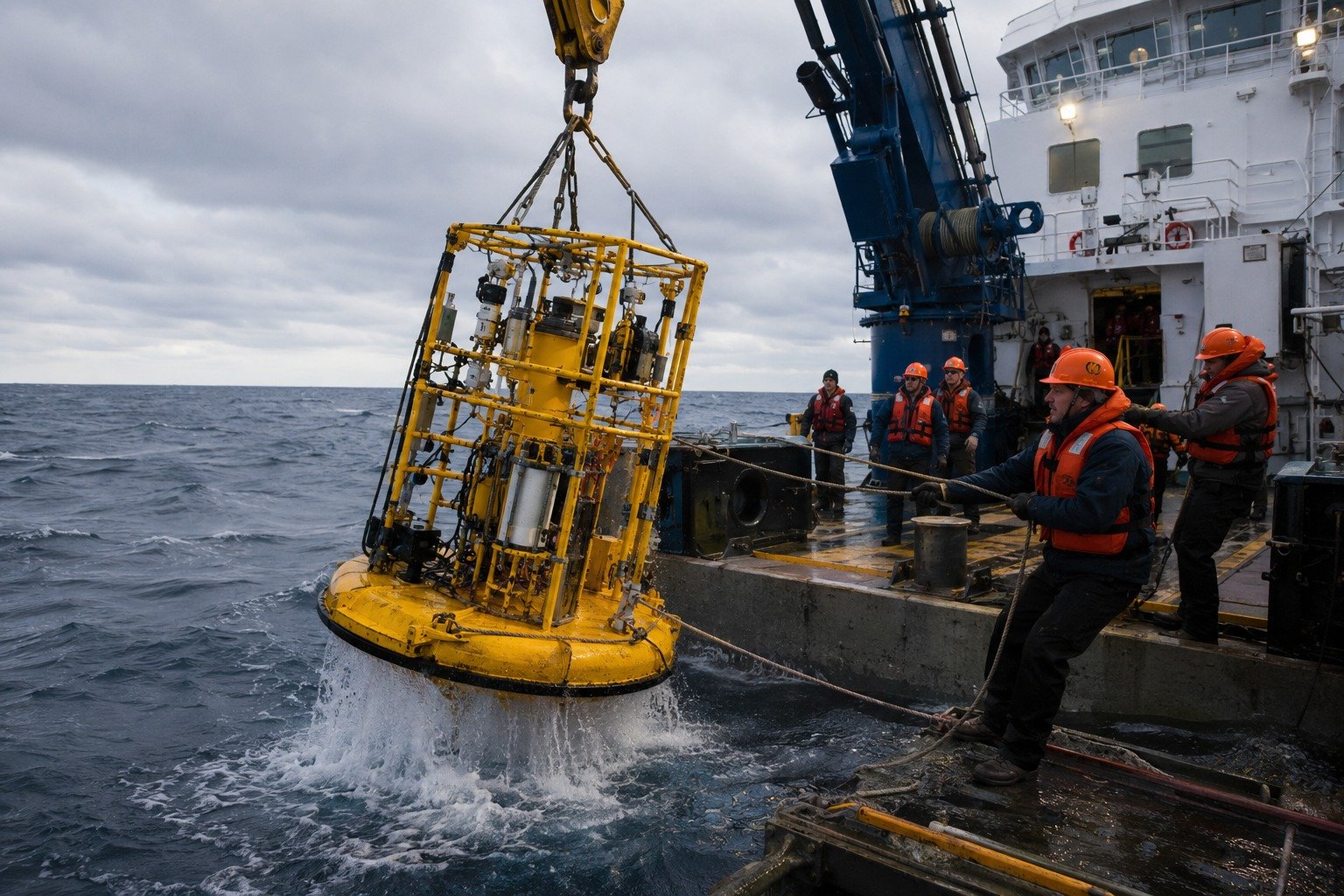
The federal government has started tearing down one of the most ambitious ocean-monitoring systems ever built. The National Science Foundation has begun dismantling the Ocean Observatories Initiative, a $370 million network of deep-sea sensors that has fed scientists a constant stream of data on the world’s oceans since 2016. Starting this month, crews will begin pulling more than 900 instruments off the ocean floor.
A Decade of Data Spread Across Two Oceans
The Ocean Observatories Initiative is not a single buoy bobbing in the water. It is a sprawling array of moorings, gliders, and seafloor sensors stretched across some of the most important and remote stretches of ocean on the planet. Its instruments sit off the coasts of Oregon, Washington, Alaska, and North Carolina, and in a punishing patch of the North Atlantic between Greenland and Iceland known as the Irminger Sea.
That last location is not an accident. The Irminger Sea is one of the few places on Earth where surface water sinks into the deep ocean, a process that helps drive the global system of currents that regulates the planet’s climate. Losing eyes on that region, scientists warn, means losing the ability to watch one of the engines of the world’s weather in real time.
Why the Plug Is Being Pulled
The system was engineered to run for 25 years, delivering continuous measurements of ocean currents, temperature, marine ecosystems, and the chemistry of the water itself. It reached full operation in 2016, meaning it is only about a decade into its planned lifespan.
The cost of building it ran to roughly $370 million. Keeping it running costs about $48 million a year. The National Science Foundation says that price tag no longer fits its priorities and has framed the shutdown as part of a broader pivot toward newer technologies and emerging areas of research. In short, the agency argues, the money could do more good somewhere else.
Democrats Vow a Fight
That argument is not landing quietly. Democrats in Congress have vowed to fight the shutdown, and they have history on their side. Lawmakers have already stepped in twice to restore funding after deep cuts were proposed, keeping the network alive when it was on the brink before.
Their core warning is about what cannot be undone. A monitoring network like this builds its value over time, comparing today’s readings against years of past measurements to spot trends. Once the instruments are hauled out of the water, that continuous record stops cold. There is no pause button. Restarting later would mean rebuilding much of the system and starting the data clock over again, leaving a permanent gap in the record of how the oceans are changing.
Supporters of the decision counter that no program can be funded forever, and that responsible budgeting means making hard choices about which projects continue. They argue the annual cost is better spent on emerging research that could deliver results faster and more cheaply. With the first instruments already being recovered, the practical window to reverse the decision is closing quickly.
What This Means for Americans
This is not just a debate for oceanographers. The data these sensors collect feeds into weather forecasting, fisheries management, storm prediction, and the long-term understanding of conditions that affect coastal communities from the Pacific Northwest to the Carolinas. When a system that took a decade to build is dismantled in a matter of weeks, the question for taxpayers is simple: was the investment worth abandoning, or is the country throwing away something it cannot easily get back?
Stay informed on the stories that matter most. Follow Your Daily Updates on Facebook and bookmark yourdailyupdates.news for breaking news and analysis.