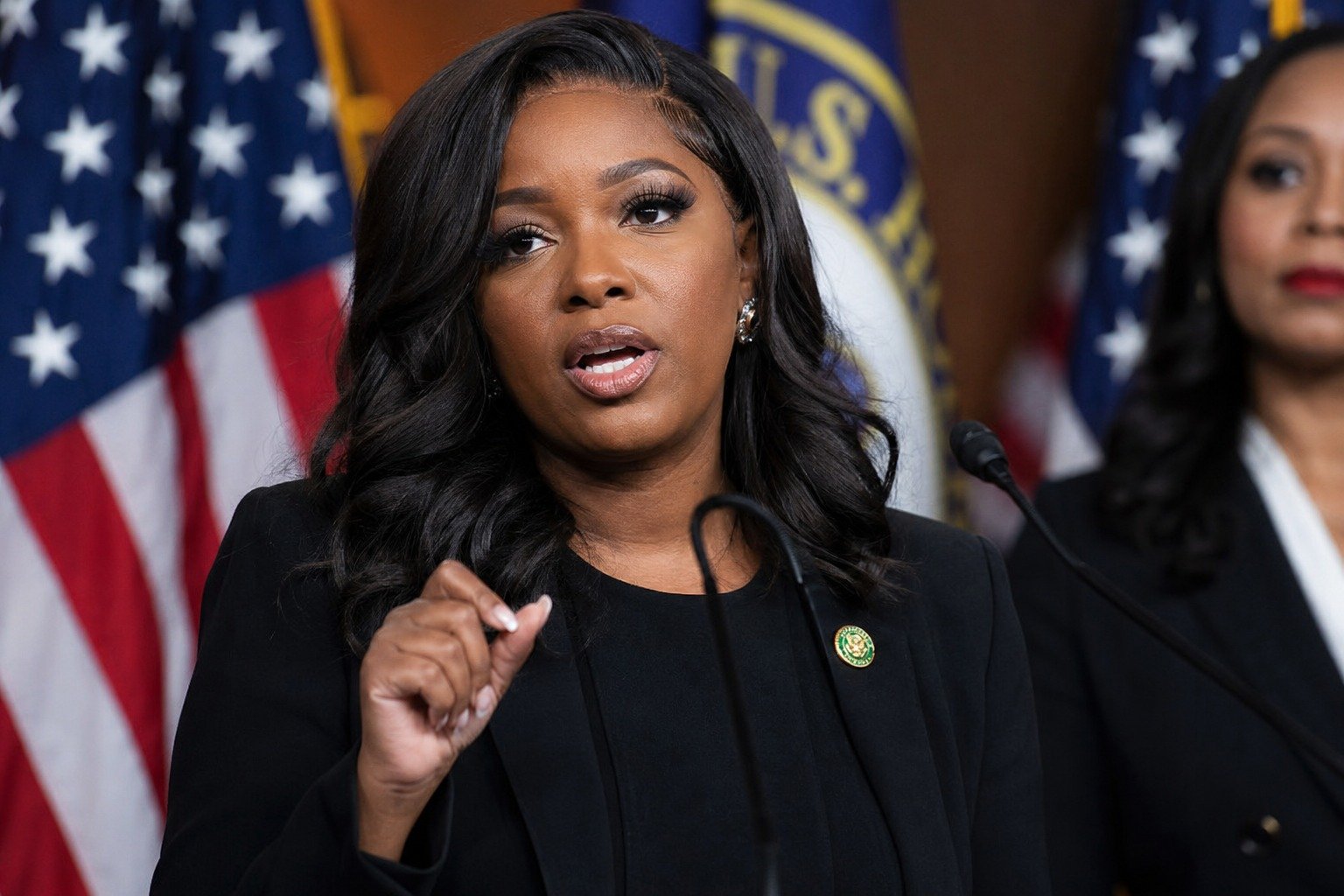
When former President Donald Trump called Texas Congresswoman Jasmine Crockett a “low IQ person” during a nationally televised interview, he probably expected the comment to land and move on. What he likely didn’t expect was a response that would generate more headlines than the insult itself.
Crockett, a Democratic congresswoman representing Texas’s 30th district, has never been one to stay quiet. A former defense attorney turned legislator, she has built a reputation for sharp, direct exchanges — both in congressional hearings and on social media. When Trump’s comments hit the news cycle, she took to X to respond — and the internet stopped scrolling.
What Trump Said
During an NBC News Meet the Press interview, Trump dismissed Crockett as a “low IQ person,” a label he has deployed against various political opponents over the years. The comment came amid a broader pattern of Trump directly engaging with, and often attacking, Democratic women in Congress — a pattern his critics say reflects something deeper than just political disagreement.
The remark quickly circulated across news networks and social media, and Crockett’s inbox lit up. Rather than issue a measured political statement, she chose a different approach entirely.
Her Response
Crockett’s reply on X was direct and pointed. “For you to be in charge of the WHOLE country, you sure do have my name in your mouth a lot,” she wrote. “Every time you say my name, you’re reminding the world that you’re terrified of smart, bold Black women telling the truth and holding you accountable. So keep talking…”
The post spread rapidly. Within hours, it had accumulated hundreds of thousands of impressions, with supporters calling it a defining moment and critics calling it grandstanding.
She didn’t stop there. In a follow-up, Crockett added a line that may have gotten even more traction than the first: “What Black woman hurt you to have you this obsessed?”
The question hit a nerve — on both sides. Supporters called it a surgical takedown. Detractors said it was inflammatory. Either way, it kept the story alive well past the initial news cycle.
The Reaction
Supporters praised Crockett for reframing the exchange entirely. Rather than defending herself against the “low IQ” label, she flipped the narrative — positioning Trump’s repeated focus on her not as a sign of dominance, but of anxiety. Her supporters called it a masterclass in deflection-through-confidence.
Trump’s supporters pushed back, arguing that Crockett was injecting race into a political disagreement unnecessarily and that Trump’s “low IQ” label is one he applies broadly to his opponents regardless of background. Several conservative commentators said her response proved she was more interested in going viral than in policy debate.
Congressional Democrats largely rallied behind her. Several members posted their own responses to Trump’s original comment, amplifying Crockett’s words across their own platforms.
Why This Keeps Happening
The exchange is part of a longer pattern. Trump has repeatedly clashed with Democratic women in Congress, often by name — a strategy that critics argue is designed to elevate fringe conflict while avoiding substantive policy debate, and that supporters argue reflects Trump’s willingness to fight back against anyone who criticizes him, regardless of identity.
Crockett, for her part, has leaned into the dynamic. She has made a name for herself as one of the more confrontational voices in the Democratic caucus, particularly during high-profile House committee hearings where her prosecutorial background often shows.
Whether this particular exchange fades or hardens into something more politically significant remains to be seen. What’s clear is that both sides walked away from it believing they’d won — which, in today’s media environment, might be exactly the point.
The back-and-forth between the White House and individual members of Congress shows no signs of slowing down. And every round creates a new debate: who’s actually driving the conversation — and who’s just responding to it?