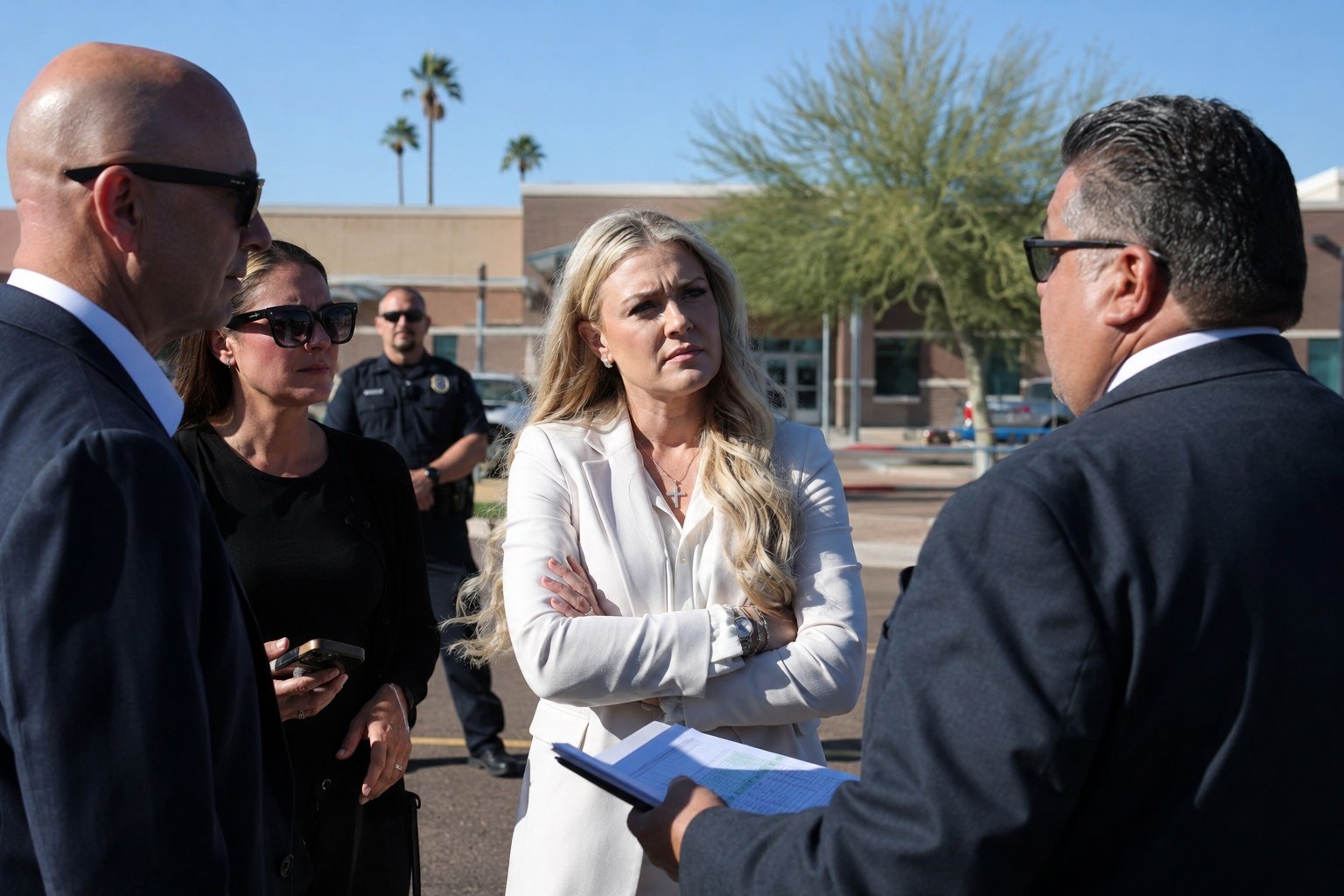
A planned lunchtime event featuring right-wing commentator Erika Kirk at Pinnacle High School in north Phoenix has been moved off campus after a wave of pushback from students and parents — marking the latest flashpoint in the ongoing national debate over political speakers at public schools.
Principal Jeremy Richards sent an email to Pinnacle families notifying them that the event would be “moved to an offsite location after the school day.” The event itself will still take place — Club America, a student-run club affiliated with Turning Point USA, will host Kirk with invited guests — but it will no longer occur on school property or during school hours.
What Happened at Pinnacle High School
The controversy began when Club America announced it had invited Kirk to speak to members during the school’s lunch period. Kirk is a prominent conservative commentator with a following in Turning Point USA circles — she creates content aimed at young conservatives and is known for provocative political commentary that generates significant engagement online.
Before Kirk could set foot on campus, the backlash erupted. Multiple students publicly objected to Kirk being hosted as a school event, with one student quoted as saying her content is “too extremist for a school.” Parents separately raised concerns about student safety and potential disruption to the school day — concerns that carried additional weight given that Kirk had recently canceled another public appearance, citing threats against her.
School administration moved quickly. Richards’ email to parents framed the decision as a logistical move, not a cancellation — the event will proceed, just off campus after hours. That framing hasn’t satisfied either side of the debate.
The Backlash — From Both Sides
Kirk’s supporters were quick to call the move censorship. Conservative voices on social media argued that a legitimate student club has every right to invite speakers aligned with their values, and that removing the event from school grounds effectively punishes students for their political beliefs. Some framed the principal’s decision as school administrators caving to a vocal minority of students and parents opposed to conservative viewpoints.
Those who pushed back on the event argued the issue isn’t about free speech — it’s about appropriateness. Students opposed to Kirk’s appearance pointed to the nature of her content, arguing that a lunch-period school event is not the appropriate venue for commentary they described as extremist. Parents raising safety concerns cited the recent pattern of Kirk’s own appearances being threatened or canceled, suggesting her presence could create security complications for an already-packed school day.
A Pattern Playing Out Across the Country
The Pinnacle situation is not unique. High schools and college campuses across the United States have increasingly found themselves caught in the same bind: student groups affiliated with political organizations — on both the left and the right — invite speakers whose content is divisive, and administrators are forced to make judgment calls with no clean answer.
The legal landscape adds complexity. Public schools operate under First Amendment constraints that private institutions don’t face. Student clubs generally have the right to associate with outside organizations and invite speakers. But schools also have legitimate authority to regulate the time, place, and manner of events on campus — particularly when disruption or safety concerns are raised. Moving the event off campus after hours threads that needle: it doesn’t ban the speech, it just removes it from school property.
Whether that distinction satisfies First Amendment advocates is another question. Legal experts have long debated where a school’s authority to manage its environment ends and viewpoint discrimination begins — and cases like the one at Pinnacle tend to land exactly on that line.
What This Means for Students and Families
For students at Pinnacle — and at schools like it across the country — the Erika Kirk situation raises a question that doesn’t have an easy answer: what is a school’s responsibility when the content of a student club’s invited speaker becomes a source of genuine conflict within the student body? The students who objected to Kirk’s appearance felt their school was being used to platform content they found harmful. The students who invited her felt their club was being targeted for its political viewpoint.
Both of those things can be true at the same time. And the tension between them isn’t going away. Schools are increasingly being asked to navigate political conflicts that the adults in charge of the country have failed to resolve — and students are watching how those decisions get made.
Stay informed on the stories that matter most. Follow Your Daily Updates on Facebook and bookmark yourdailyupdates.news for breaking news and analysis.