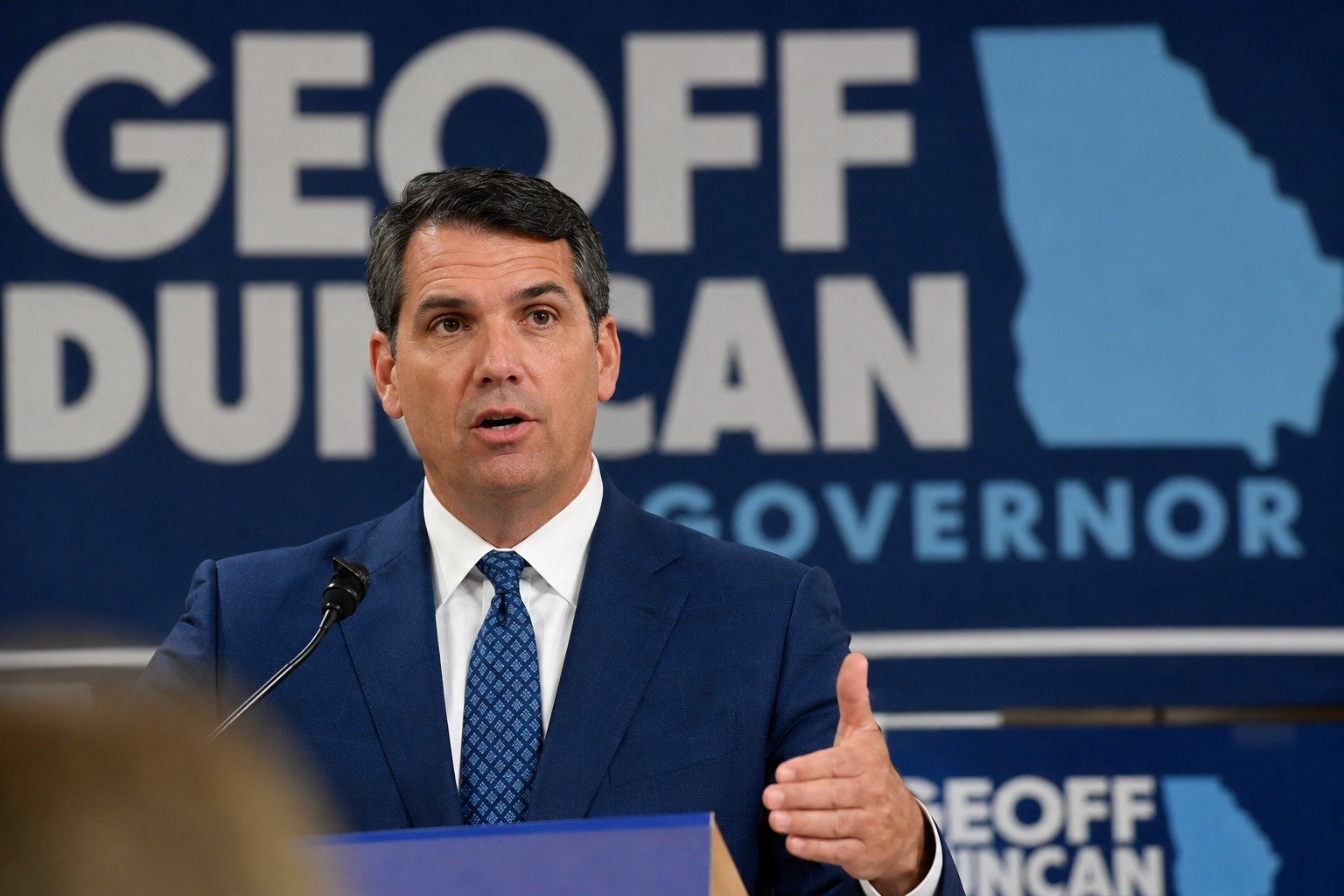
Former Georgia Lieutenant Governor Geoff Duncan made national headlines when he announced he was abandoning the Republican Party entirely and running for governor as a Democrat. It was a dramatic, headline-grabbing move — and on May 19th, Georgia voters delivered their verdict with a swift and decisive rebuke.
Duncan received just 7% of the vote in the Democratic primary. Former Atlanta Mayor Keisha Lance Bottoms dominated the field with 56%, effectively clinching the Democratic nomination before the night was over. For a candidate who had spent months positioning himself as a transformative political figure, it was a stunning collapse.
From Republican Rising Star to Democratic Long Shot
Duncan served as Georgia’s Lieutenant Governor from 2019 to 2023, gaining national attention as one of the few prominent Republicans willing to publicly criticize Donald Trump after the 2020 election. He was vocal, visible, and widely praised by the political media as a model for a post-Trump Republican Party.
But when it became clear the GOP wasn’t pivoting away from Trump, Duncan made an extraordinary decision: he would run for governor — as a Democrat. He framed the switch as a principled stand against MAGA extremism and an attempt to forge a new bipartisan path forward for voters on both sides who were fed up with party politics.
The announcement generated significant media buzz. Duncan appeared on major news networks, gave interviews to national outlets, and cultivated an image as the rare politician willing to sacrifice party loyalty for his convictions. Polls showed he had moderate name recognition, and some political observers speculated he could attract disaffected Republicans into the Democratic primary.
Primary Night Reality Check
It didn’t happen. Democratic primary voters turned out not to validate Duncan’s crossover experiment — they turned out to find the strongest candidate to challenge Georgia’s incumbent Republican governor. And for most of them, that wasn’t a former Republican lieutenant governor with a complicated history.
Keisha Lance Bottoms, who served as Atlanta’s mayor from 2018 to 2022 and was briefly considered as a running mate for Joe Biden in 2020, ran a focused, traditional Democratic campaign. She finished with 56% of the vote — more than eight times Duncan’s share.
The margin wasn’t close. It wasn’t even a respectable second-place finish. Duncan’s 7% showing placed him far behind the field, raising immediate questions about whether the media narrative around his candidacy had ever matched the reality on the ground with actual Democratic voters.
What the Results Tell Us
The Duncan result is a data point in a larger political argument: is there really a market for party-switching politicians? The media has long been fascinated by the idea of the principled crossover candidate who can unite voters across party lines. The voters themselves tend to be more skeptical.
Democrats who turned out for the Georgia primary weren’t looking for a former Republican — they were looking for someone they trusted to carry the Democratic banner into a difficult general election against an entrenched incumbent. Duncan, despite his anti-Trump credentials, never made that case convincingly enough to a Democratic electorate that had its own deep bench of candidates to choose from.
The result also raises questions about what happens to politicians like Duncan — those who make high-profile breaks from their party expecting that the political landscape will reorganize itself around them. Sometimes it does. More often, as Tuesday’s results showed, both parties keep moving and the crossover candidate finds himself without a home in either one.
For now, Keisha Lance Bottoms heads into the general election as the Democratic nominee. And Geoff Duncan’s bold gamble on switching parties has produced one of the more definitive primary night verdicts of the 2026 cycle.