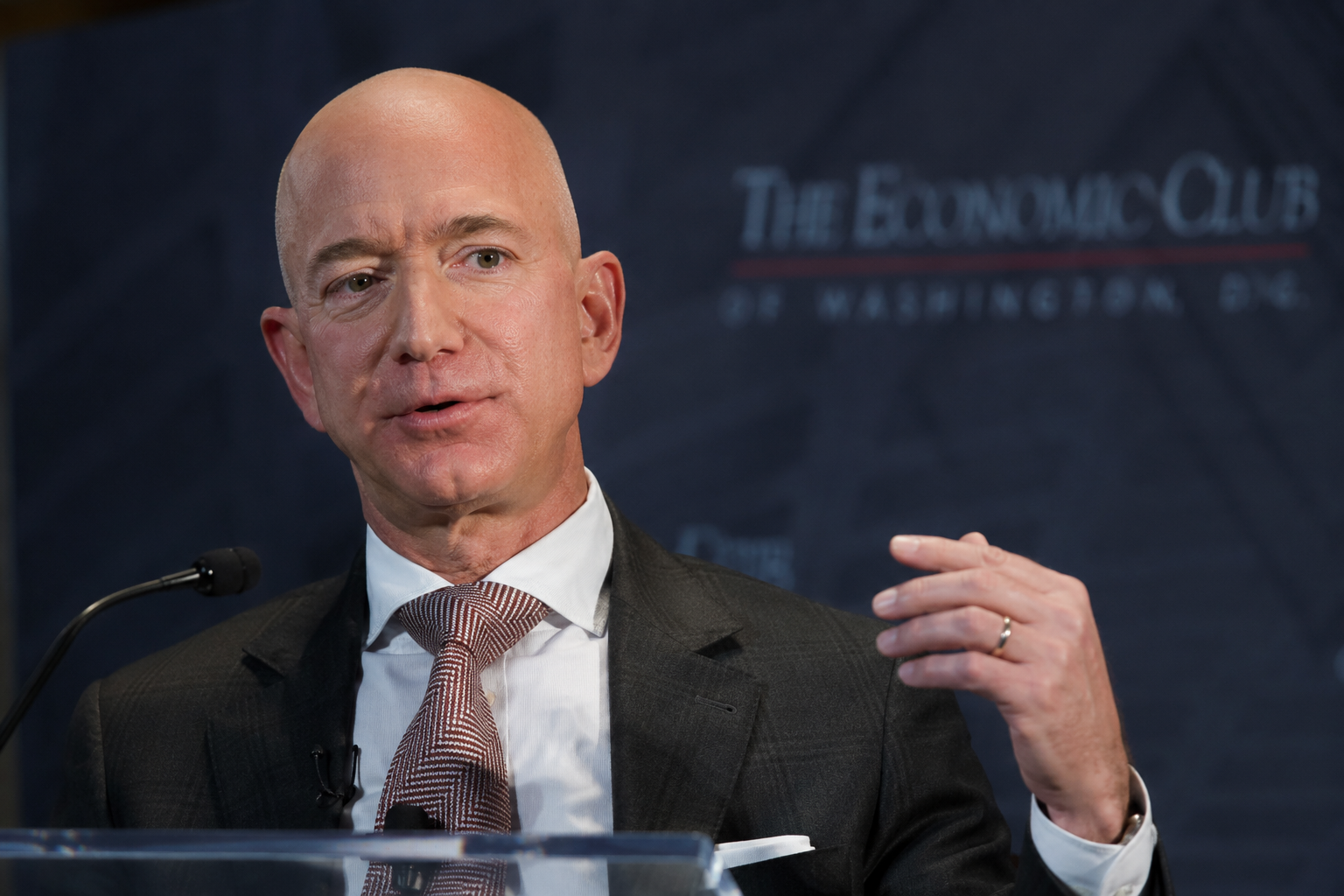
Jeff Bezos, the world’s wealthiest individual, has entered the American tax debate with a proposal that cuts across traditional political lines: he wants the bottom half of all U.S. earners to pay zero federal income taxes — and he’s prepared to bring that proposal directly to President Donald Trump.
A Proposal From an Unlikely Messenger
The federal income tax has been a source of political friction for decades. Republicans have long pushed for broad tax cuts; Democrats have focused relief on low and middle earners while calling for higher rates on the wealthy. What makes Bezos’s proposal unusual isn’t its direction — it’s the source. The founder of Amazon and owner of The Washington Post, worth more than $200 billion, is publicly advocating for working-class tax relief in a way few in his financial stratosphere have been willing to do openly.
Bezos has stated that Americans in the bottom 50% of the income distribution should owe no federal income taxes. Not a reduced rate. Not a partial exemption. Zero. And rather than simply floating the idea publicly, he’s committed to taking it to Trump as a formal policy proposal — a development that signals a notable shift in the relationship between two figures who have historically been at odds.
What the Proposal Actually Says
The rationale behind the proposal is straightforward: even modest tax obligations represent a disproportionate burden on lower earners. When a family making $35,000 a year owes several thousand dollars in federal income taxes, that money directly reduces their ability to afford housing, food, childcare, and healthcare. Bezos argues that eliminating their income tax obligation would provide an immediate, meaningful quality-of-life improvement for tens of millions of Americans.
According to IRS data, the bottom 50% of earners — roughly 75 million tax filers — account for approximately 3% of total federal income tax revenue. That figure means the fiscal cost of eliminating their obligation is smaller than the sheer number of people affected might suggest. Critics, however, point out that even 3% of a multi-trillion dollar tax base represents hundreds of billions of dollars in annual revenue that must either come from elsewhere or be added to an already-strained national debt. Bezos has not offered a detailed funding mechanism, and that omission has become the central target for skeptics.
The Bezos-Trump Dimension
The political backdrop here matters. Bezos and Trump have had a notoriously complicated relationship. Trump repeatedly targeted Amazon over its postal agreements and attacked The Washington Post over its coverage. Yet Bezos is now volunteering to work with the Trump administration on a domestic economic policy proposal — a gesture that carries weight regardless of whether the policy advances. Whether this represents a genuine policy push, strategic relationship-building, or both is a question Washington observers are already asking.
Trump has long been drawn to tax cut messaging, and his administration has already pushed significant reductions since returning to office. A proposal to eliminate income taxes entirely for half the country’s earners fits neatly within that rhetorical framework, even if the funding gap creates real legislative complications. The combination of a high-profile billionaire advocate and an administration already predisposed to tax cuts gives this proposal more traction than it might otherwise have.
Reactions From Both Sides
Progressive economists have raised immediate concerns about who would fill the revenue gap if lower earners are taken off the tax rolls. If the shortfall falls on middle earners rather than the ultra-wealthy, the net effect could actually harm the very people the policy claims to help. Some have also pointed out the irony of one of the world’s richest people advocating for a change that would do nothing for his own tax bill. Conservative voices have been more receptive in principle — lower taxes for working Americans aligns with the GOP’s core economic messaging — but many remain skeptical without a credible offset plan in hand.
What This Means for American Workers
If even a version of this proposal advanced — reducing or eliminating income taxes for lower earners — the impact would be immediate for millions of families. Extra hundreds or thousands of dollars annually isn’t an abstraction for someone paying rent on a tight income. Whether Bezos’s intervention accelerates that conversation or gets buried in political debate over funding, one thing is certain: working Americans now have one of the world’s richest people explicitly on record arguing their tax burden is too high. What Washington does with that is the next chapter.
Stay informed on the stories that matter most. Follow Your Daily Updates on Facebook and bookmark yourdailyupdates.news for breaking news and analysis.