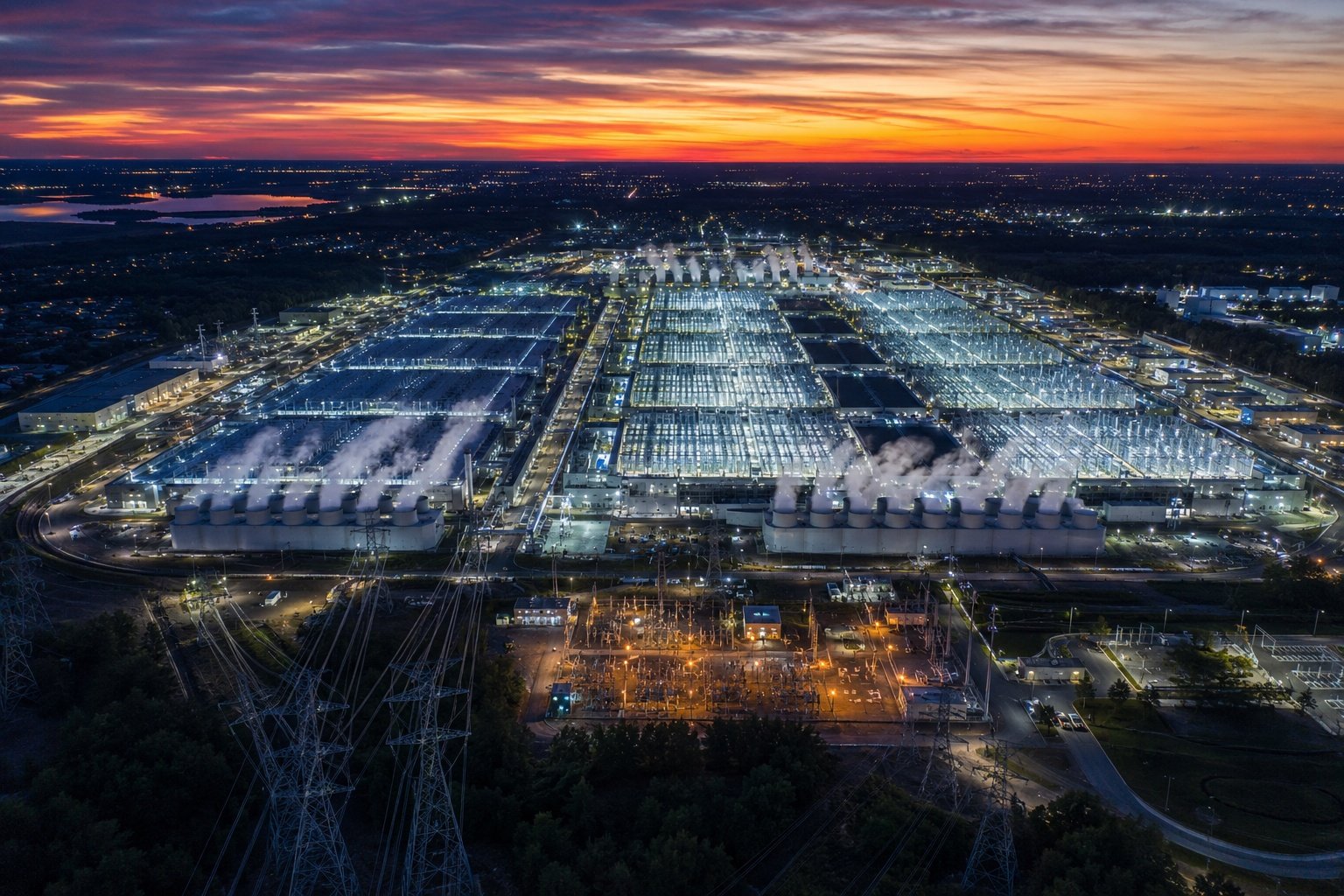
A single mid-size AI data center consumes roughly 20 million watts of electricity — enough to power every home, business, and streetlight in Montclair, New Jersey, a city of nearly 40,000 people. Now, 60 environmental, labor, and community groups across the state have had enough. In a sweeping letter submitted May 14, they’re demanding Governor Mikie Sherrill use her emergency powers to immediately stop all new data center approvals before New Jersey’s power grid buckles under the weight.
A Grid Under Siege
New Jersey is facing a quiet energy crisis. As tech companies race to build AI infrastructure, the state has become a magnet for massive data center projects — facilities that run 24 hours a day, seven days a week, consuming electricity at a scale that dwarfs entire neighborhoods. The coalition’s letter warns that New Jersey is being “overrun” with data centers without any coordinated state plan to manage the consequences for residents, ratepayers, or the environment.
The groups — spanning environmentalists, labor unions, and local grassroots organizations — want Sherrill to issue an emergency pause on all new approvals and construction of data center facilities. Their ask: hold until state officials can complete a full study of the cumulative impact on the electrical grid, utility rates, water supply, and public health. They’re not asking for a permanent ban — they’re asking for a time-out before the damage becomes irreversible.
Voters Are Already Demanding Action
The public isn’t waiting for Trenton to act. A Fairleigh Dickinson University poll found that 65% of registered New Jersey voters support banning new data centers outright until more power generation capacity can come online. Communities in the Pinelands region have gone even further — municipalities including Pemberton, Monroe, and North Hanover have passed local ordinances prohibiting new data center construction within their boundaries. Dozens of additional mayors are reportedly exploring similar measures.
The trend is significant. Local officials across party lines are hearing from residents who are alarmed by the prospect of surging electric bills, strained infrastructure, and industrial facilities moving into their communities with little public input. Data centers don’t bring many jobs — but they do bring enormous, permanent electricity demand that utilities must scramble to meet.
The PFAS Threat Nobody’s Talking About
Beyond the electricity crisis, the coalition is raising alarms about a less-discussed danger: the toxic chemicals used in data center cooling systems. Many large facilities rely on fluorinated compounds — chemicals linked to PFAS contamination — in their thermal management systems. PFAS, often called “forever chemicals,” have been tied to cancer, kidney disease, liver damage, and birth defects. They don’t break down in the environment and they accumulate in the body over time.
The groups warn that data centers using these cooling systems leak toxic substances into surrounding soil, groundwater, and air on a continuous basis. New Jersey is already fighting widespread PFAS contamination from decades of industrial activity — and the coalition argues the state cannot afford to add dozens of new contamination sources at precisely the moment it’s trying to clean up the existing ones. The intersection of electricity demand and chemical risk makes this one of the most complex environmental policy fights the state has faced in years.
What Sherrill Does Next Could Define Her Tenure
Governor Mikie Sherrill has not publicly responded to the coalition’s letter. Her silence itself is a political statement — the data center industry represents billions in investment and tax revenue, and tech companies have powerful lobbying operations in Trenton. But the political math is shifting. With 60 organized groups, a 65-percent voter majority, and local municipalities already acting unilaterally, the pressure for state-level action is building fast.
If Sherrill declines to act, communities will be forced to fight new data center projects town by town — an exhausting, expensive, and inconsistent process that favors industry over residents. If she acts, she sets a national precedent at a moment when AI infrastructure is expanding at breakneck speed and almost no state has a coherent policy framework for managing it. Either way, the decision will define her early tenure on environmental and energy issues.
What This Means for You
If you live in New Jersey — or any state where data centers are expanding — this fight directly affects your electric bill, the quality of your drinking water, and the capacity of your local grid. AI is one of the most electricity-hungry technologies ever built, and the infrastructure costs are being absorbed by ordinary ratepayers, not by the tech companies generating the demand. The question being asked in New Jersey is the same one that will soon reach every state: who pays for the AI boom, and who decides where the infrastructure gets built?
Stay informed on the stories that matter most. Follow Your Daily Updates on Facebook and bookmark yourdailyupdates.news for breaking news and analysis.