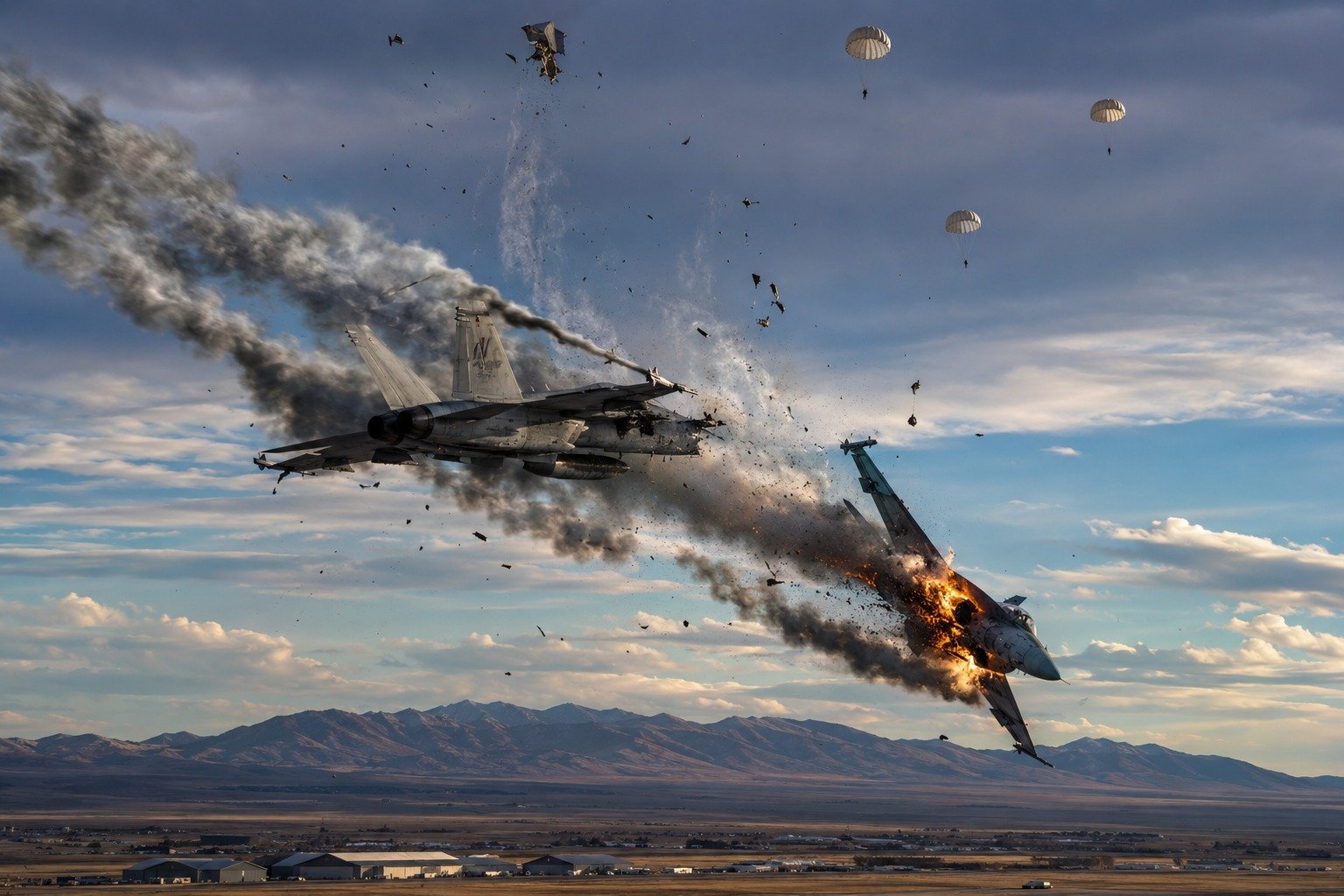
In front of a packed crowd of spectators, two U.S. Navy EA-18G Growler jets collided midair Sunday during the Gunfighter Skies Air Show at Mountain Home Air Force Base in Idaho — and video of the terrifying moment has gone absolutely viral, spreading across social media platforms within hours of the incident.
The footage is nothing short of stunning. The two jets can be seen flying in close formation before making contact mid-air, locking together momentarily, pitching violently upward, and then cartwheeling toward the ground in a massive ball of fire and smoke. Within seconds of impact, all four crew members had successfully ejected from their aircraft — parachuting safely to earth as both planes disintegrated on the desert floor below. The U.S. Navy confirmed that all four aviators were evaluated by medical personnel on the scene and are expected to recover.
The aircraft involved were the EA-18G Growler, the Navy’s premier electronic warfare platform. Developed by Boeing as a derivative of the F/A-18F Super Hornet, the Growler is specifically designed to jam enemy radar systems, suppress air defenses, and provide electronic protection for strike packages in contested airspace. Each aircraft costs roughly $67 million — and far more importantly, each requires years of specialized training to fly effectively. Both aircraft that collided Sunday belonged to Electronic Attack Squadron 129 (VAQ-129), known as the “Vikings,” based out of Naval Air Station Whidbey Island in Washington State. VAQ-129 serves as the Navy and Marine Corps’ fleet replacement squadron for the EA-18G, meaning it is responsible for training all Growler aviators.
The Gunfighter Skies Air Show is a major annual event hosted by Mountain Home Air Force Base — home to the 366th Fighter Wing, one of the Air Force’s most storied composite wings. Sunday marked the second and final day of the 2026 show when the collision occurred. The base was immediately locked down as emergency crews rushed to the impact sites, and the air show was suspended for the remainder of the day. Officials confirmed the crash sites were secured and no spectators were injured.
What made this incident remarkable — beyond the sheer spectacle of the collision — was that all four crew members survived. The EA-18G is a two-seat aircraft, so each jet carries a pilot and an electronic warfare officer. In a mid-air collision at airshow altitude and speed, even a half-second delay in ejection can be fatal. The fact that all four aviators successfully ejected and were recovered safely is a testament to the reliability of the Martin-Baker NACES ejection seat system used across Navy strike aircraft, as well as the trained instincts of the aircrew involved.
The Navy has confirmed that a formal mishap investigation will be launched to determine the exact cause of the collision. Mid-air collisions during airshow performances are extraordinarily rare, particularly among the tightly controlled formations flown by military demonstration teams. Investigators will examine flight data recorders, radio communications, and eyewitness accounts to piece together what went wrong in the final moments before the aircraft made contact.
For the Navy, the loss of two EA-18G Growlers represents a significant material cost — but the survival of the crew is what matters most. These are elite aviators with years of training and experience. The airshow community and military aviation world collectively exhaled when confirmation came that all four had been recovered alive and conscious.
Miraculously, all four crew members survived. In any other scenario — even a split second later — this ends very differently. Drop a comment below: what do you think about the incredible bravery and training it takes to fly missions like this?