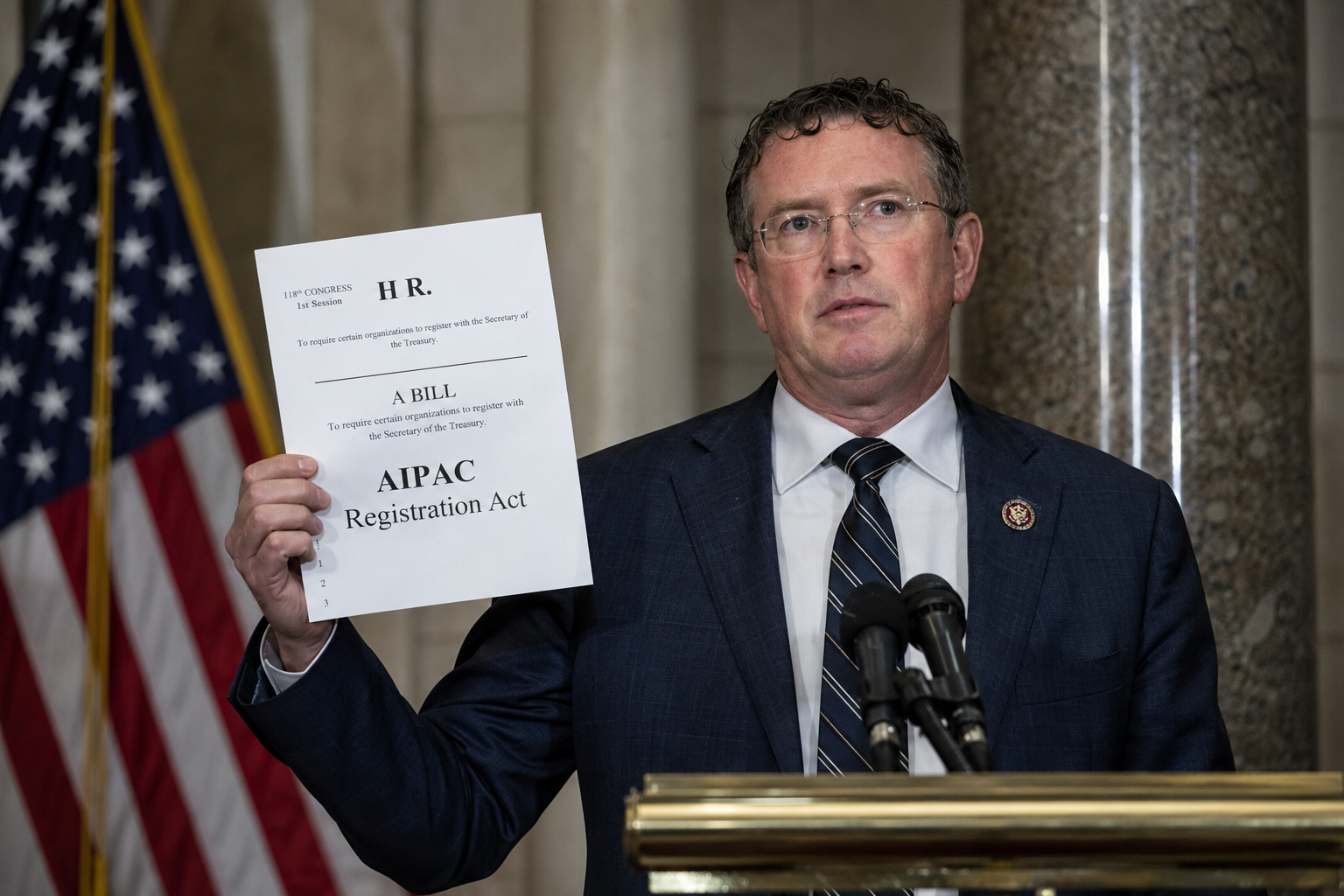
Republican Rep. Thomas Massie of Kentucky has introduced legislation that would require the American Israel Public Affairs Committee — one of the most powerful lobbying organizations in Washington — to register as a foreign agent under federal law. The bill, called the AIPAC Act (Americans Insist on Political Agent Clarity Act), arrives at a moment of maximum political tension: just days before Massie faces a primary election in which AIPAC has reportedly spent heavily to end his congressional career.
What the AIPAC Act Would Do
AIPAC was founded in 1953 and has operated for decades as a domestic lobbying organization, arguing that it represents American citizens who support U.S.-Israel relations and therefore falls outside the scope of the Foreign Agents Registration Act. FARA, passed in 1938, requires individuals and organizations acting on behalf of foreign principals to publicly disclose their activities, funding sources, and political work.
Massie’s bill would amend FARA to include any organization that receives direction, funding, or significant coordination from a foreign government in the conduct of its U.S. political activities. Under the legislation, AIPAC would be required to register with the Justice Department, publicly disclose its funding sources and any coordination with Israeli government officials, and file regular reports on its lobbying expenditures and political activities.
AIPAC’s Power — and Why It Matters
AIPAC spent more than $100 million in the 2024 election cycle alone, making it one of the single largest political spenders in American politics. The group has run aggressive primary campaigns against members of Congress it views as insufficiently supportive of Israel — pouring resources into races across both parties. Critics have long argued that AIPAC’s mission of advancing policies favorable to the Israeli government makes it functionally equivalent to a foreign agent, regardless of its membership structure.
In recent years, FARA enforcement has become a politically charged flashpoint. The Justice Department has ramped up prosecutions, and several high-profile figures — including former Trump campaign chairman Paul Manafort — have faced FARA charges for lobbying work connected to foreign governments. The question of whether major advocacy organizations like AIPAC should face similar scrutiny has become a growing fault line in debates about foreign influence in American democracy.
The Timing: A Direct Confrontation
The timing of Massie’s bill is impossible to ignore. AIPAC-aligned super PACs have reportedly poured significant resources into his Kentucky primary, backing a challenger aimed squarely at removing Massie from Congress. His introduction of the AIPAC Act days before that vote reads, to most observers, as a deliberate escalation — a public statement that he will not be intimidated into silence by the very organization targeting him.
Massie has been a consistent voice of skepticism toward Washington’s foreign policy establishment. He has voted against military aid packages, opposed U.S. involvement in overseas conflicts, and challenged the bipartisan consensus on American obligations to allied nations. His bill is entirely consistent with his broader political philosophy: transparency in how foreign interests shape American policy, and resistance to what he views as unaccountable lobbying power.
Supporters, Critics, and the Legal Debate
Supporters of the bill argue that no lobbying organization should be exempt from transparency requirements based solely on which foreign country it advocates for. If an organization coordinating with a foreign government to shape American elections doesn’t meet the definition of a foreign agent, they argue, then the law has a significant gap that needs closing.
Opponents — and there are many — argue that AIPAC is a domestic membership organization made up of American citizens exercising their First Amendment rights, and that labeling it a foreign agent would be both legally suspect and politically motivated. Several AIPAC-aligned lawmakers have dismissed the legislation as a campaign stunt, and legal scholars remain split on whether the bill’s definition of “direction or coordination” would survive constitutional challenge in federal court.
What This Means for Americans
Whether this bill passes or not — and most observers believe it won’t, at least not in this Congress — it forces a conversation every American voter should be having. When lobbying organizations spend hundreds of millions of dollars reshaping elections, the question of who those organizations ultimately answer to stops being an abstract legal debate. It becomes a question about who actually controls American foreign policy, and whether voters have the right to know the answer.
Stay informed on the stories that matter most. Follow Your Daily Updates on Facebook and bookmark yourdailyupdates.news for breaking news and analysis.