More than half of Americans now believe billionaires represent a direct threat to U.S. democracy — and a new poll reveals just how dramatically public opinion has shifted in a single year.
A Harris Poll conducted in October 2025 surveyed 2,117 Americans nationwide and found that 53% view the ultra-wealthy as a threat to democratic governance. That’s up 7 percentage points from 46% just one year earlier — a significant jump that suggests the sentiment isn’t a fleeting reaction but a deepening trend.
The Numbers Tell a Clear Story
The threat question is only the beginning. The poll paints a comprehensive picture of how Americans feel about billionaire influence in public life — and the results are striking across the board.
Seventy-one percent of respondents said they want the ultra-wealthy to play a smaller role in U.S. politics. That same 71% also support a national wealth tax. Sixty-four percent favor mandatory philanthropic contributions for anyone worth over $1 billion. And 53% support a hard cap on personal wealth — with most respondents suggesting the limit should be set at $10 billion.
These aren’t fringe positions. They represent majority or supermajority views among the American public, cutting across party lines in ways that traditional partisan polling rarely captures.
The Inauguration Moment That Changed Everything
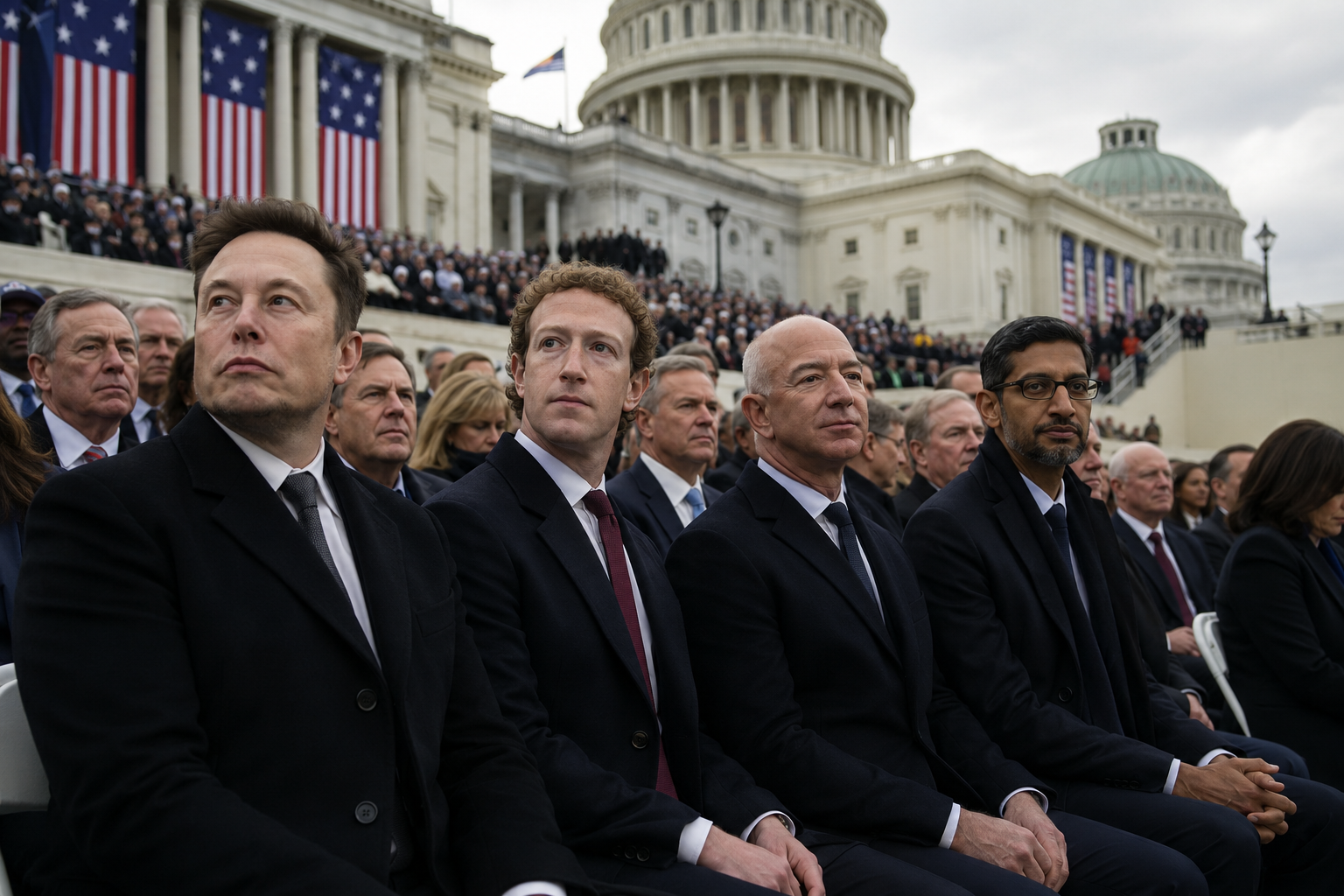
It’s hard to discuss this poll without addressing what many analysts believe accelerated the shift: the front-row presence of Elon Musk, Mark Zuckerberg, Jeff Bezos, and Sundar Pichai at Donald Trump’s January 2025 inauguration. The image of four of the world’s wealthiest men seated in positions of prominence at one of the most powerful political ceremonies in the world went viral — and it sparked a national conversation that hasn’t stopped.
For many Americans, that moment crystallized a concern that had been building for years: that the very wealthy don’t just influence politics — they occupy it. The question is no longer whether billionaires have outsized political power. The question is what, if anything, should be done about it.
The Debate: Rights vs. Influence
The counterargument is straightforward. Billionaires are American citizens. The First Amendment guarantees every citizen — regardless of wealth — the right to participate in the political process. Many argue that Musk, Bezos, and others built transformative companies that employ hundreds of thousands of people, and that their political engagement is no different from any other citizen exercising their rights.
Critics push back hard. They argue that political “participation” at the billionaire level — funding super PACs, owning major media platforms, and landing front-row seats at inaugurations — is categorically different from ordinary civic engagement. When one person can spend more on a single election than entire states raise in tax revenue, the word “participation” starts to feel inadequate.
What This Means for Americans
For most Americans, this debate isn’t abstract. It’s about whether their vote carries the same weight as a billionaire’s checkbook — and whether politicians are accountable to their constituents or to their donors. The Harris Poll suggests that a growing majority of Americans believe the answer to both of those questions is no. Whether that belief translates into policy action is the question that Washington will have to reckon with.
Stay informed on the stories that matter most. Follow Your Daily Updates on Facebook and bookmark yourdailyupdates.news for breaking news and analysis.