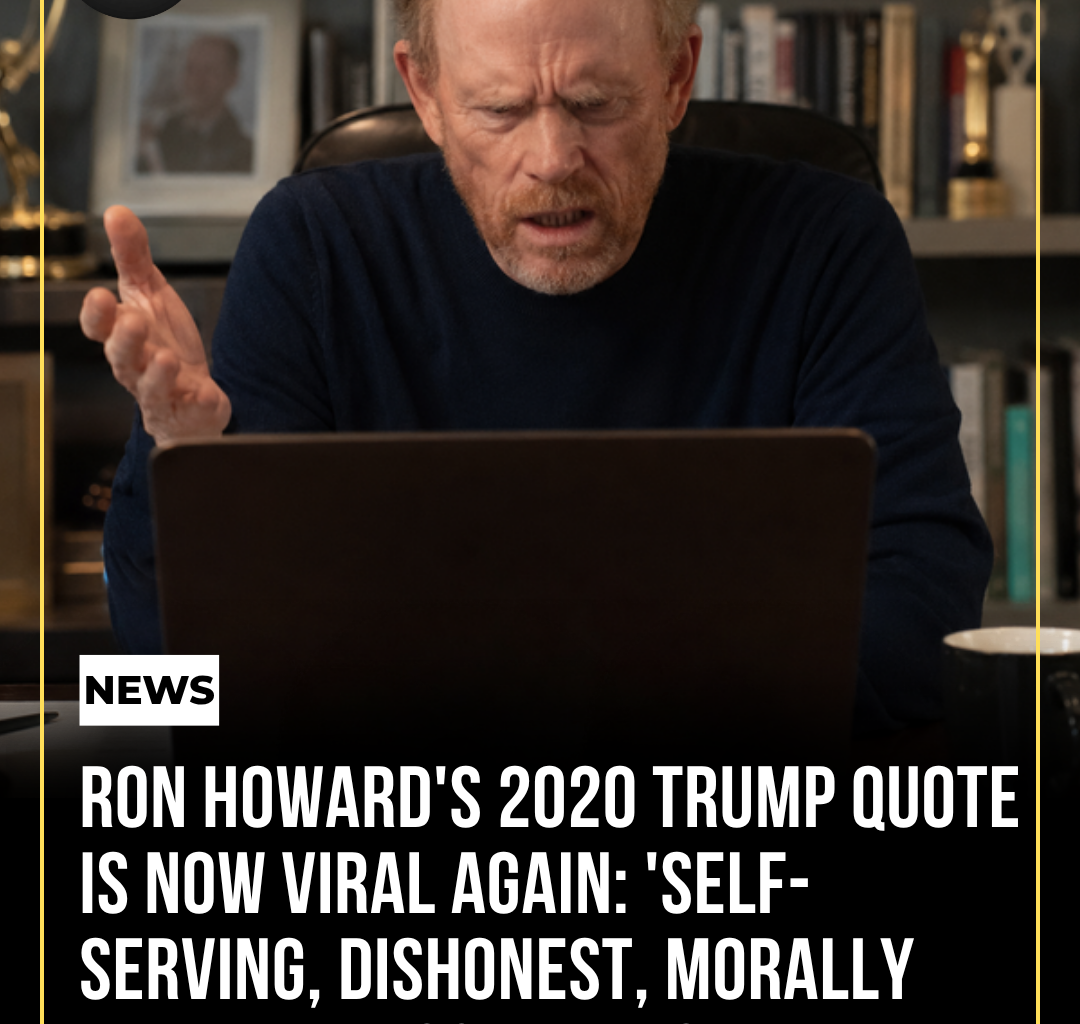
On New Year’s Day 2020, Oscar-winning director Ron Howard posted a tweet that became one of Hollywood’s most-shared political statements of the Trump era. He described Donald Trump as “a self-serving, dishonest, morally bankrupt ego maniac who doesn’t care about anything or anyone but his fame and bank account.” Six years later, the quote is back — circulating across social media in 2026 and dividing people all over again.
Howard, known for directing some of Hollywood’s most celebrated films — including Apollo 13, A Beautiful Mind, Frost/Nixon, and The Da Vinci Code — has never been shy about his political views. But the January 1, 2020 post stood out. It wasn’t a response to a specific policy or debate. It was a blunt, comprehensive character assessment that landed differently because it came from someone who had spent decades in the same elite entertainment circles Trump had occupied long before entering politics.
Howard framed the statement not just as personal opinion but as a sentiment he said was broadly shared among those in the entertainment industry who had observed or interacted with Trump over the years. Trump, who appeared on television, invested in Atlantic City casinos, hosted beauty pageants, and crossed paths with Hollywood’s biggest names throughout the 1980s and 1990s, was well known in celebrity circles long before he became a political figure.
The 2020 tweet came shortly after the House of Representatives voted to impeach Trump for the first time, on charges related to his conduct toward Ukraine. Tensions were high, and Howard’s words spread rapidly. Supporters shared it as validation. Critics dismissed it as Hollywood elitism. And then, like most viral moments, it faded — until now.
In 2026, as Trump’s second term moves forward, the quote has resurfaced with fresh urgency. For those who oppose Trump’s administration, the six-year-old statement feels newly relevant — a reminder that the concerns raised years ago have never been resolved. They share it with the same conviction as the first time around, as if no further argument is needed.
Trump supporters see it through an entirely different lens. To them, Hollywood’s unrelenting hostility toward Trump — stretching back a decade — is not insight but bias. They point out that Trump has won the loyalty of tens of millions of American voters across two presidential elections, suggesting the entertainment industry’s verdict does not reflect the views of ordinary Americans. Many argue that directors, actors, and producers living in the same coastal bubble simply do not understand the concerns that drove so many working-class voters to Trump in the first place.
The debate over Ron Howard’s quote ultimately reflects a larger, unresolved argument in American politics: whether opposition to Trump reflects principled concern about democratic institutions and character, or whether it represents the cultural contempt of a liberal elite for the half of the country that sees the world differently. Neither side has convinced the other, and neither appears close to doing so.
Howard has continued to speak publicly about Trump through both of his presidential terms. He has not walked back the 2020 statement. And in 2026, the fact that a six-year-old tweet is still generating debate — still being shared, still being argued over — says as much about the state of American political life as it does about the man the quote describes.