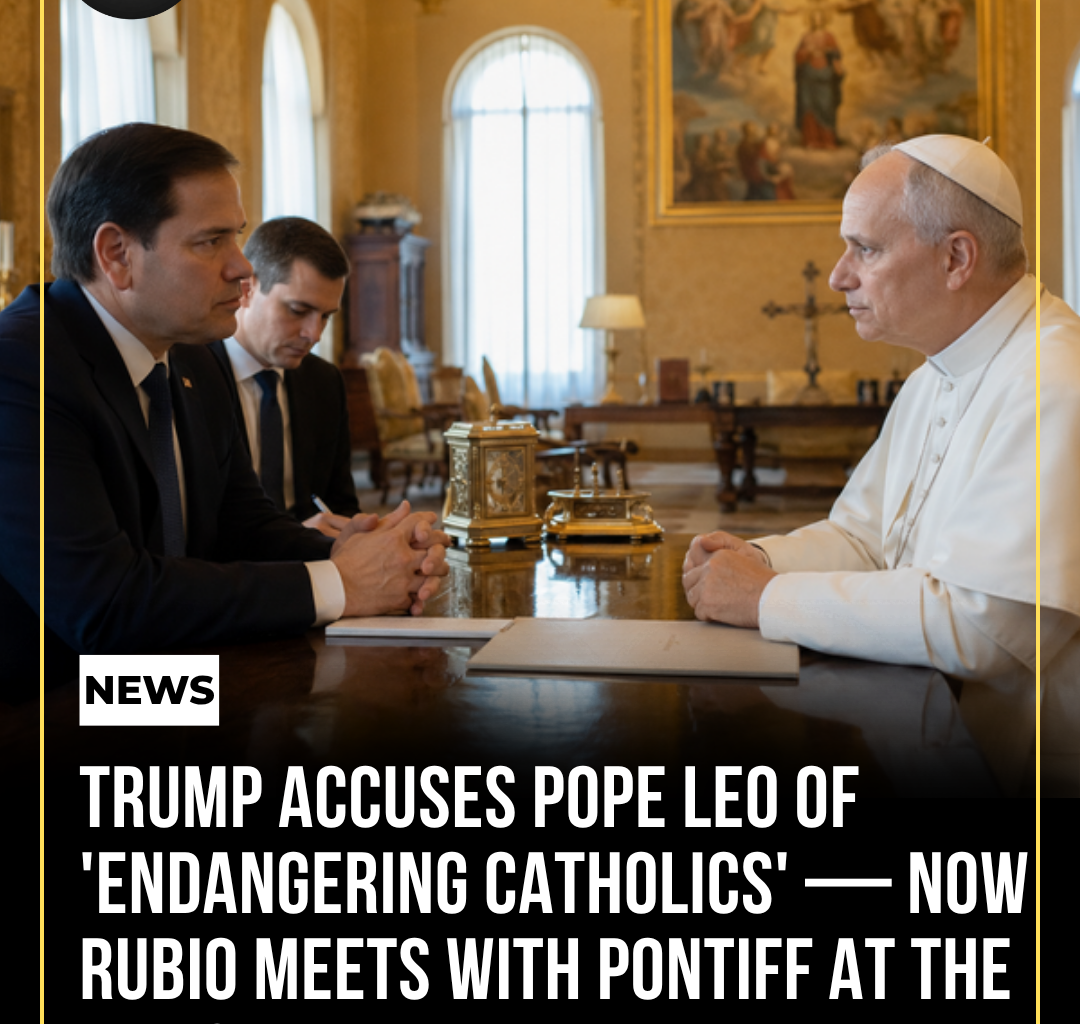
Secretary of State Marco Rubio traveled to the Vatican this week for what he described as a “very cordial and important” meeting with Pope Leo XIV — even as an increasingly sharp public feud between President Trump and the American-born pontiff continues to escalate over the U.S. military operation in Iran.
Rubio sat down with Pope Leo for a private meeting at the Vatican, briefing the pontiff on the situation in the Middle East and laying out what he called “the danger Iran poses to the world.” According to Rubio, the conversation was substantive and productive. He told reporters afterward that both sides exchanged their perspectives openly, that they found areas of agreement on protecting civilian life, and that he walked away feeling encouraged by the dialogue — even if the two sides remain far apart on the broader question of military action.
The Vatican meeting came at a delicate moment. President Trump has been escalating his public criticism of Pope Leo in increasingly blunt terms, targeting the pope’s vocal opposition to American military strikes on Iran. Trump called the pope “WEAK on crime, and terrible for Foreign Policy” in a social media post — and followed up by accusing the pontiff of “endangering a lot of Catholics” with his insistence on pursuing a negotiated peace. In a radio interview, Trump went further, saying: “I guess if it’s up to the pope, he thinks it’s just fine for Iran to have a nuclear weapon.” The White House has made no attempt to soften the attacks.
Pope Leo, for his part, has not backed down. He posted on social media that “God does not bless any conflict,” and added that anyone who follows the teachings of Christ “is never on the side of those who once wielded the sword and today drop bombs.” The message was widely interpreted as a direct rebuke of the Trump administration’s military posture. The pope has repeatedly called for a ceasefire and diplomatic engagement, positioning the Holy See as an advocate for negotiations over force.
Vice President JD Vance — who has been publicly promoting a book about his conversion to Catholicism — waded into the dispute with a pointed message of his own. Vance told reporters the pope should “be careful” when invoking “matters of theology” in the context of geopolitics, drawing a line between faith and foreign policy in a way that drew sharp criticism from Catholic commentators across the political spectrum.
The backdrop to all of this is a high-stakes nuclear negotiation. The Trump administration walked away from the Obama-era Iran nuclear deal and has since pursued a more aggressive posture toward Tehran, including the military strikes that prompted the current standoff. The U.S. is now in talks aimed at securing a new agreement that would limit Iran’s nuclear program in exchange for sanctions relief. At stake is not just the nuclear question but control of the Strait of Hormuz — the narrow waterway through which roughly 20 percent of the world’s oil supply flows — which Iran has repeatedly threatened to block.
Rubio’s visit to the Vatican places him in a uniquely complicated diplomatic position. He is representing an administration that has publicly attacked the pope while simultaneously seeking the Holy See’s credibility and moral authority in international affairs. Vatican officials have signaled that Pope Leo intends to continue speaking out, regardless of the political pressure from Washington.
For American Catholics — who make up roughly 20 percent of the U.S. electorate — the open confrontation between the White House and the Vatican presents an uncomfortable divide. Church leadership has been clear about where it stands. The White House shows no sign of softening its position. And with nuclear talks ongoing and military options still on the table, the stakes could not be higher. Rubio left Rome with no public breakthrough to announce — just the acknowledgment that the conversation happened, and that it was, at least, cordial.