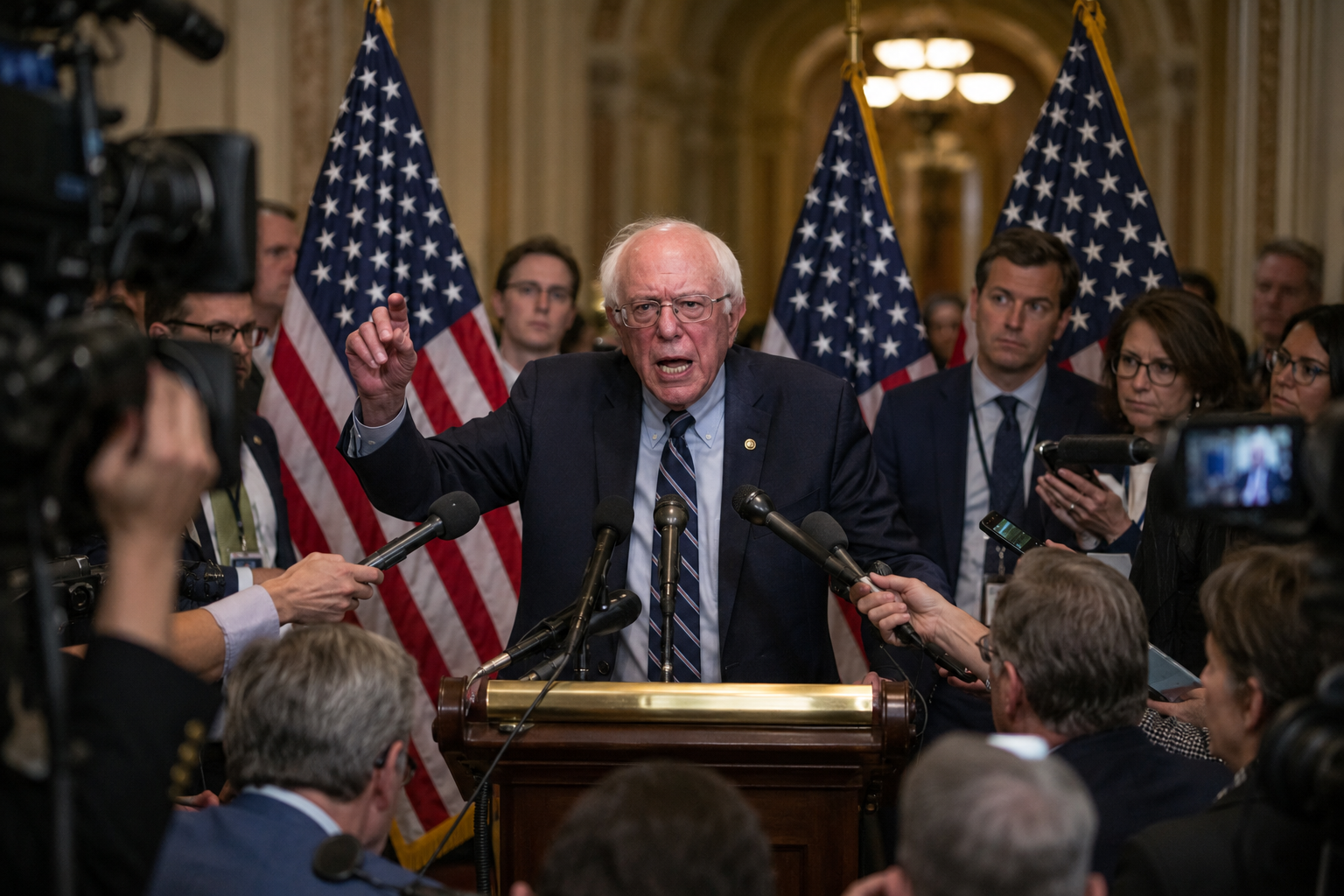
Senator Bernie Sanders and Representative Ro Khanna have introduced legislation that would fundamentally reshape how America taxes its wealthiest citizens — and the debate it’s igniting is already enormous.
The bill, called the Make Billionaires Pay Act, would impose a 5% annual tax on the accumulated wealth of America’s 938 billionaires. Economists Emmanuel Saez and Gabriel Zucman — who helped draft the proposal — project the plan would raise $4.4 trillion over the next decade. That’s not income tax. That’s a direct annual levy on the total net worth of the ultra-wealthy, assessed year after year regardless of whether those assets are sold.
Here’s where that money would go: every person in a household earning under $150,000 would receive a $3,000 direct payment — that’s $12,000 for a family of four. Public school teachers would get a guaranteed minimum salary of $60,000 per year. Medicare would be expanded to cover dental, vision, and hearing, and the bill would reverse $1.1 trillion in proposed Medicaid cuts that have alarmed healthcare advocates across the country.
Sanders has been pushing versions of this idea for years, but this version is more detailed — and more aggressive — than anything he’s formally introduced before. “At a time of massive wealth inequality,” Sanders said at the bill’s unveiling, “we must demand that the very wealthy pay their fair share.”
Supporters point to data showing that America’s billionaire class has seen its collective net worth soar by roughly $2 trillion since 2020 alone, while median wages for working-class Americans have barely kept pace with inflation. They argue the wealth gap isn’t the result of merit — it’s the result of a tax code that treats capital gains far more favorably than wages.
Opponents, however, are raising serious objections. Constitutional scholars point out that a direct annual wealth tax has never been tested at the federal level and could face significant legal challenges under Article I, which restricts “direct taxes.” Conservatives argue the bill would discourage investment, drive capital offshore, and ultimately harm the very workers it claims to help.
There’s also an international track record that critics are eager to invoke. France, Sweden, Germany, and several other European nations experimented with annual wealth taxes — and most eventually repealed them after they failed to generate projected revenue, triggered capital flight, and proved enormously difficult to administer. Billionaires with diversified, illiquid assets don’t always have cash on hand to pay a multi-million-dollar tax bill without selling stakes in the companies they run.
Proponents counter that those European models were poorly designed, had too many loopholes, and set rates too low to be effective. The Sanders-Khanna proposal, they argue, is structured differently and comes with robust enforcement mechanisms.
Whether or not the bill passes — and in the current Congress, its path is narrow — it is already reshaping the economic debate heading into the 2026 election cycle. Democrats running in competitive districts will face pressure to either embrace or distance themselves from the proposal. Republicans will use it to paint the left as hostile to investment and economic growth.
The real question may be simpler than the policy debate: if a check showed up in your mailbox every year — $3,000 per person, $12,000 for a family of four — would you want it? And if the price is a 5% annual tax on the 938 wealthiest Americans in the country, is that a trade-off you’d support?