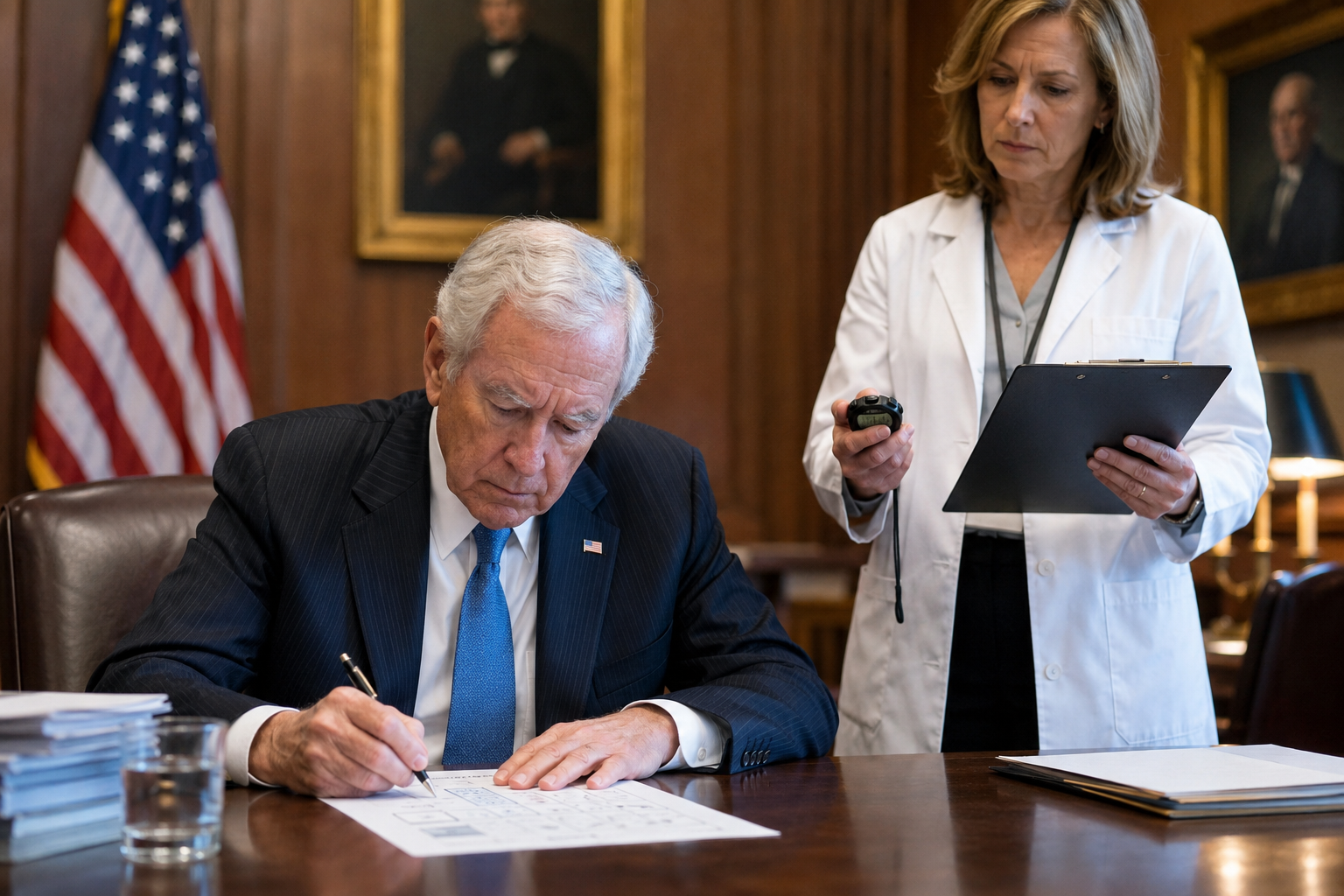
A Washington State lawmaker has introduced legislation that would require members of Congress to pass cognitive fitness tests — a proposal that, if enacted, would mark the first time in American history that sitting federal legislators face a standardized mental evaluation as a condition of holding office.
Why Now?
The push comes amid mounting public scrutiny of lawmakers’ mental sharpness. Nearly 120 members of the U.S. Congress are 70 years or older, and in recent years, viral clips of confused moments during hearings and floor votes have intensified debate about whether age limits or fitness standards should apply to elected officials. The average age of a U.S. Senator now exceeds 65 — the oldest in congressional history.
Despite controlling trillion-dollar budgets and authorizing military operations, members of Congress face no formal cognitive assessment whatsoever. That double standard is at the center of the new proposal.
What the Bill Would Do
The legislation would empower the Office of Congressional Conduct to administer standardized cognitive evaluations to sitting members of Congress. Tests would assess memory, attention, reasoning, and decision-making capacity. Results would be reviewed by independent medical professionals, and lawmakers who fail would enter a review process before being allowed to continue exercising their full voting authority.
The bill’s sponsor draws a direct comparison to other high-stakes professions: airline pilots are required to pass cognitive and physical exams every six months after age 40; surgeons face periodic peer review and credentialing requirements; commercial truck drivers undergo medical evaluations. Yet U.S. senators and representatives — who vote on declarations of war, shape the national economy, and confirm Supreme Court justices — face no such requirements.
Supporters argue the measure is long overdue. They point to several high-profile incidents in recent years — confused floor statements, scripted answers that still missed the mark — as evidence that some lawmakers are no longer operating at the cognitive level the job demands. “If you’re trusted with decisions that affect 330 million Americans, you should be able to pass a memory test,” one advocacy group supporting the bill stated.
The Pushback
Critics have pushed back sharply. Several constitutional scholars argue the legislation directly conflicts with Article I of the Constitution, which lays out the explicit qualifications for congressional service — age, citizenship, and residency only. Adding cognitive tests would require a constitutional amendment, which demands approval from two-thirds of both chambers of Congress and ratification by three-quarters of the states — a near-impossible bar under current political conditions.
Some lawmakers have called the bill “ageism dressed up as reform.” Others warn it could be weaponized politically — used selectively against opponents during moments of partisan tension. Civil liberties advocates have also signaled opposition, arguing the proposal could disproportionately affect lawmakers with certain disabilities and create a dangerous precedent for removing elected officials through bureaucratic mechanisms.
What This Means for Americans
Americans frustrated with an aging political class will likely view this as a rare moment of accountability. But the constitutional hurdles are real — and without a formal amendment process, no law can override Article I’s qualifications for office. Still, the debate is unlikely to fade. With voters on both sides of the aisle polling in favor of some form of age or fitness standards for federal officials, pressure on Congress to act is growing — whether lawmakers want it to or not.
Stay informed on the stories that matter most. Follow Your Daily Updates on Facebook and bookmark yourdailyupdates.news for breaking news and analysis.