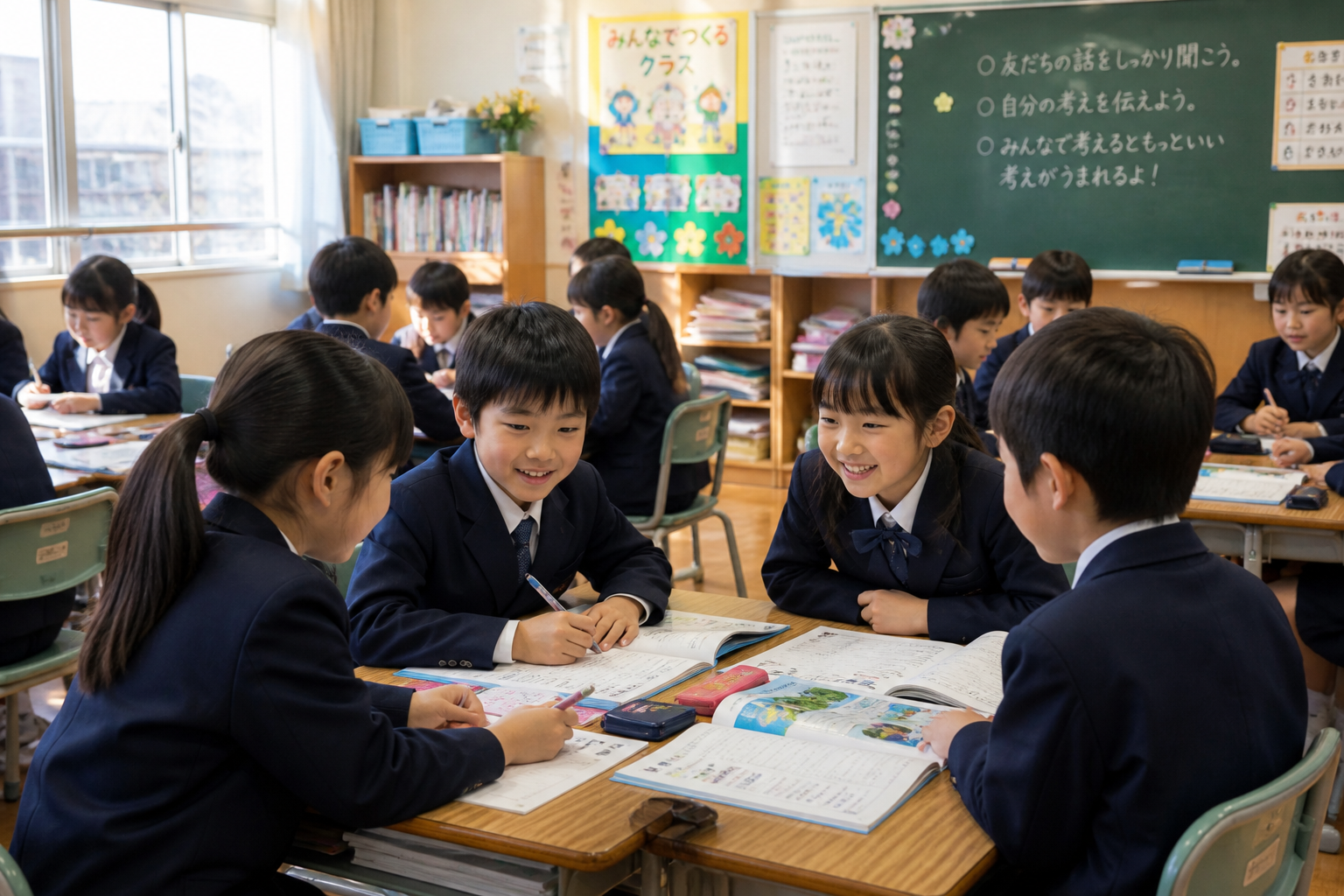
Japan doesn’t give children a single graded exam until the 4th grade. No standardized tests. No report cards ranked by performance. No academic pressure designed to sort children by how fast they can absorb information before they’ve lost their first tooth.
For the first three years of school, Japanese children aren’t being tested on what they know. They’re being shaped into who they’re going to be.
And the results have been embarrassing American educators for decades.
What the First Three Years Actually Look Like
Walk into a Japanese elementary school during those early years and you won’t find rows of children hunched over worksheets. You’ll find kids cleaning their own classrooms. Serving lunch to their classmates. Practicing how to bow, how to address a teacher, how to wait their turn, how to take responsibility for shared spaces.
This isn’t supplementary programming. This is the curriculum.
Japan’s education philosophy — rooted in a concept called “whole child” development — holds that character must come before content. The theory is that a child who hasn’t learned discipline, respect, and collective responsibility isn’t actually ready to learn anything else at a deep level. You can drill facts into an undisciplined mind. You can’t build lasting knowledge there.
So Japan invests the first three years in the foundation. By the time formal academics and testing begin in the 4th grade, students have already spent years developing the habits that make learning stick.
What the Data Says
This isn’t an abstract philosophical preference. Japan consistently ranks among the world’s top nations in international assessments for math, science, and reading. The Programme for International Student Assessment — the most widely referenced global education benchmark — has placed Japan near the top for years.
The United States has not.
The U.S. spends more per pupil than almost any nation on earth. It has more standardized testing infrastructure, more assessment frameworks, and more education policy debates than most countries could sustain. And it has been losing ground in international rankings for decades while spending more to do it.
Japan, by contrast, spends comparatively less, tests later, and consistently outperforms.
What America Does Instead
The American approach to early education has moved steadily in the opposite direction from Japan’s.
Standardized testing in the U.S. begins in many states as early as kindergarten. By the time American students reach 3rd grade — the year before Japan even introduces formal exams — they’ve already sat through years of high-stakes assessments designed to measure, rank, and sort them.
The logic behind this approach is intuitive: if you want children to perform academically, start measuring academic performance early. Identify gaps. Intervene. Improve outcomes.
The data suggests this logic is wrong. Or at least, that starting with measurement before the foundation is built doesn’t produce the outcomes it promises.
Character Isn’t Soft — It’s Infrastructure
The most consistent pushback against Japan’s model from American education reformers is that it sounds nice but isn’t rigorous enough. That “cleaning classrooms” and “learning to bow” won’t prepare students for a competitive global economy.
Japan’s test scores answer that argument directly.
What Japanese educators understand — and what the American system has largely forgotten — is that character isn’t a soft add-on to serious education. It’s the infrastructure that serious education runs on. Discipline, attention, collective accountability, respect for the learning environment: these aren’t values that come naturally to young children. They have to be taught. And if you don’t teach them first, you spend the rest of a child’s academic career trying to work around their absence.
Japan teaches them first. Then it teaches everything else.
The Question America Needs to Ask
This isn’t an argument for copying Japan wholesale. Different cultures produce different systems, and not every element of Japan’s education model is transferable. Japan also faces its own serious education challenges, including intense academic pressure in middle and high school and mental health concerns among older students.
But the early-years model raises a question worth sitting with: What if America’s problem isn’t that it starts too late — but that it starts the wrong things too early?
Standardized testing in kindergarten doesn’t produce curious, disciplined learners. It produces anxious ones. The pressure to perform academically before the behavioral and emotional foundation is built doesn’t accelerate learning. It undermines it.
Japan figured that out a long time ago. The scores prove it’s working.
The only question left is whether American education policy is willing to look at what the data is saying — and make a different choice.