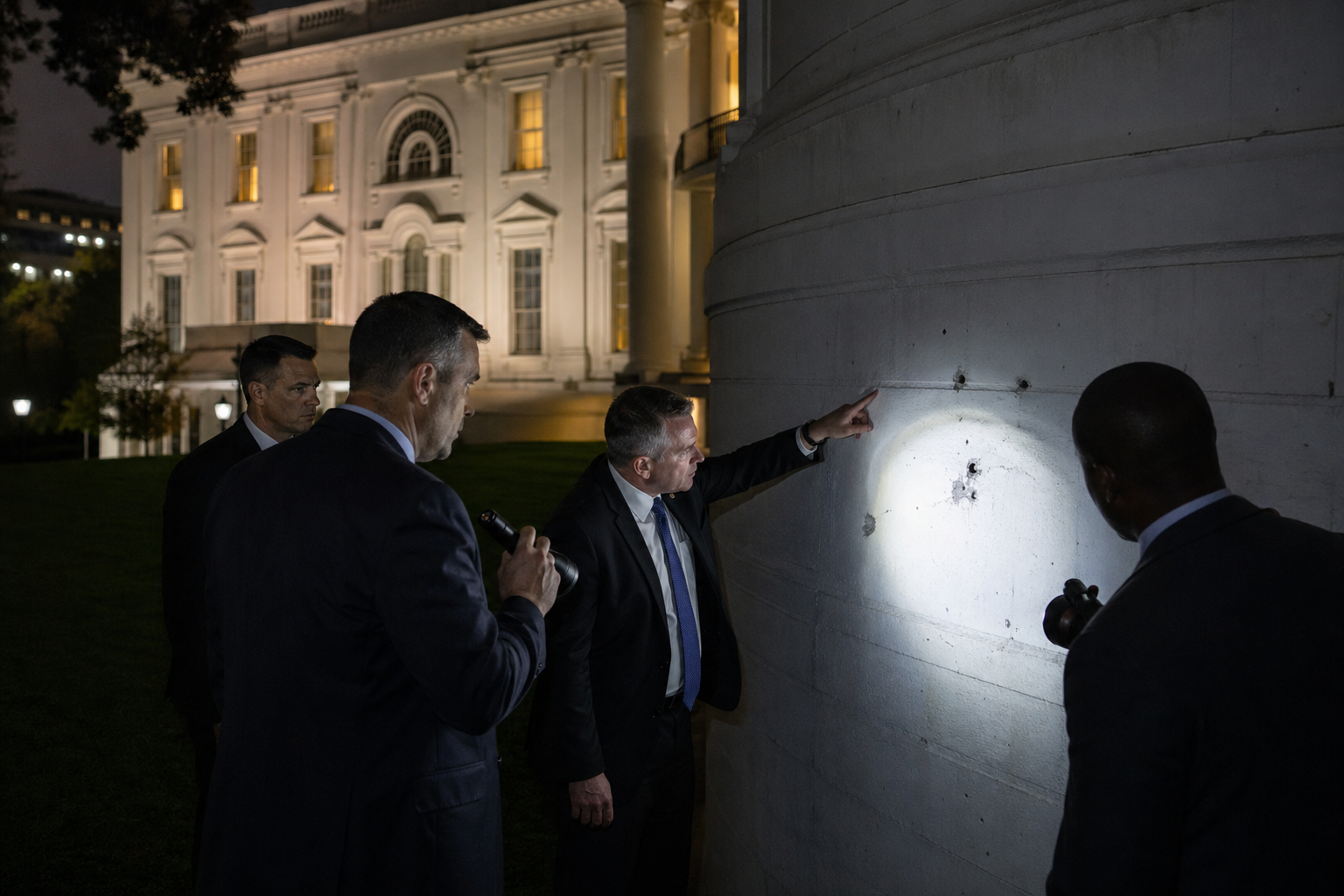
In November 2011, a gunman opened fire on the White House from Constitution Avenue. Seven bullets struck the building’s second-floor residence. Sasha Obama and her grandmother were inside. The Secret Service did not realize bullets had hit the building for four days.
A Pattern Hidden in Plain Sight
That incident was one of at least 11 documented assassination attempts against Barack Obama during his eight years in office — the vast majority of which received little or no sustained national media coverage. Presidential security threats are routinely handled quietly, kept out of the news cycle to avoid encouraging copycats and to protect ongoing investigations. But the cumulative picture, viewed together, is staggering.
By some accounts, Obama received four times as many threats as any previous president in Secret Service history. The agency tracked them, prosecuted many, and disclosed almost none. Most Americans had no idea.
The 2011 White House Shooting — The One That Made It Through
The most dramatic incident came from Oscar Ortega-Hernandez, a 21-year-old Idaho man who drove to Washington, D.C. and opened fire on the White House with a semi-automatic rifle. Surveillance footage captured the moment, but Secret Service agents on duty initially dismissed the sound as a car backfire. It took four days — and a housekeeper who noticed broken glass and concrete dust — before anyone realized the residence had actually been struck. At least seven rounds had hit the second-floor exterior. Secret Service Director Mark Sullivan later resigned, in part over the agency’s failure to recognize the attack.
The Other Ten — Plots Most Americans Never Heard Of
The 2011 shooting was the most visible, but far from the only threat. In 2008, before Obama had even been inaugurated, two white supremacists in Tennessee were arrested while allegedly plotting to murder him and dozens of Black students in a simultaneous attack. In 2009, a man carrying a knife and using fake press credentials managed to get dangerously close to Obama’s motorcade during a NATO summit in Istanbul. A militia group called FEAR — Forever Enduring, Always Ready — was dismantled before members could execute what investigators described as a planned attack on government officials. Multiple other plots, ranging from lone-actor threats to organized conspiracies, were tracked, investigated, and quietly resolved without ever making the front page.
Biden Was Not Exempt
The pattern extended into the Biden years. U.S. authorities disrupted an Iran-backed plot to assassinate American officials — including Biden himself — as direct retaliation for the U.S. killing of Iranian General Qasem Soleimani. In May 2023, a man rammed a U-Haul truck into security barriers near the White House, telling investigators afterward that he intended to harm the president and seize power. In August 2023, Craig Robertson — a Utah man who had posted repeated, specific armed threats against Biden online — was shot and killed by FBI agents when they moved in to arrest him.
Why All of This Is Back in the News Now
On April 25, 2026, a gunman opened fire near the White House Correspondents’ Dinner, striking a Secret Service agent in the protective vest. The agent survived. The Trump administration has since pointed to the shooting as evidence of an escalating threat environment — and cited it as partial justification for a proposed $400 million White House renovation that includes a new ballroom described in official documents as “critical for national security.”
Critics have pushed back sharply, arguing that presidential security threats have always been this serious and that the renovation proposal is using genuine security concerns as political cover for luxury spending. Supporters argue the physical infrastructure protecting the president has not kept pace with a threat landscape that has grown more dangerous, more organized, and more international in scope. Both sides are reaching for the same history — and finding very different lessons in it.
What This Means for Americans
The question has never been whether presidents face real threats. They always have. The question is whether Americans are getting an accurate picture of how serious that reality is — and whether security decisions are being made on the merits or shaped by political calculation. When it takes four days to notice bullet holes in the White House, something has already gone wrong. Who gets to define what “fixing it” looks like, and at what cost, is a debate the public deserves to have with full information.
Stay informed on the stories that matter most. Follow Your Daily Updates on Facebook and bookmark yourdailyupdates.news for breaking news and analysis.